

NPS New Withdrawal Rules 2026: What Actually Changed, and Who It Applies To?

1. Non-government NPS subscribers (Corporate NPS & All Citizen Model) can now withdraw up to 80% as lump sumat normal exit, up from 60% — annuity requirement drops to a minimum of 20%.
2. Government employees are unaffected and stay on the older 60:40 splitfor corpus above ₹12 lakh.
3. Corpus ≤ ₹8 lakhat normal exit → full withdrawal, no annuity needed; between ₹8L–₹12L → up to ₹6 lakh as lump sum.
4. Premature exit with corpus ≤ ₹2.5 lakhcan be withdrawn in full; above that, 80% still goes into annuity.
5. Tax exemption on the lump sum stays capped at 60% of the corpus under Section 10(12A)— the rules don’t change how withdrawals are taxed.
6. Rules came via the PFRDA (Exits and Withdrawals under NPS) (Amendment) Regulations, 2025, notified in December 2025— not a fresh 2026 regulation.
If you’re a non-government NPS subscriber, you can now pull out up to 80% of your pension corpus as a lump sum. That’s up from 60% earlier — annuity purchase drops to a minimum of 20%. Government employees don’t get this; they’re still on the older 60:40 split. And the rule itself isn’t new-new — it comes from the PFRDA (Exits and Withdrawals under the National Pension System) (Amendment) Regulations, 2025, notified back in December 2025, not some separate 2026 regulation as a few recent write-ups seem to suggest.
Here’s the thing about most NPS content floating around right now: it glosses over exactly who these changes apply to. Government versus non-government, normal exit versus premature exit — mix those up and the whole explanation falls apart. So let’s go through it properly, one piece at a time.
Who does the 80:20 rule actually cover?
Just non-government subscribers — that’s Corporate NPS and the All Citizen Model. At normal exit (15 years of subscription or age 60, whichever hits first), these subscribers can now take up to 80% as lump sum, with only 20% mandatorily going into annuity. Compare that to the old 60/40 split, and it’s a big jump.
Government employees aren’t part of this change at all. They stay on 60:40 — up to 60% lump sum, at least 40% annuity — for any corpus above ₹12 lakh at superannuation. This is probably the single most common mistake in articles covering this topic: applying the 80:20 figure across the board when it simply doesn’t apply to government subscribers.
Is the 80% still paid out as one lump sum?
Not necessarily, and this part often gets missed. The regulations don’t just widen the lump-sum percentage — they also open up how you actually receive it. Along with a straight lump sum, subscribers can now choose Systematic Lump Sum Withdrawal (SLW) or Systematic Unit Redemption (SUR). So instead of everything landing in your account on day one, you can space it out. It’s less “retire, withdraw everything, buy an annuity” and more a proper retirement-income structure where you decide the pace.
What’s changed about the vesting period and lock-in?
Under the All Citizen Model, normal exit now kicks in after 15 years of subscription, or age 60 — whichever comes first. Earlier, this was tied almost entirely to turning 60. So someone who’s put in 15 years can qualify for normal-exit benefits well before they hit 60, depending on the scheme’s specific conditions.
Separately — and this trips people up — the 5-year lock-in for premature exit under the All Citizen Model has been dropped. Worth being careful here: lock-in and vesting aren’t the same thing. Removing the lock-in doesn’t mean you can walk away with the whole corpus whenever you like. Premature exit, normal exit, and partial withdrawal each still run on their own separate rules.
Does having a smaller corpus get you anything extra?
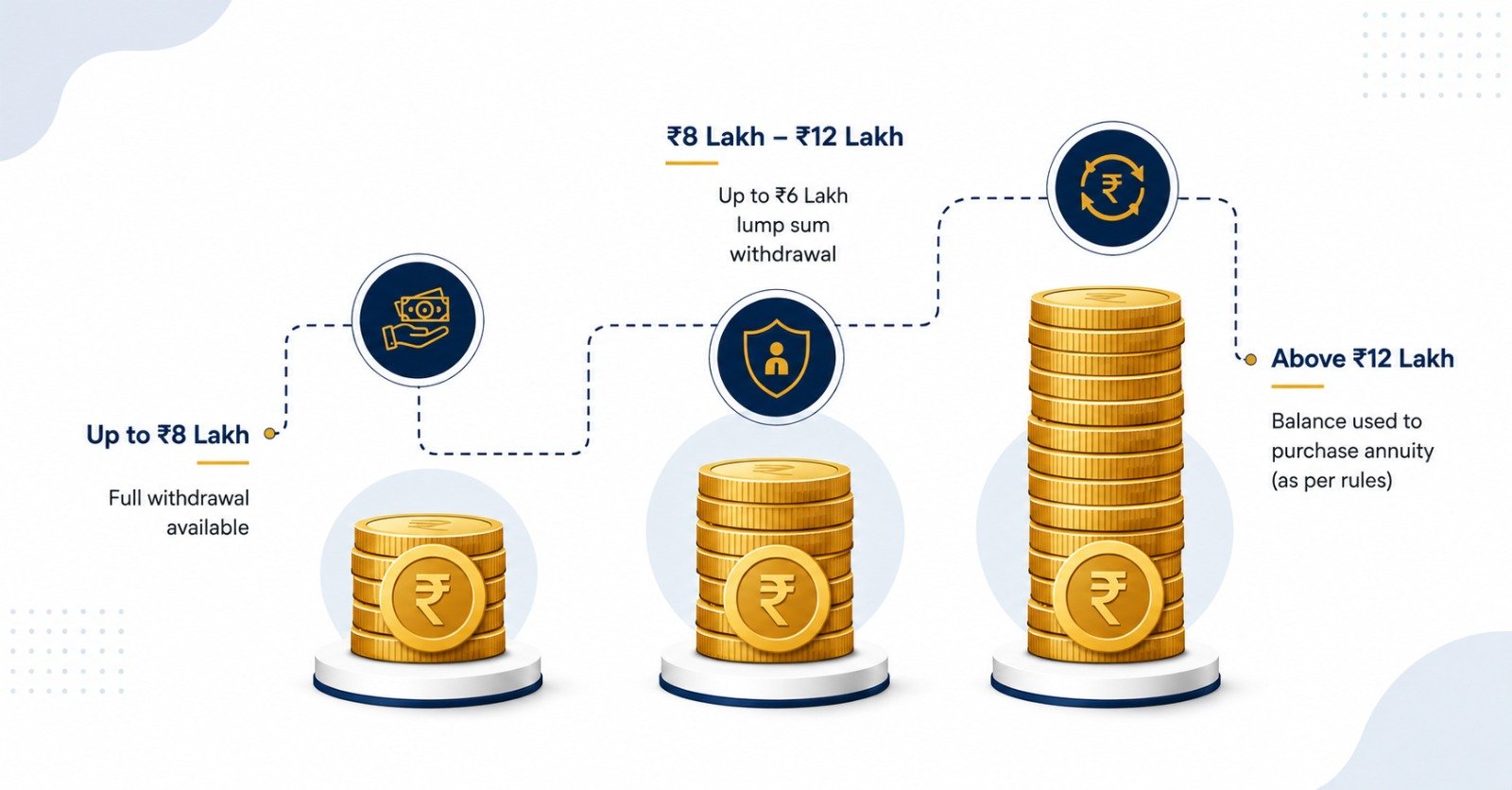
Yes, and the thresholds have moved up quite a bit. The rules work off two separate benchmarks depending on whether it’s a normal exit or a premature exit:
1. Normal exit, corpus ≤ ₹8 lakh: full withdrawal allowed — lump sum, SLW, or SUR — with no annuity requirement at all.
2. Normal exit, corpus between ₹8 lakh and ₹12 lakh: up to ₹6 lakh as lump sum, with the rest handled through systematic withdrawal or annuity.
3. Premature exit, corpus ≤ ₹2.5 lakh: full withdrawal allowed, no annuity needed.
4. Premature exit, corpus above ₹2.5 lakh: standard premature-exit rules apply — up to 20% lump sum, minimum 80% annuity.
Two thresholds, two different situations — ₹8 lakh for normal exit, ₹2.5 lakh for premature exit — and it’s easy to accidentally swap them when writing or reading about this.
What about premature exit specifically?
This is still the stricter of the two. Exit before completing 15 years, or before age 60 — whichever applies earlier under your scheme — and at least 80% of your corpus has to go into annuity, with up to 20% available as lump sum. That ratio hasn’t budged.
The one exception is the small-corpus rule above: ₹2.5 lakh or less at premature exit, and you can take the whole amount, no annuity needed.
Worth keeping the two structures straight:
1. Normal exit: up to 80% lump sum, minimum 20% annuity (non-government)
2. Premature exit: up to 20% lump sum, minimum 80% annuity — unless corpus is ₹2.5 lakh or under, in which case it’s 100% withdrawal
How do partial withdrawals work now?
You can still withdraw without a full exit — up to 25% of your own contributions. Emphasis on own contributions. This is calculated strictly on what you personally put in, not employer contributions, and not the investment growth on top. It’s not 25% of whatever your account is currently worth.
Under the All Citizen Model, subscribers under 60 can make up to four partial withdrawals, spaced at least four years apart. Past 60, the gap eases to a three-year interval, and the 25% cap on own-contribution still holds. Valid reasons include children’s higher education, children’s marriage, buying or building a house, and medical treatment or disability-related expenses — all subject to the applicable conditions.
Can you borrow against your NPS corpus?
There’s now a provision for subscribers to seek financial assistance against their pension corpus, from a regulated financial institution, with a lien of up to 25% of their own contribution. PFRDA has said separate operational guidelines will govern how this actually works. Calling it “NPS now offers loans” is a bit of an overstatement at this stage — it’s financial assistance secured against the corpus, and the fine print on eligibility and mechanics is still being worked out.
Until when can you stay invested?

Subscribers can now remain in NPS up to age 85 — up from 75 earlier — unless an earlier exit is triggered under the applicable rules. Retirement doesn’t force an immediate cash-out anymore. You can defer withdrawal, defer buying an annuity, or just keep contributing well past the traditional retirement age.
PFRDA has also scrapped the 15-day prior-intimation requirement that used to apply before an account could continue past exit eligibility. Put these together and the direction is pretty clear: NPS is moving away from a single forced exit point, toward something more flexible.
What happens to the money if the subscriber dies?
Under the All Citizen Model, the nominee or legal heir gets 100% of the accumulated pension wealth as a lump sum, with SLW, SUR, or annuity available as alternative options depending on the framework. For estate planning purposes, that matters — the corpus doesn’t disappear or get forced into an annuity just because the subscriber passed away before exiting.
So when were these rules actually notified?
This is where a lot of the recent coverage gets sloppy. The regulations were notified as the PFRDA (Exits and Withdrawals under the National Pension System) (Amendment) Regulations, 2025 — in December 2025. Not a separate “2026 regulation” issued later in the year, which some articles seem to imply. If you’re citing a date for this, December 2025 is the one to use.
Does this change how the withdrawal is taxed?
Not on its own. These regulations decide how much you can withdraw and when — they don’t rewrite the Income Tax Act. Right now, the tax exemption on the NPS lump sum still sits at 60% of the corpus under Section 10(12A) for non-government subscribers. Since the withdrawable lump sum has gone up to 80% in many cases, whatever falls above that 60% exempt slice could be taxable, unless the Income-tax Act gets amended to match. It’s a detail that’s easy to skip past — but one that catches people off guard if nobody flags it in advance.
Separately, this doesn’t touch employer-side tax treatment either. Employer contributions to an employee’s NPS account under a Corporate NPS scheme continue to be deductible for the employer and tax-exempt for the employee up to prescribed limits under Section 80CCD(2) — a detail HR and payroll teams structuring Corporate NPS benefits should keep an eye on.
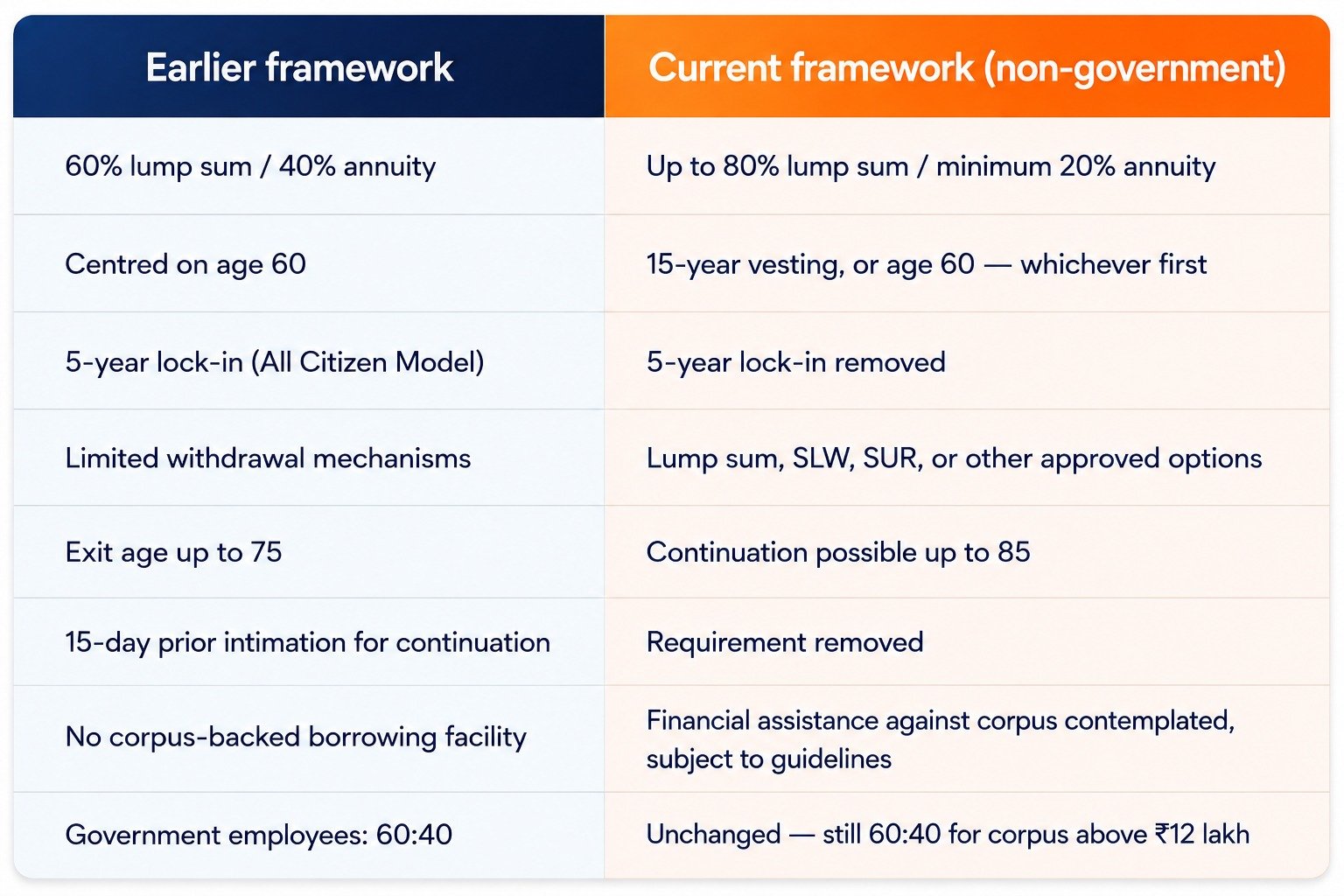
What changed — quick comparison
Structuring Corporate NPS the Right Way
These changes give non-government subscribers — including employees enrolled through Corporate NPS — meaningfully more flexibility at exit. But that flexibility only helps if the underlying scheme, contribution structure, and employee communication are set up correctly in the first place.
TalentCo HR Services helps corporate clients structure compliant Corporate NPS schemes and broader employee benefit frameworks — from scheme design and vendor coordination to keeping payroll and tax treatment aligned with the latest PFRDA and Income Tax rules.
References
PFRDA — Latest NPS Exits & Withdrawals Regulations
www.pfrda.org.in.
PFRDA — Exits & Withdrawals Amendment Regulations, 2026
www.pfrda.org.in/w/pension-fund-regulatory-and-development-authority-exits-and-withdrawals-under-the-national-pension-system-amendment-regulations-2026
PFRDA — Exits & Withdrawals Amendment Regulations, 2025
www.pfrda.org.in/en/web/pfrda/w/regulatory-framework/regulations/pension-fund-regulatory-and-development-authority-exits-and-withdrawals-under-the-national-pension-system-amendment-regulations-2025
PFRDA — Official Regulations
www.pfrda.org.in/regulatory-framework/regulations
TalentCo HR Services LLP is an HR consulting and solutions company offering services across HR operations, compliance, liasoning, payroll management, and HR technology through its proprietary platform ABStart. This article is intended for general informational and educational purposes only. Tax laws and compliance requirements are subject to change based on government notifications. Readers are advised to independently verify current regulations or consult qualified professionals before making any business or financial decisions.