

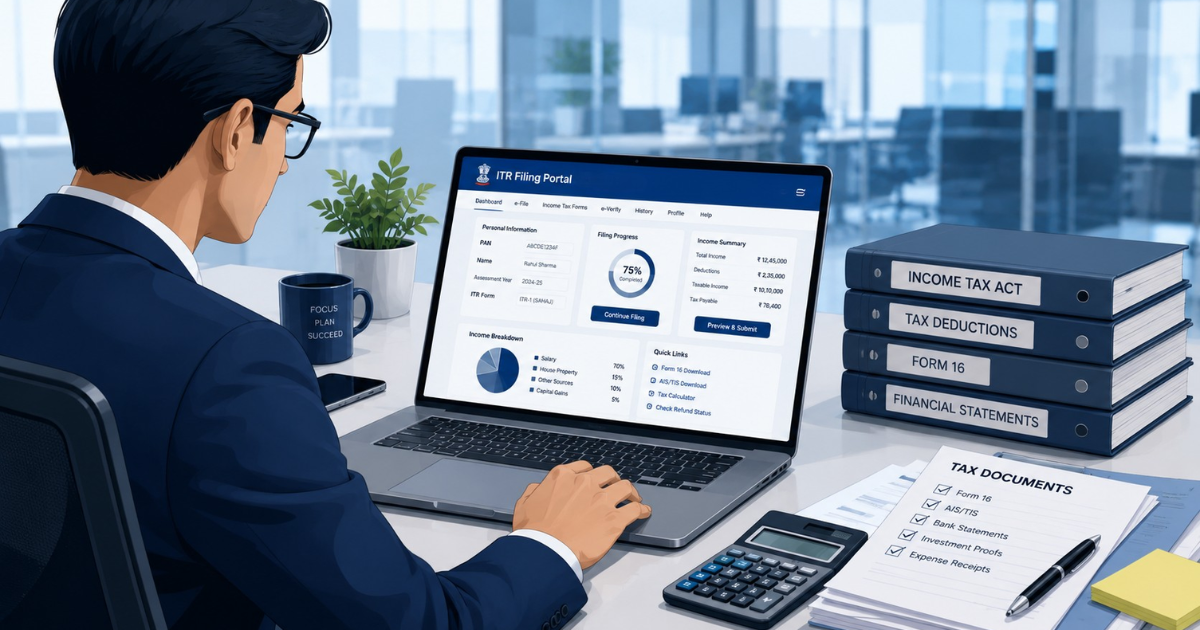
Yes — you can file your ITR without Form 16, using salary slips, Form 26AS and AIS. The deadline for AY 2026-27 is 31 July 2026 for salaried individuals and non-audit businesses, 31 October 2026 for audit cases, and filing late costs up to ₹5,000 plus 1% interest per month.
There are plenty of ITR guides online that restate the rules. This one is written from the other side of the table — 30 years of running payroll and TDS for Indian businesses, watching exactly where employees and employers get tripped up every July. It covers what most guides skip: what to do when Form 16 hasn’t arrived, which tax regime you are actually filing under, and what a delay really costs in rupees.
Who actually needs to file an ITR for AY 2026-27?
Not everyone. Filing is mandatory if your total income exceeds the basic exemption limit — ₹4 lakh under the new tax regime for FY 2025-26 (₹2.5 lakh under the old regime). It is also mandatory in specific situations regardless of income: if you hold foreign assets, have deposited large amounts in current accounts, spent above thresholds on foreign travel or electricity, or if TDS has been deducted and you want it back. That last one matters — if any tax was deducted from your salary or bank interest, filing is the only way to claim the refund.
What are the ITR filing deadlines for AY 2026-27?
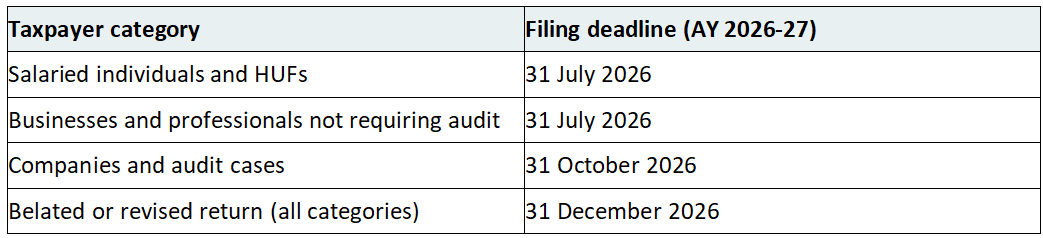
These are statutory dates. Extensions are sometimes announced, but planning around a hoped-for extension is how returns end up belated
Old or new tax regime — which one are you filing under?
This is the decision most AY 2026-27 guides skip, and it changes everything else. The new regime is now the default — you are taxed under it unless you actively opt out while filing. Under the new regime, the basic exemption is ₹4 lakh, the Section 87A rebate makes income up to ₹12 lakh effectively tax-free, and salaried taxpayers get a ₹75,000 standard deduction.
The trade-off: the deductions taxpayers spent years planning around — Section 80C (PPF, ELSS, life insurance), 80D (health insurance premiums), 80E (education loan interest), and HRA — are not available under the new regime. If your combined deductions are large, the old regime may still save you more; salaried taxpayers can choose afresh each year. Run the comparison before you file, not after.

What if you don’t have your Form 16 yet?
Employers were required to issue Form 16 for FY 2025-26 by 15 June 2026 — the law backs this with a penalty of ₹100 per day, per certificate, under Section 272A(2)(g). If yours is late, it usually means a TDS reconciliation issue on the employer’s side: Part A of Form 16 can only be generated from the TRACES portal after all four quarterly TDS returns (Form 24Q) are filed and matched, and a single PAN or challan error can stall it.
Here is what most people don’t realise: Form 16 is a convenience, not a legal requirement for filing. Everything in it exists elsewhere. If it hasn’t arrived:
1. Ask HR or payroll — it is often a reconciliation delay, not negligence.
2. Pull your Form 26AS from the income tax portal — it shows every rupee of TDS recorded against your PAN and serves as proof of tax deducted.
3. Check your AIS for salary, interest and dividend data.
4. File from source documents — salary slips, 26AS, AIS and bank statements, entering TDS details manually on the portal. It takes longer, but it works. Form 16 is never uploaded with your return in any case.
How do you reconcile Form 16, Form 26AS and AIS before filing?
Form 16 is the TDS certificate from your employer — your salary and the exact tax deducted from it. Form 26AS is the department’s ledger of tax credits against your PAN from all sources — salary, banks, and others. AIS is the department’s wider record of your financial activity: interest, dividends, securities transactions, high-value spends.
The three should tell one story. Mismatches between what you declare and what the department already holds are the single most common trigger for intimations under Section 143(1) — and for held-up refunds. Ten minutes of cross-checking before submission prevents months of correspondence after it.
What does late filing actually cost?
Three things, and they stack. A late filing fee of ₹5,000 under Section 234F (₹1,000 if total income is under ₹5 lakh). Interest at 1% per month on unpaid tax under Section 234A — and a part of a month counts as a full month, so one day late costs a month’s interest. And the quiet one: a belated return forfeits your right to carry forward capital losses from shares or mutual funds (loss from house property is the only exception). For businesses, carried-forward business losses are lost the same way.
What are the rules for belated, revised and updated returns?
Missed 31 July? You can file a belated return until 31 December 2026 — with the late fee and interest above. Spotted an error after filing? A revised return can be filed until the same date, 31 December 2026.
And even that is not the end of the road. The Updated Return (ITR-U) allows filing up to 48 months after the end of the assessment year, with graded additional tax of 25% to 70% depending on how late you are. It is an expensive route — but “the window has closed forever” is a myth.
Which records should you keep as an individual?
1. Salary slips — they validate every income component, and they are your filing source if Form 16 is delayed.
2. Bank statements — interest income shows up in AIS whether you report it or not; report it first.
3. Deduction proofs — insurance premiums, PPF passbooks, ELSS statements, loan interest certificates. Relevant only if you opt for the old regime, but keep them until you have run the regime comparison.
4. TDS certificates from banks and other deductors (Form 16A).
How does the Income Tax Department verify your income?
Returns are matched automatically against AIS and 26AS. The system flags gaps between declared income and recorded transactions — that flag becomes a 143(1) intimation, not a conversation. The practical defence is boring and effective: review your AIS before filing and make sure every income source it shows appears in your return.
For businesses: how does the audit requirement affect your filing?
Businesses above the prescribed turnover thresholds must have their accounts audited by a Chartered Accountant, which is why audit cases get the 31 October deadline. The return rests on the audit; the audit rests on the books. Keep profit and loss statements, balance sheets and the audit report ready — clean documentation is the difference between a routine scrutiny and a painful one. Professionals and freelancers filing business income can deduct legitimate professional expenses, but the substantiation standard is the same: documented, business-purpose, defensible.

Where does payroll fit into all of this?
Almost every employee-side problem in this article traces back to one employer-side system. When payroll data is clean every month, TDS is deposited on time, the quarterly 24Q returns match, Form 16 generates from TRACES without a fight and reaches employees by 15 June, and each employee’s 26AS mirrors their Form 16. No chasing, no mismatches, no 143(1) letters. When payroll runs on spreadsheets, the same chain breaks silently — and surfaces in July as fifty employees asking HR where their Form 16 is.
That chain is what ABStart HRMS is built around — payroll, TDS workings and statutory records maintained in one place, by a team that managed these processes manually for three decades before building software for them. For a deeper look at the employer’s side of this, see our guides on payroll compliance (PF, ESI and TDS) and on choosing a HRMS for a growing Indian business.
Key takeaways
1. 31 July 2026 is the deadline for salaried and non-audit filers; 31 October for audit cases; 31 December for belated and revised returns.
2. The new regime is the default — 80C, 80D, 80E and HRA don’t apply under it. Compare regimes before filing.
3. No Form 16 yet? You can still file — salary slips, 26AS and AIS carry everything you need.
4.Delay costs ₹5,000 plus 1% a month — and forfeits capital-loss carry-forward..
5. Match Form 16, 26AS and AIS before submitting — mismatches, not income, trigger most notices.
References: Income Tax Department (incometax.gov.in) — return filing and regime FAQs; Rule 31, Income-tax Rules, 1962 (Form 16 issuance); Sections 234A, 234F, 272A(2)(g), 139(4), 139(5), 139(8A), Income-tax Act; TRACES (tdscpc.gov.in). Facts verified July 2026.
TalentCo HR Services LLP is an HR consulting and solutions company offering services across HR operations, compliance, liasoning, payroll management, and HR technology through its proprietary platform ABStart. This article is intended for general informational and educational purposes only. Tax laws and compliance requirements are subject to change based on government notifications. Readers are advised to independently verify current regulations or consult qualified professionals before making any business or financial decisions.