


At What Headcount Does Manual HR Legally Stop Being an Option?
Three headcounts change everything: 10, 20, and 50 employees. Each one activates a different law with its own compliance obligation. Below 10, most statutory requirements don’t apply. Past 50, the number of obligations running in parallel makes manual tracking practically unsustainable, not just legally risky.
Most founders treat these numbers as background facts they’ll deal with “when it comes up.” In practice, each threshold arrives quietly, tied to a specific date rather than a gradual ramp, and by the time it’s noticed, the obligation has usually already been active for weeks or months.
What Are the Exact Thresholds and the Laws They Trigger?
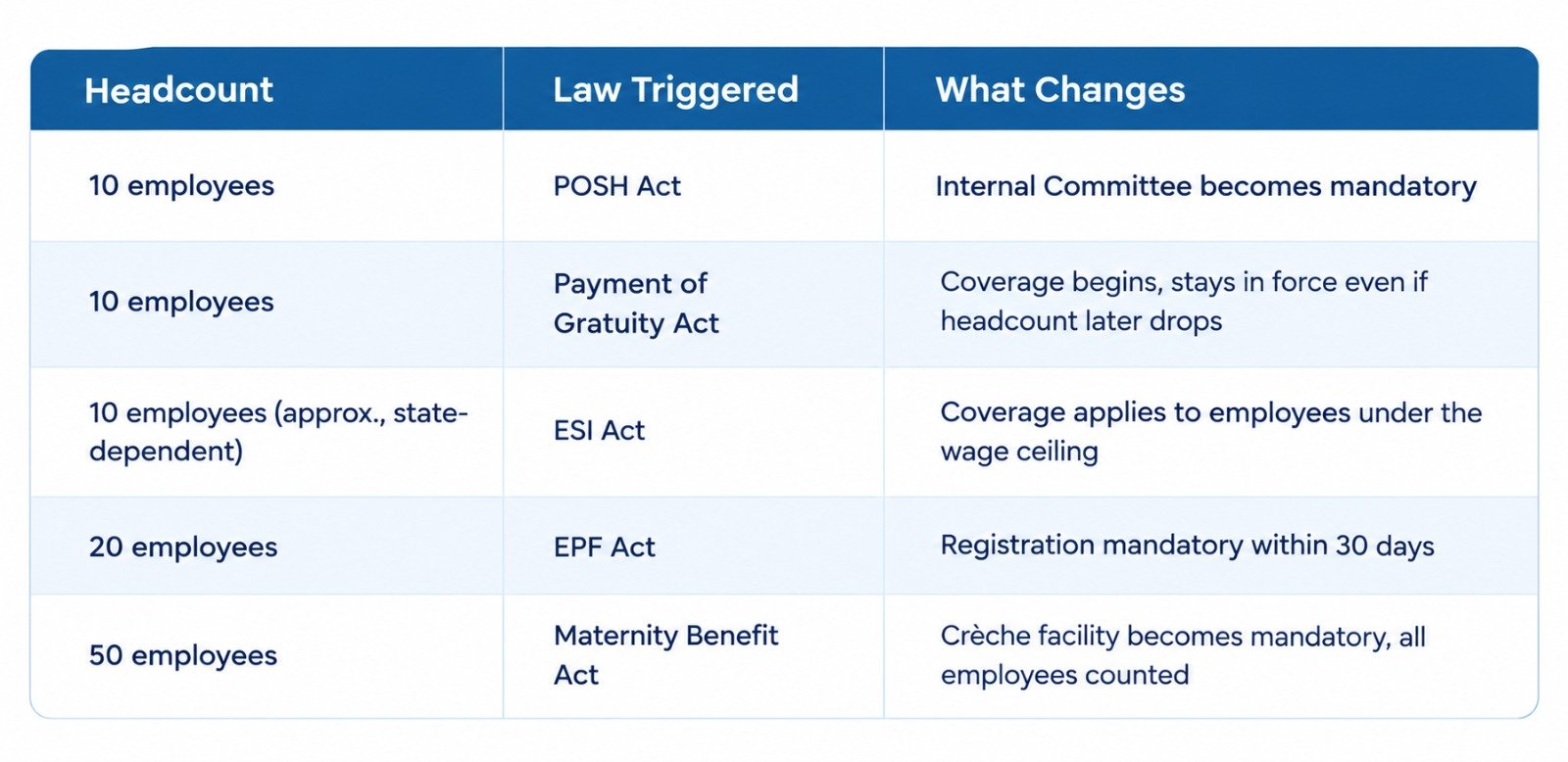
All thresholds count contract staff, interns, and trainees, not just full-time payroll — and most are triggered by crossing the number on any single day, not by an average headcount over the year. This single detail causes more missed thresholds than any other, because internal headcount trackers usually reflect only people on the official payroll register, not the full working population of the establishment on a given day.
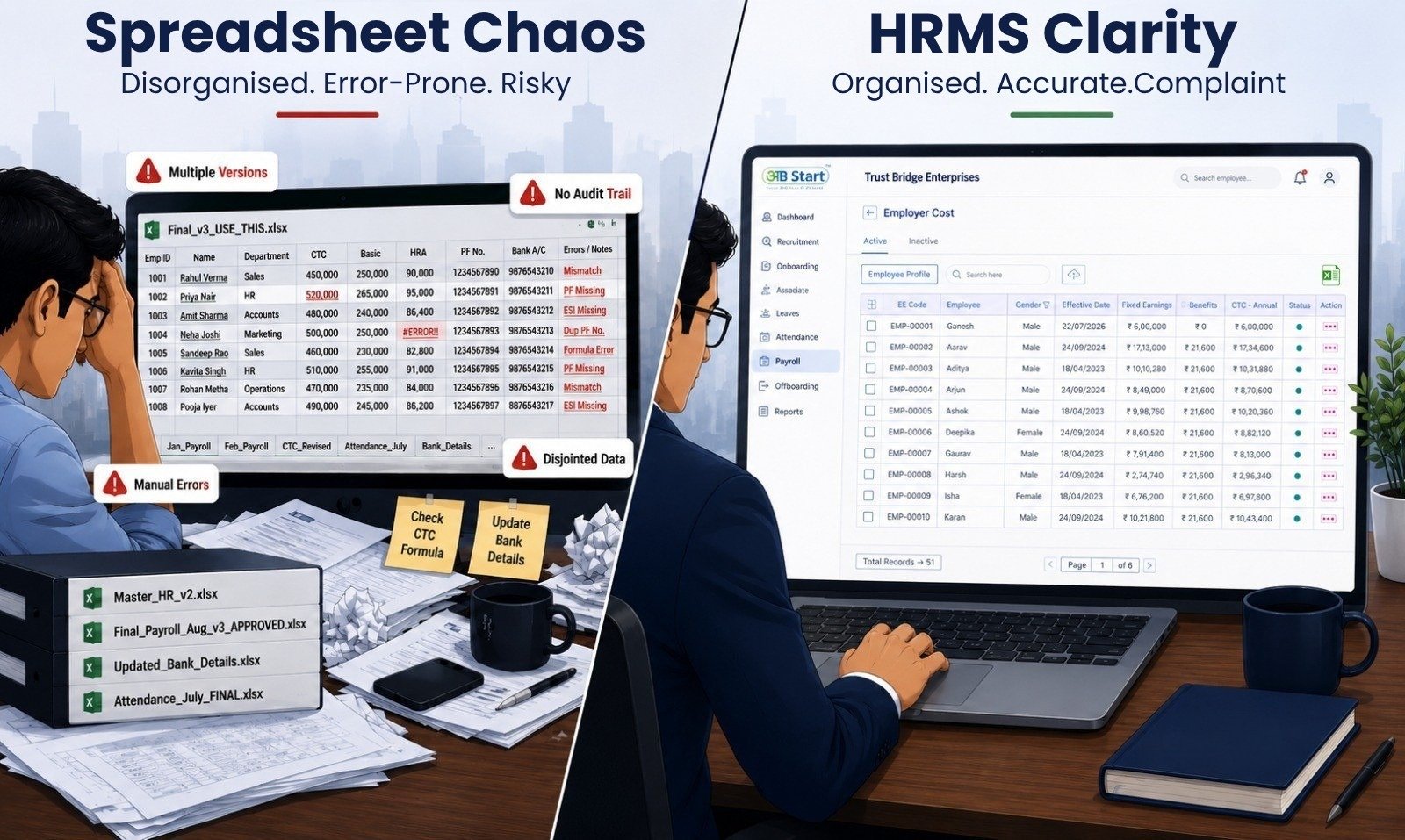
To see how unorganised master files trigger these audit risks, read our detailed guide on spreadsheet HR operational risks.
How Does the POSH Internal Committee Requirement Actually Work at 10 Employees?
The moment total headcount touches 10, the POSH Act requires a formally constituted Internal Committee: a senior woman as presiding officer, at least two internal members, and one external member from outside the organisation. Below 10 employees, complaints instead route to a government-appointed Local Committee.
Constituting the committee is only the first step. It needs a documented complaint process, defined inquiry timelines, and an annual report filed with the district officer. A company that forms the committee but never documents how a complaint would actually be handled hasn’t fully met the requirement — it has met the letter of it, but not the operational substance.
Why Does Gratuity Coverage Also Begin at 10 Employees, and Why Does It Matter So Early?
The Payment of Gratuity Act applies once an establishment employs 10 or more people on any day in the preceding 12 months, covering shops, factories, and most other establishment types. Once triggered, this coverage is permanent — it continues even if headcount later drops below 10.
Gratuity is easy to overlook early because the actual payout obligation only arises after five years of continuous service. But the coverage decision is made much earlier, at the point of crossing 10 employees, and companies that don’t track that crossing date accurately can later struggle to determine exactly which employees are covered and from when — a problem that only surfaces years later, at the point of someone’s exit.
How Does ESI Coverage Differ From the Other Thresholds?
ESI typically applies once an establishment crosses 10 employees, covering anyone earning up to a specified wage ceiling for medical and cash benefits. Unlike POSH or gratuity, this isn’t a one-time trigger — eligibility depends on wage bands that shift with every salary revision, and the exact threshold can vary somewhat by state.
An employee under the wage ceiling today can move out of ESI coverage after a routine increment, and a new hire brought in below the threshold enters coverage immediately. A system that only reviews headcount once a year, during annual appraisals, will systematically miss these mid-year shifts — which means ESI contribution filings can be out of sync with actual coverage status for months without anyone noticing.
Why Is 20 Employees the Threshold With the Most Expensive Consequences?
Cross 20 employees — on any single day, counting part-time and contract staff — and EPF registration becomes mandatory within 30 days. Miss the window, and the penalty isn’t calculated from the date of discovery. It’s backdated to the actual date headcount crossed 20: back-contributions, damages of up to 25% per annum under Section 14B, and interest of 12% per annum under Section 7Q. Coverage, once triggered, doesn’t reverse even if headcount later falls below 20.
This threshold is particularly easy to cross without noticing because EPF applicability is assessed per establishment, counted on any single day, rather than as an annual average. A short-term spike in contract or seasonal hiring — a festive season push, a project ramp-up — can trigger the 20-employee threshold for a brief period, and if nobody records that specific date, the company has no internal record of exactly when its obligation began.
“Most SMEs don’t miss these thresholds because they’re careless — they miss them because nobody’s job is to watch the headcount number every single day. By the time an inspector asks for proof, the company is defending a gap it didn’t even know existed.”
— Rahul Dhamdhere
Founder & Managing Director, ABStart HRMS
What Changes Once a Company Crosses 50 Employees?
At 50 employees, the Maternity Benefit Act requires every establishment to provide a crèche facility within a prescribed distance of the workplace, typically within 500 metres under most state guidelines, with women employees permitted four visits per day. This threshold counts all employees, not just women, which surprises many SMEs that assume the obligation only applies once they cross 50 female employees specifically.
By this stage, a company is usually also fully covered under EPF, ESI, gratuity, and POSH, which means 50 employees marks the point where every major HR-related statutory obligation is active simultaneously. This is also typically where the volume of routine compliance activity — filings, registers, renewals — makes a manual or semi-manual system genuinely difficult to sustain, independent of any single mistake.
What Happens If an SME Crosses These Thresholds Without Noticing?
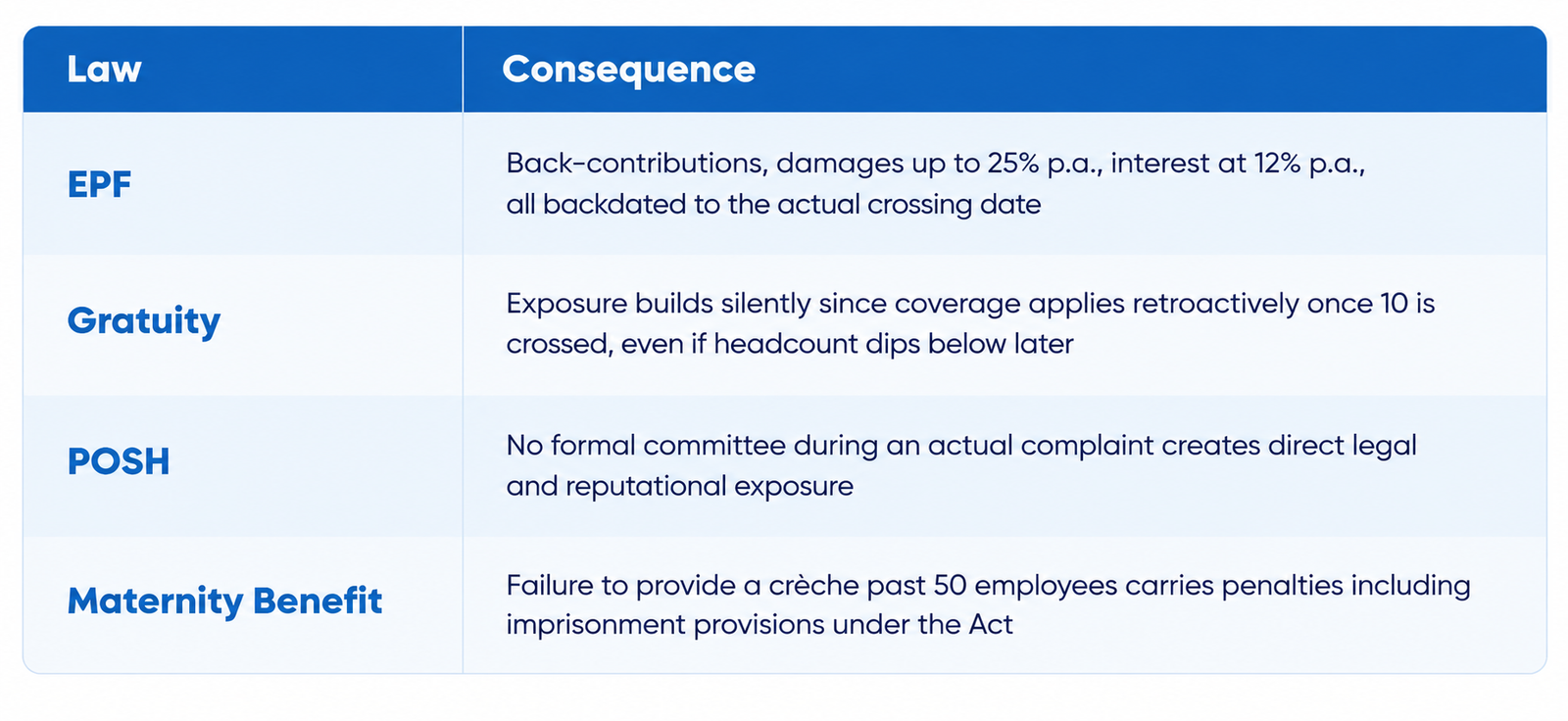
What makes these consequences harder to manage in practice is that they rarely surface in isolation. An inspection triggered by one issue — an unrelated complaint, a routine audit — often uncovers gaps across several thresholds at once, because the same underlying problem (no reliable headcount tracking) tends to affect every threshold equally.
Labor inspections in India occur via both Shram Suvidha portal digital audits and on-site physical visits by Labour Officers/Enforcement Officers (triggered by employee complaints or randomized portal selection)
Why Do These Thresholds Cluster Precisely in the 20–100 Employee Range?
This is exactly where most Indian SMEs are scaling fastest and formalising slowest. A company hiring aggressively can cross 10, 20, and edge toward 50 within the same calendar year — meaning three separate legal obligations can activate in quick succession, often before HR headcount, process maturity, or dedicated compliance ownership has caught up with the pace of hiring.
Below 20 employees, the operational cost of a missed threshold is usually contained — fewer people affected, easier to correct manually. Past 100, most companies have already been forced into a formal HR function simply because the volume of activity leaves no other option. The 20–100 range is where the gap between legal obligation and operational readiness is widest, and where the cost of that gap is highest.
What Should an HRMS Actually Track at Each of These Thresholds?
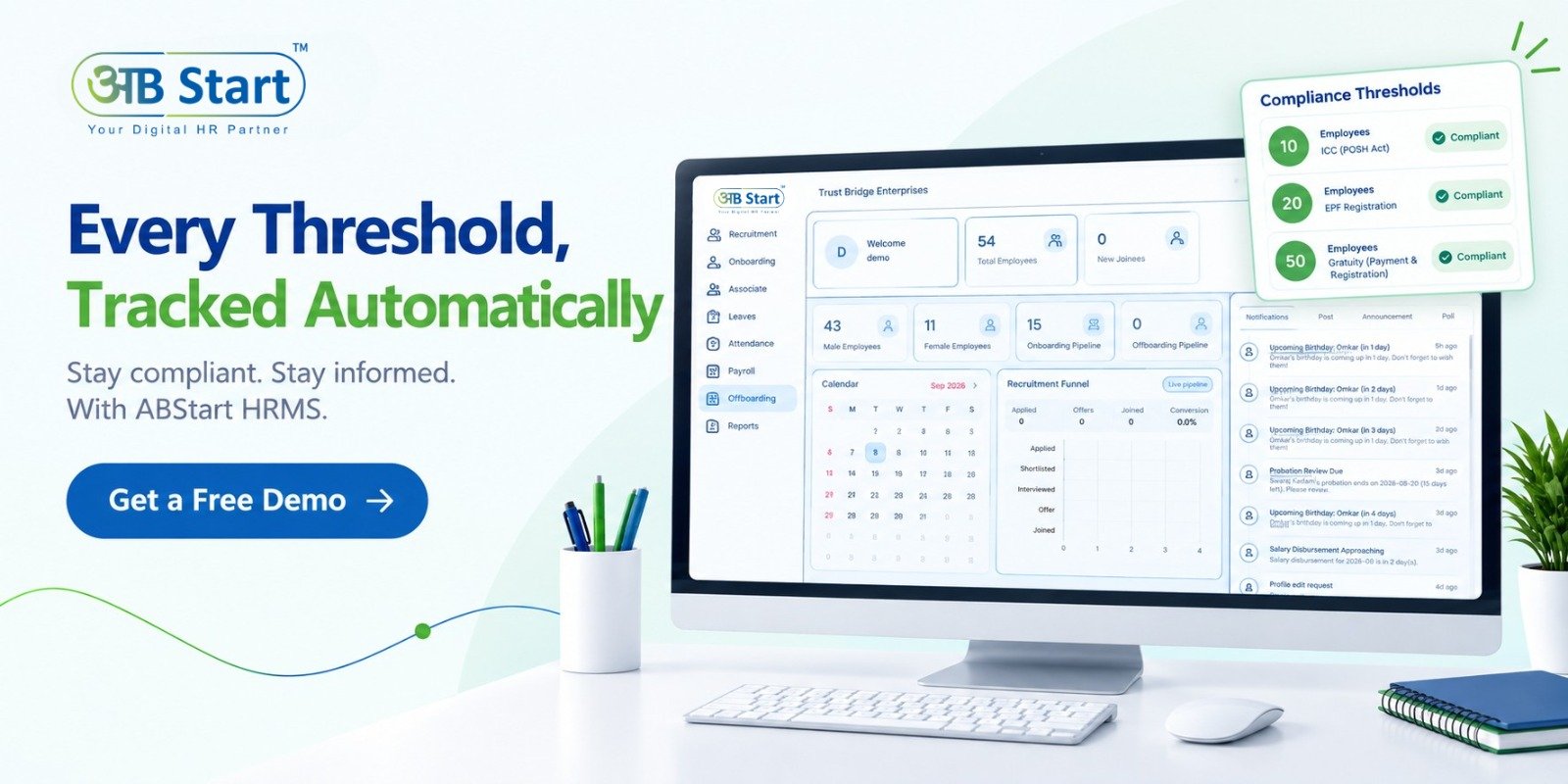
1. Live headcount monitoring— flags the exact date of crossing 10, 20, and 50 employees
2. Wage-band tracking— flags ESI eligibility shifts automatically with every salary revision
3. Committee and compliance documentation— stores POSH Internal Committee records and annual filings in one place
4. Crèche and benefit tracking— flags Maternity Benefit obligations once headcount crosses 50
5. Audit-ready history— every threshold crossing timestamped and exportable on demand
A structured system doesn’t change the underlying legal obligations — each of these laws applies exactly as written, regardless of what tools a company uses. What it changes is whether the company can prove, with a timestamped record, exactly when each obligation began.
How Should a Growing SME Actually Approach This Transition?
1. Establish the current headcount precisely, including contract, part-time, and trainee staff, as a documented baseline
2. Check that baseline against each threshold — 10, 20, and 50 — to confirm which obligations already apply
3. Consolidate all employee records into one editable, access-controlled file rather than several parallel spreadsheets
4. Set a recurring review of headcount and wage bands against each threshold, rather than relying on someone happening to notice
5. Move to a system that automates this tracking once the current data is confirmed accurate
Skipping the first two steps is the most common mistake. Some companies move straight to purchasing software without first confirming whether they’ve already crossed a threshold — which means the new system simply inherits the same blind spot it was meant to solve.
References
[1] Employees’ Provident Fund Organisation (EPFO) – EPF Act, 1952, Section 14B, Section 7Q: epfindia.gov.in
[2] Sexual Harassment of Women at Workplace (Prevention, Prohibition and Redressal) Act, 2013, Section 4: government notification
[3] ESIC – Employees’ State Insurance Corporation Official Portal: esic.gov.in
[4] Payment of Gratuity Act, 1972 – Chief Labour Commissioner: clc.gov.in
[5] Maternity Benefit (Amendment) Act, 2017, Section 11A – Ministry of Labour and Employment: labour.gov.in
TalentCo HR Services LLP is an HR consulting and solutions company offering services across HR operations, compliance, liasoning, payroll management, and HR technology through its proprietary platform ABStart. This article is intended for general informational and educational purposes only. Labour laws and compliance thresholds are subject to change and can vary by state. Readers are advised to independently verify current regulations or consult qualified professionals before making any business decisions.