
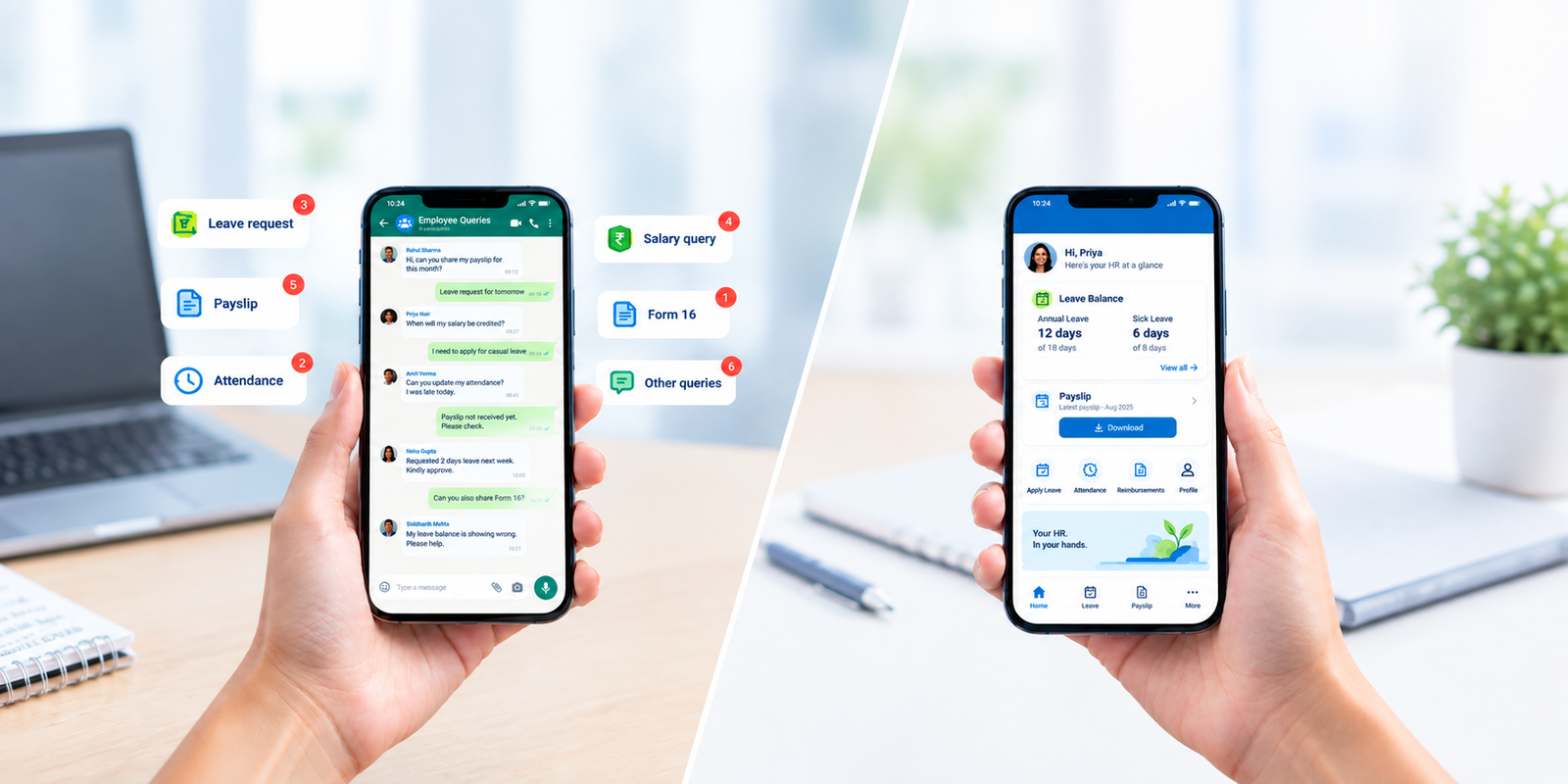
Why Do Leave and Payslip Requests End Up on WhatsApp in the First Place?
Employees use WhatsApp because it’s faster than emailing HR or filling a form nobody checks regularly. HR ends up managing two systems at once: the official process and the informal one everyone actually uses. The fix isn’t banning WhatsApp — it’s giving employees a self-service option that’s just as fast.
This pattern rarely starts as a policy decision. It starts small — one employee messages HR directly because they’re travelling and can’t access the portal, HR responds quickly to be helpful, and within a few weeks that becomes the default channel for the whole team. By the time it’s noticed, it’s not one employee’s habit; it’s the entire company’s unofficial process.
What Does WhatsApp-Based HR Actually Cost an HR Team Day-to-Day?
1. Constant interruption — leave requests, payslip queries, and document requests arrive throughout the day with no queue or priority order
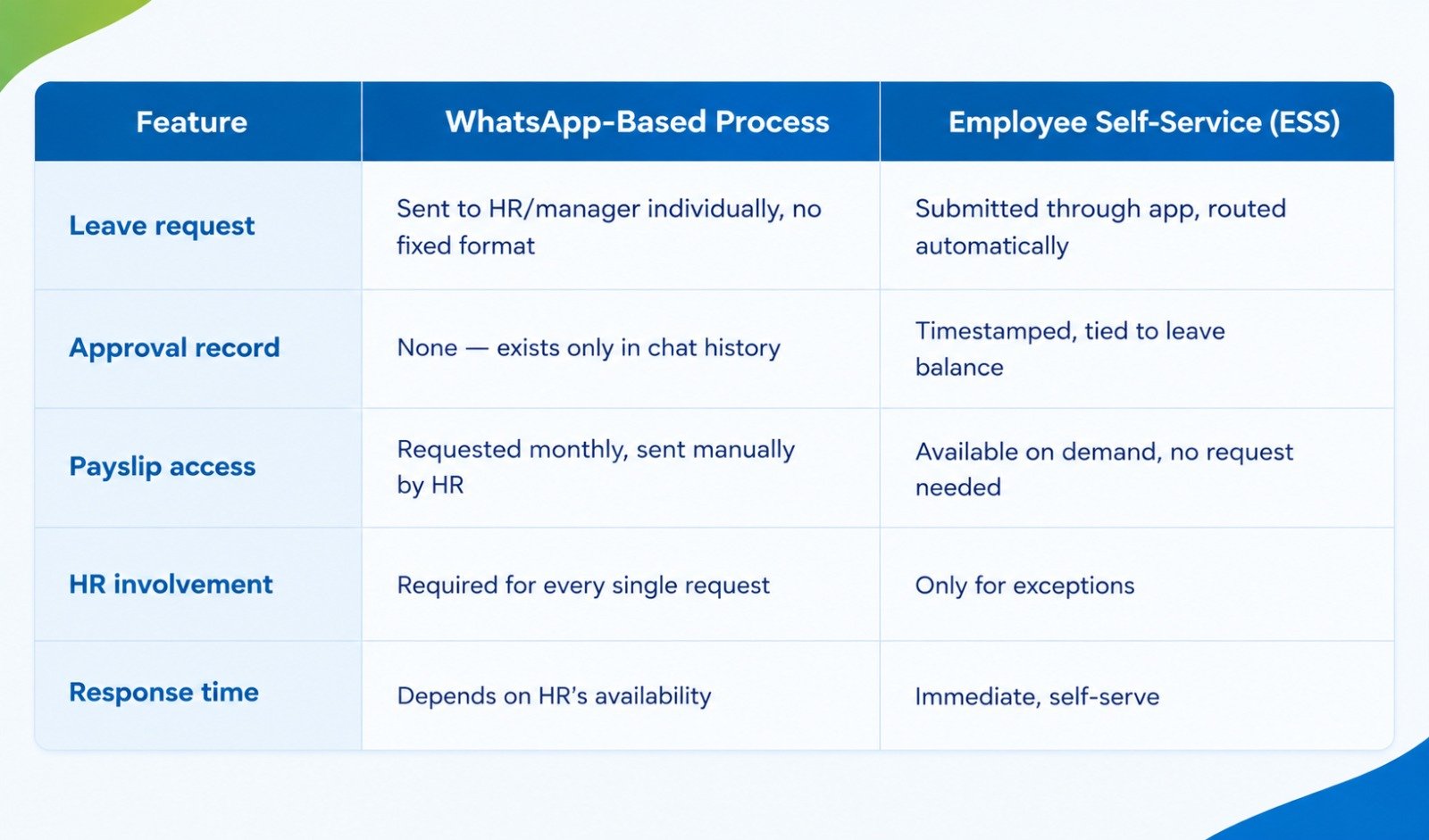
2. No audit trail — an approved leave on chat has no timestamp, no record tied to the employee’s official leave balance
3. Duplicate work — HR checks WhatsApp, email, and the official system separately, then manually reconciles all three
4. Payslip requests repeat monthly — the same request, from the same employees, every single cycle, answered each time manually
5. Inconsistent approvals — a leave approved in a WhatsApp chat carries no record of who approved it or when, which becomes a problem the moment there’s a dispute
None of these costs shows up on an invoice, which is exactly why they persist. They’re absorbed as “part of the job” rather than tracked as time lost — but the hours spent answering the same handful of requests every day add up to a significant share of an HR operations role.
WhatsApp Requests vs. Employee Self-Service: What Actually Changes?
Can HR Teams Fix This Without Buying New Software?
Yes, if the existing HRMS already includes an Employee Self-Service (ESS) module that isn’t being used. Most mid-sized HR systems in India come with ESS built in — leave application, payslip download, and document requests — but many companies never activate it, or employees were never trained to use it, so WhatsApp filled the gap by default.
Before evaluating new tools, it’s worth checking the current HRMS contract or admin panel for an unused ESS or employee-portal feature. It’s common for companies to pay for a tier that already includes this, without anyone on the HR team realising it was part of the package.
“Most HR teams don’t realise they’re already paying for the fix. Employee self-service usually sits unused in the same HRMS licence they signed up for — WhatsApp fills the gap simply because nobody activated the feature or trained employees to use it.”
— Shailendra Dhamdhere
Founder & Managing Director, ABStart HRMS
What Steps Actually Move Employees Off WhatsApp?
1. Audit whether the current HRMS already includes ESS, before assuming new software is needed
2. Migrate one function at a time — start with payslips, since it’s the highest-volume, lowest-resistance request
3. Set a hard cutoff date after which WhatsApp requests are redirected to the ESS link, not answered directly
4. Send payslips and leave balance updates through the ESS app’s own notifications, so employees have a reason to open it
5. Track adoption weekly for the first month, and follow up individually with employees still messaging HR directly
The hardest part of this shift isn’t technical — it’s behavioural. Employees will keep messaging HR directly as long as doing so still works. The moment HR stops responding to WhatsApp requests and redirects to the portal instead, adoption typically follows within a few weeks, not months.
Why Does Starting With Payslips Work Better Than Starting With Leave?
Payslip requests are repetitive, predictable, and carry no approval decision — an employee wants their payslip, not a conversation. Leave requests, on the other hand, often involve a manager’s approval and some back-and-forth, which makes them a harder first habit to break. Moving payslips first proves the ESS system works before asking employees to trust it with something that needs approval.
There’s also a trust factor at play. An employee who successfully downloads their payslip from the portal on the first try is far more likely to use the same portal for a leave request later. An employee whose first experience with the portal is a failed or confusing leave submission is likely to go straight back to WhatsApp.
How Does This Reduce HR’s Daily Workload Without New Spend?
Once ESS handles routine requests, HR’s daily volume of WhatsApp messages drops to genuine exceptions — a system error, a lost password, an urgent leave case. The requests that remain are the ones that actually need a human, instead of every request needing one.
This shift also changes what an HR operations role actually looks like day to day. Instead of the morning being consumed by a backlog of overnight messages, HR can spend that time on tasks that genuinely need judgment — a policy exception, an escalated dispute, onboarding for a new hire — rather than re-answering the same payslip question for the fifth time that week.
What Should an Employee Self-Service Module Actually Include?
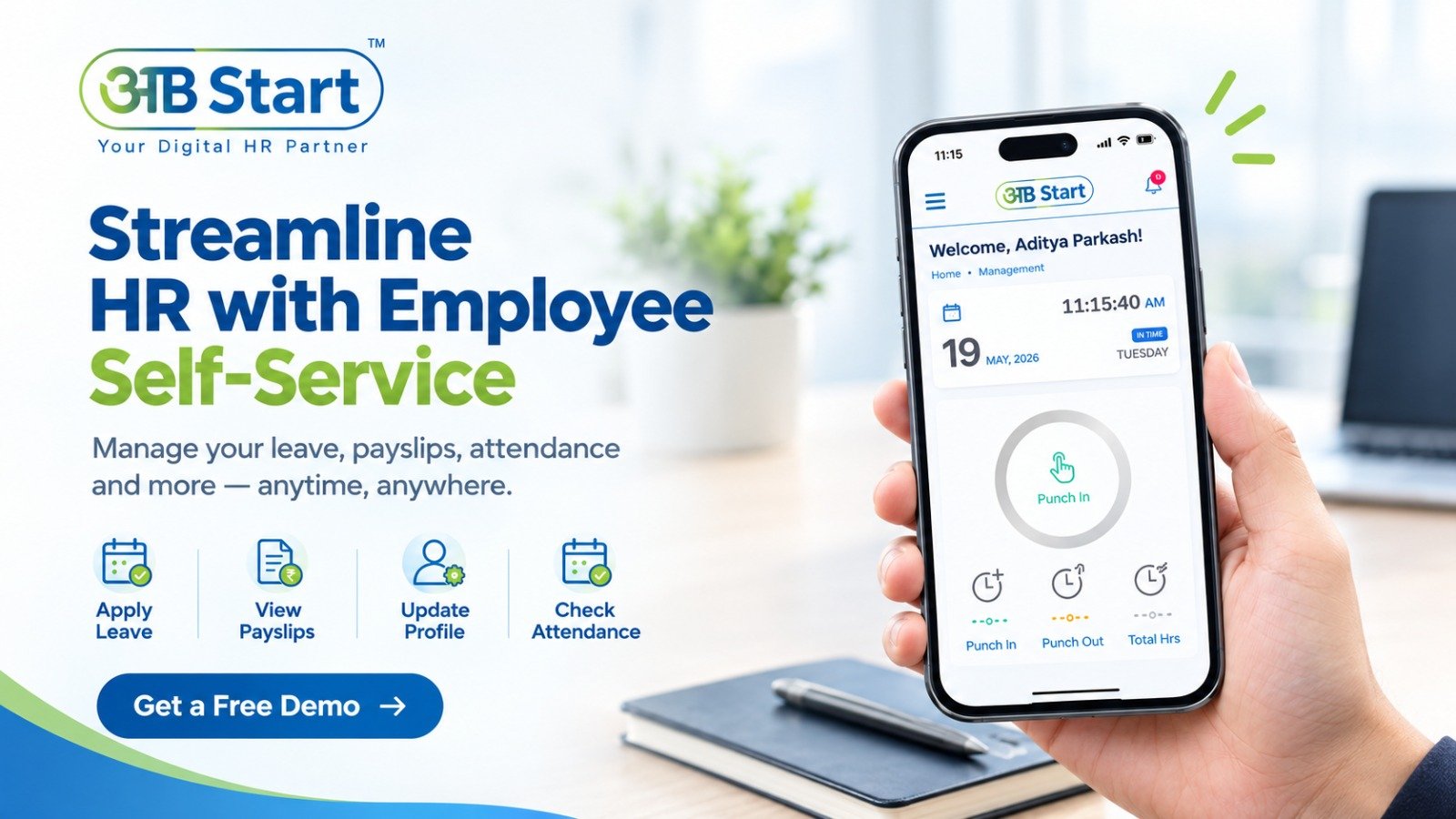
1. Leave application and balance tracking — employees apply and check status without messaging HR
2. On-demand payslip download — available the moment payroll is processed, no request needed
3. Document requests — offer letters, experience letters, and Form 16 available through the same portal
4. Push notifications — leave approvals and payslip availability sent directly, replacing the need to ask
5. Manager approval workflows — leave requests route automatically to the right approver, with no manual follow-up
A module that only covers payslips but not leave, or only leave but not documents, tends to leave a gap that WhatsApp quietly fills back in. The goal isn’t to reduce WhatsApp usage for one request type — it’s to remove HR as the default channel for every routine request an employee might have.
Does This Actually Save Money, or Just Shift the Work?
If ESS is already part of the existing HRMS licence, the cost is zero — the feature exists, it’s simply unused. Even where a company needs to add ESS as a module, the ongoing cost is typically lower than the HR hours currently spent manually answering repeat requests every single day.
The more relevant comparison isn’t software cost against zero — it’s software cost against the hidden cost of HR time already being spent on requests that don’t need a person to handle them. For most companies, that trade works out in favour of activating or adding ESS, even before accounting for the reduced dispute risk from having a proper audit trail.
What Should HR Watch Out for During the Transition?
1. Employees without smartphone access — a small number of employees, especially in field or factory roles, may need an alternative like an SMS-based or kiosk option
2. Data accuracy before go-live — leave balances and employee records need to be correct in the system before employees start relying on it, or the first bad experience will undo the transition
3. Manager buy-in — if managers keep approving leave over WhatsApp instead of through the app, the whole shift stalls regardless of what employees do
This isn’t a topic covered in isolation — the same underlying issue of scattered, unsynced HR data shows up across version control and payroll mismatches more broadly. Fixing WhatsApp-based requests is often the first visible symptom of a company outgrowing its manual or semi-manual HR processes.
References
[1] Payment of Wages Act, 1936, Section 13A – record-keeping requirements for employee wage data: clc.gov.in
[2] Capterra’s 2025 HR Software Trends Survey — tool usage and adoption patterns among HR professionals: capterra.com
TalentCo HR Services LLP is an HR consulting and solutions company offering services across HR operations, compliance, liasoning, payroll management, and HR technology through its proprietary platform ABStart. This article is intended for general informational and educational purposes only. Processes and features may vary by HRMS provider. Readers are advised to verify current capabilities with their specific HR software vendor before making implementation decisions.