
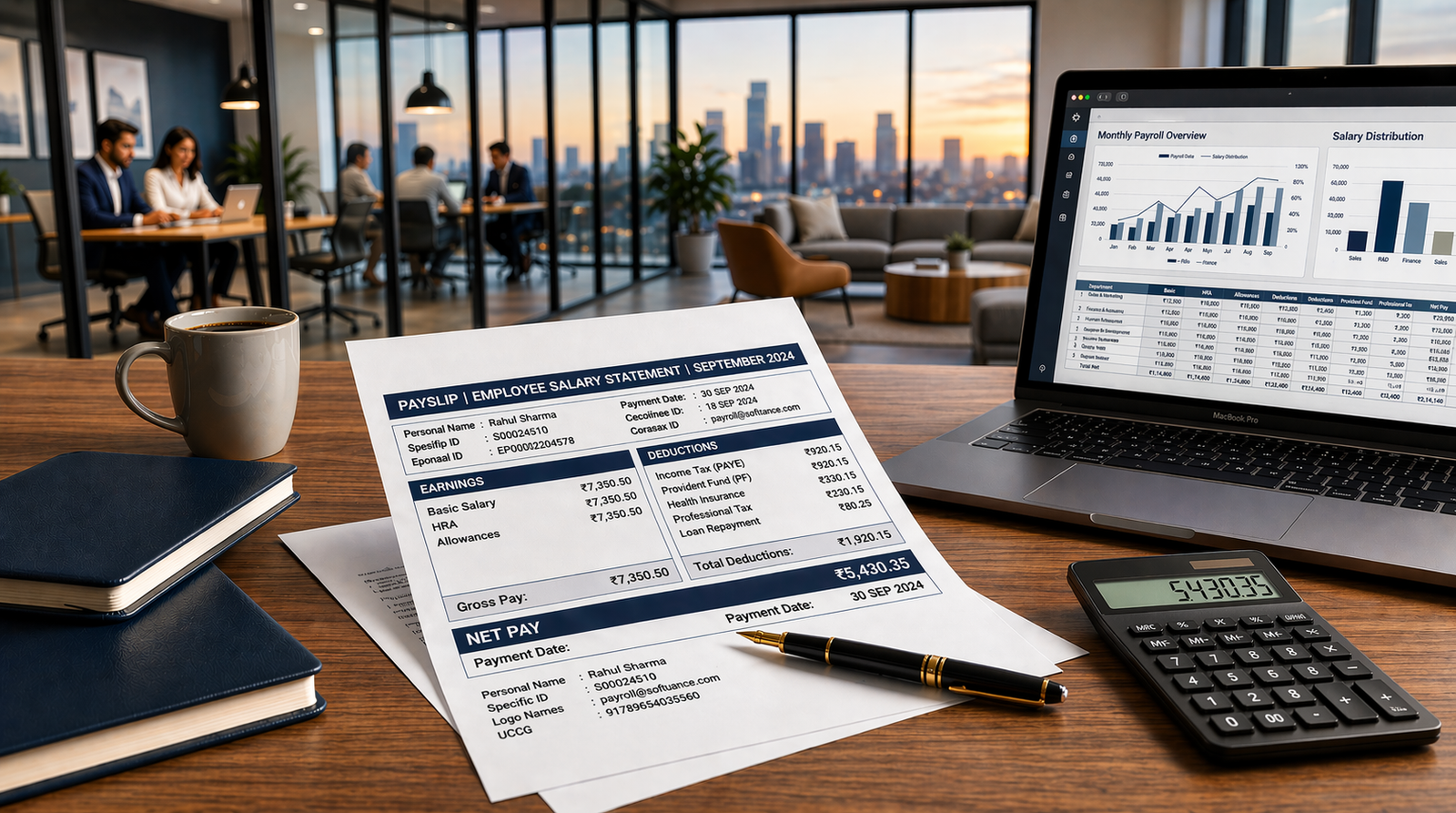
Most employees receive a payslip every month but rarely read it with full understanding. Every component on that document has a name, a purpose, and a legal basis and knowing what each one means can directly affect how much tax is paid, how much PF is accumulated, and whether entitlements are being correctly applied. This article breaks down every component of a payslip, explains how it is calculated, and highlights what employees commonly miss.
According to industry surveys, a significant proportion of employees estimated at around 60% do not fully understand the components of their payslip, which can lead to confusion about actual earnings, deductions, and benefits.
Research also indicates that approximately 1 in 3 employees end up overpaying income tax, often because they miss making the necessary declarations or fail to submit proof of investments and expenses on time. (Source: Income Tax Department – TDS on Salary)
Surveys further suggest that a significant share of employees in some estimates, as many as 74% have never checked their Form 26AS to verify their TDS (Tax Deducted at Source) credits, which increases the risk of discrepancies in tax filings and potential financial loss. (Source: CBDT – Form 26AS Overview)
The gap nobody talks about
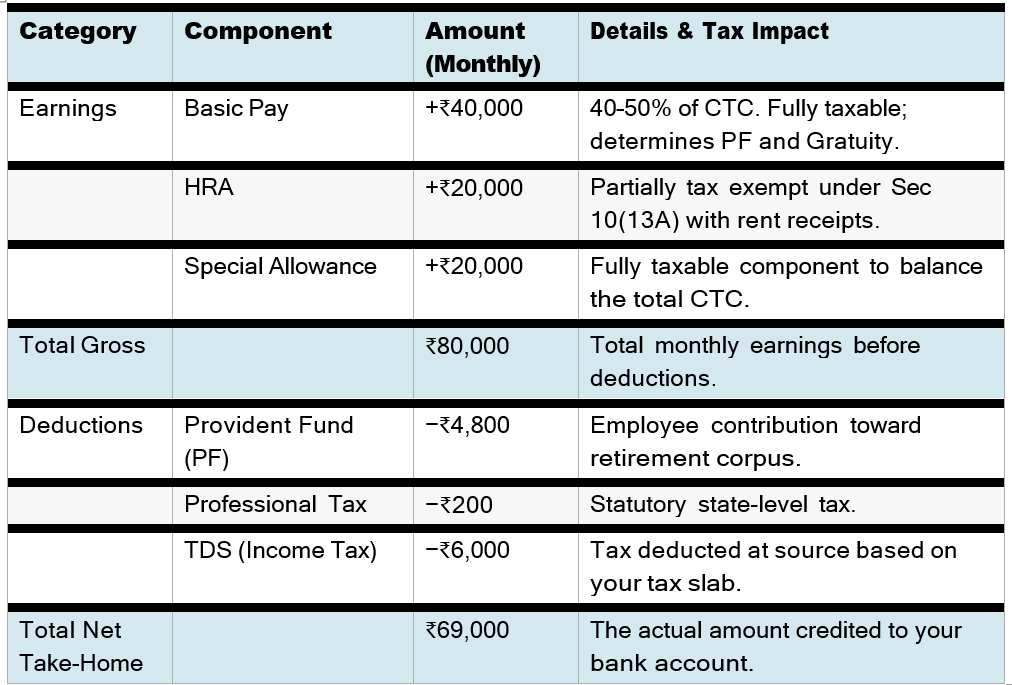
Consider a common scenario: an employee is offered ₹10 LPA. The monthly credit to their account is ₹69,000 which works out to ₹8.28L annually, not ₹10L. The difference of ₹1.72L is accounted for by statutory deductions and employer-borne costs included in the CTC. This is a standard feature of how CTC is structured in India, and the payslip is the document that explains every element of it.
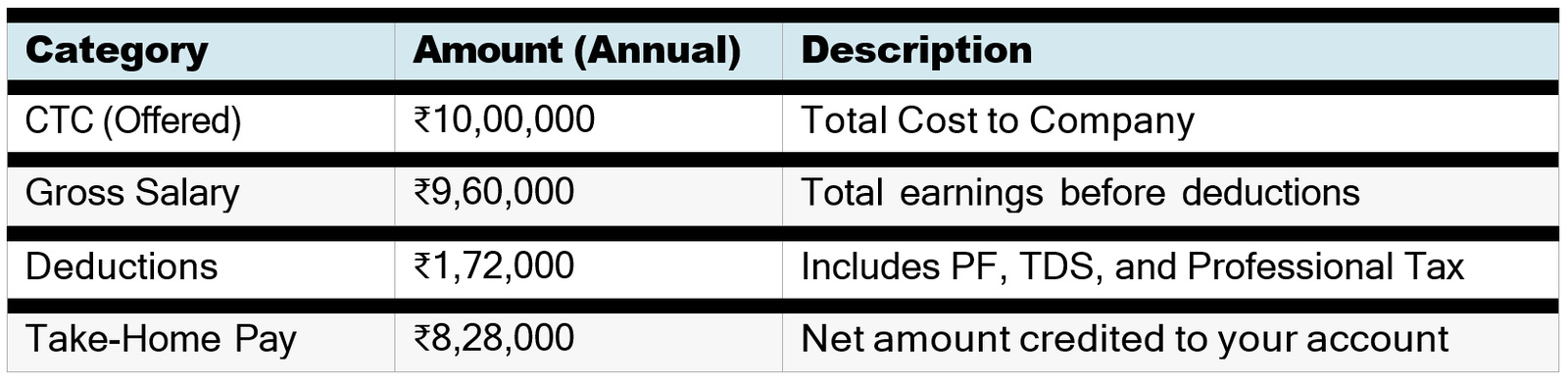
CTC (Cost to Company) is the total expense your employer incurs including their PF contribution, gratuity, and insurance. It is a notional figure, not your take home. Gross salary is what you earn before deductions. Net salary is what lands in your bank. The Payment of Wages Act, 1936 mandates employers furnish a wage slip every pay period.
What every line on your payslip means
Here is a decoded breakdown of a typical ₹10 LPA payslip every component, its purpose, and the law behind it.
Understanding Deductions in Detail
Special Allowance
Special Allowance: This is a fully taxable component used by employers to bridge the gap between CTC and structured allowances such as Basic and HRA. It carries no exemptions. Employers include it to meet a target CTC figure without inflating components that affect PF or HRA calculations.
Tax Deducted at Source (TDS)
TDS is not a separate tax it is the annual income tax liability divided across 12 months. The employer estimates the employee’s tax liability for the year and deducts a proportionate amount
each month. This amount reduces when the employee submits Form 12BB declarations covering rent, ELSS, PPF, and insurance premiums. Declarations should be submitted at the start of the financial year in April, not at the end in March. (Ref: Section 192 – Income Tax Act)
Professional Tax
This is a state-level statutory levy. The applicable amount varies by state — Maharashtra, for example, caps it at ₹200 per month, while certain states such as Delhi do not levy it at all.
Professional Tax is deductible from taxable income under Section 16(iii) of the Income Tax Act.
Provident Fund (PF)
The employee contributes 12% of Basic Pay to the EPFO account each month, and the employer matches this with an equivalent 12% contribution. In the example above, this amounts to a combined monthly credit of ₹9,600 to the employee’s PF account, earning interest at 8.25% per
annum as applicable. The employee’s contribution is deductible under Section 80C of the Income
Tax Act. PF accumulations are generally accessible upon retirement at age 58, subject to applicable EPFO regulations.
How Form 12BB Declarations Affect Take-Home Pay
One of the most direct ways to reduce monthly TDS is through the Form 12BB declaration submitted at the start of every financial year. When employees inform their employer of rent payments, ELSS investments, PPF contributions, and insurance premiums at the beginning of April, the employer factors these into the TDS calculation and reduces the monthly deduction accordingly. Many employees either skip this step or submit declarations late in March rather than April.
When declarations are submitted late, TDS is deducted at a higher rate for most of the year. The employee then claims a refund during ITR filing which means the excess amount remains with the government, interest-free, for several months. Under Section 80C of the Income Tax Act, investments up to ₹1.5L per year including PF, ELSS, PPF, and life insurance premiums reduce taxable income directly, and timely declaration ensures these benefits are reflected in monthly take-home pay rather than recovered as a lump-sum refund.
Important: Timing of Investment Declarations
Declare your investments in April not March. The earlier you submit Form 12BB, the more your TDS reduces across the full year. Late declarers get a refund instead of monthly savings, which means less cash flow all year long.
Common Payslip Questions, Answered
The following addresses questions employees commonly raise about their payslip components:
- “My PF says ₹4,800, where’s my employer’s share?” Into the same EPFO account. Your total monthly credit is ₹9,600. Verify it on the EPFO Member Portal using your UAN.
- “I pay TDS monthly do I still file an ITR?” Yes, always. TDS is advance tax. ITR reconciles your actual liability you may get a refund or owe more. Skipping ITR blocks future loans and
- “My HRA is ₹20,000 but I pay ₹15,000 rent am I losing the gap?” Exemption is the lower of: actual HRA received, actual rent minus 10% of basic, or 40–50% of basic (by city). Submit receipts to HR to claim it.
- “CTC was ₹10L but I get ₹28L was I misled?” No. CTC includes employer’s PF, gratuity, and benefits. Ask HR for a written CTC breakup letter every employer must provide one under the Labour Codes.
5-Step Payslip Review
1. Confirm name, PAN, and UAN are Errors here affect TDS credit and PF access both are painful to fix later.
2. Verify PF deduction equal to exactly 12% of Basic Any discrepancy should be raised with HR in writing.
3. Check TDS against Form 26AS every quarter to confirm the employer is depositing
4.Compare HRA with your offer letter some companies silently reduce it at appraisal while keeping gross unchanged.
5.Save all payslips in one Banks, visa offices, and background-check firms ask for 3–6 months often at the worst moment.
Understanding a payslip in full its earnings, deductions, and statutory components enable employees to verify accuracy, make timely investment declarations, and avoid common errors in tax filing. Many employees forego significant savings each year simply due to undeclared investments, unverified TDS credits, or unclaimed HRA exemptions.
Reviewing last month’s payslip against the breakdown in this article is a practical starting point. Matching each component to its purpose, verifying PF and TDS figures, and checking Form 26AS quarterly are straightforward steps that can prevent errors and optimize tax outcomes over the full financial year.
References
- 1. Employees’ Provident Fund Organisation (EPFO) – Official Website: epfindia.gov.in
- 2. Income Tax Department of India – Official Portal: incometax.gov.in
- 3. Form 12BB – Investment Declaration Form (CBDT)
- 4. Payment of Wages Act, 1936 – Chief Labour Commissioner (CLC): gov.in/clc/acts- rules/payment-wages
- 5. Section 80C Deductions – Income Tax Department (AY 2026-27): gov.in – Salaried Individuals AY 2026-27
- 6. Code on Wages, 2019 – Ministry of Labour and Employment: https://labour.gov.in/offerings/schemes-and-services/details/labour-codes-gzNzQzMtQWa
- 7. EPFO FAQ on PF Contributions: gov.in/site_en/FAQ.php
Reader Note
TalentCo HR Services LLP is an HR consulting and solutions company offering services across HR operations, compliance, liasoning, payroll management, and HR technology through its proprietary platform — ABStart. This article is intended for general informational and educational purposes only. Labour laws, tax regulations, and compliance requirements are subject to change. Readers are advised to independently verify current regulations or consult qualified professionals before making any business or financial decisions. Our role is to simplify and present complex HR and payroll concepts in a comprehensible manner for business owners, HR professionals, and employees.