The Hidden Time Tax on Indian SME Payroll
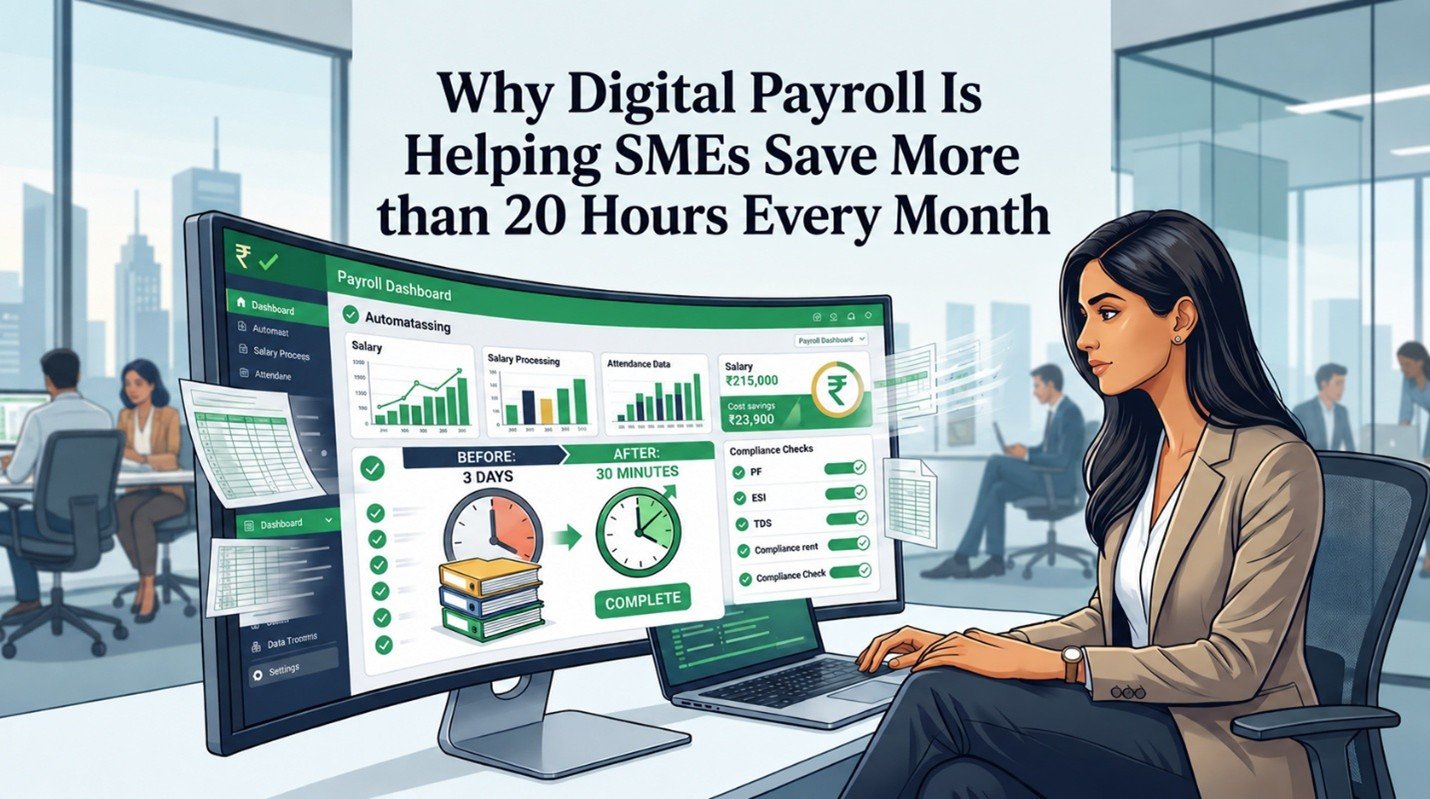
Ask any HR manager at a 50-person Indian company how long payroll takes each month. The honest answer is rarely flattering. Between reconciling attendance records, verifying leave balances, calculating variable pay, applying the correct professional tax slabs across states, and manually filing PF and ESIC challan data, a typical payroll cycle can consume up to 2–3 working days in many manually operated SMEs, sometimes more.
This trend is widely observed across the MSME sector. India’s MSME sector employs over 11 crore people according to the Ministry of MSME, and many of these businesses still rely on spreadsheets for HR and payroll operations. The hidden cost is enormous: skilled HR time redirected away from hiring, engagement, and performance into data entry and error-correction.
In 2026, this is no longer just an efficiency problem. It is a compliance exposure.
What Digital Payroll Actually Changes
The shift to a structured HRMS platform like ABStart does not simply speed up existing processes it fundamentally restructures them. Here is what the operational difference looks like in practice:
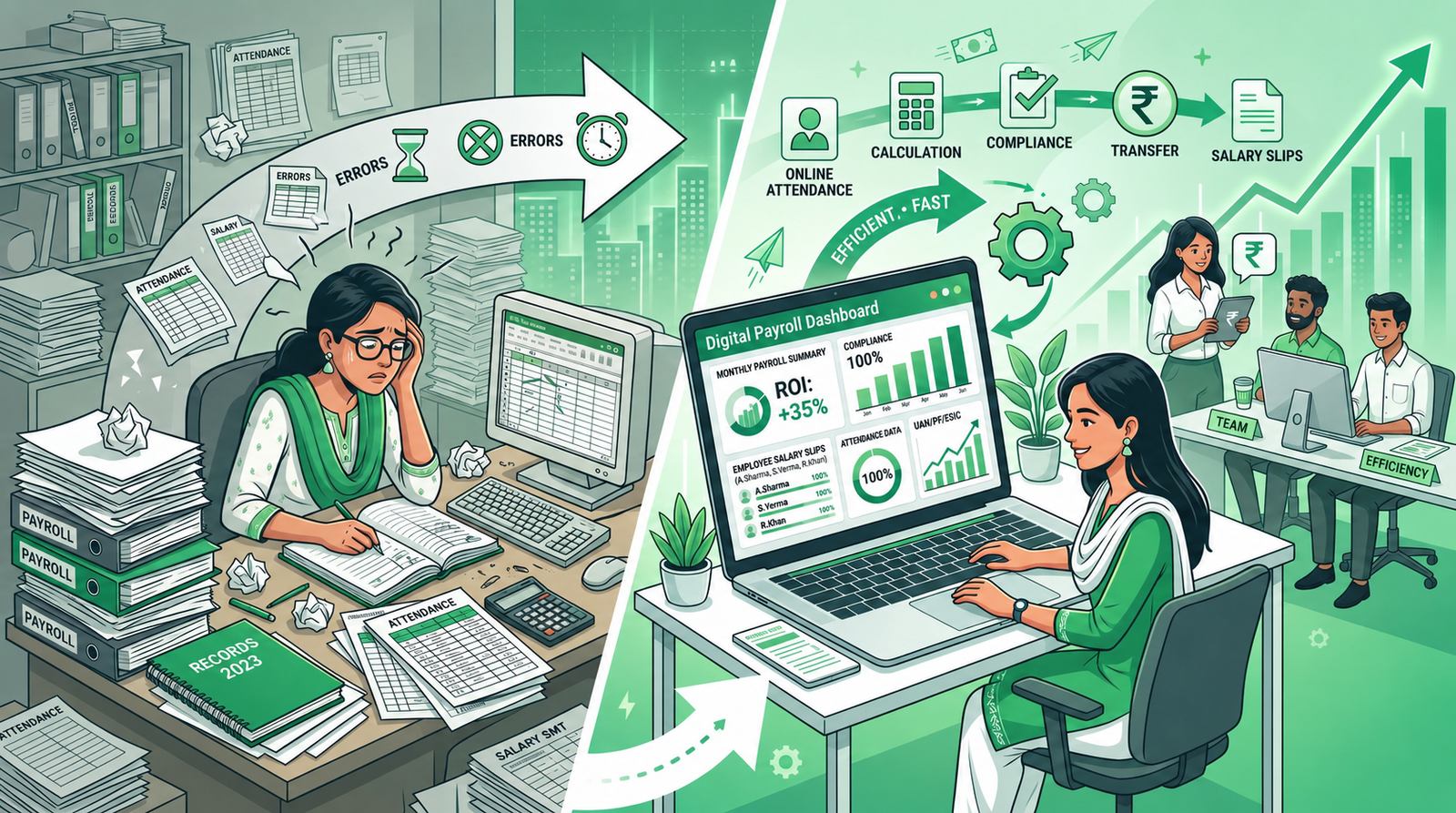
Attendance and leave data flow directly into payroll calculation, significantly reducing the need for manual reconciliation.
Salary components are pre-mapped to statutory definitions under the Code on Wages, 2019, helping ensure more accurate PF, ESIC, and professional tax
Payslips are generated and distributed automatically no formatting, no printing, no manual
PF and ESIC challans are prepared from live payroll data, reducing filing time significantly, often from hours to a much shorter duration.
Audit-ready records are maintained automatically, available for EPFO or ESIC inspection without any manual document assembly.
The result: can reduce monthly processing time from multiple days to a few hours, depending on company size and processes.
Quantifying the ROI: Beyond Time Savings
Efficiency is only one part of the return. The more consequential ROI of digital payroll lies in statutory risk avoidance.
Under Section 14B of the EPF and Miscellaneous Provisions Act, 1952, employers face damages of up to 100% of the arrears due for delayed or incorrect PF contributions. For a company with 40 employees where even a modest payroll error leads to arrears; penalties in such cases can be substantial and, in some scenarios, comparable to the cost of an annual HRMS subscription.
Under the DPDP Act, 2023, maintaining employee personal data Aadhaar numbers, bank details, salary records stored without adequate safeguards may increase the risk of non-compliance with data protection requirements. Penalties for significant data breaches can reach up to ₹250 crore, highlighting the importance of robust data protection practices.
The four Labour Codes, when fully operationalised, will are expected to require salary structures aligned with the Code on Wages definition, which may require adjustments for some SMEs. Companies running on structured digital payroll are likely to adapt faster, while others may require significant effort to align.
ABStart: Built for This Transition
ABStart, the HRMS platform developed by TalentCo HR Services, is built specifically for Indian SMEs navigating this transition. The platform automates PF, ESIC, and TDS calculations, supports DPDP-aligned data storage practices, generates audit-ready records, and supports salary structures aligned with the Code on Wages framework.
The platform is not designed to replicate enterprise HR software at a smaller scale. It is designed around the actual regulatory and operational realities that Indian growing companies face in 2026: multi-state professional tax applicability, EPFO and ESIC portal integration, and Labour Code-aligned wage definitions all within a single, accessible system.
Key Takeaways
Manual payroll in Indian SMEs routinely consumes 2–3 working days per month; structured digital payroll can be completed much faster, often within a few hours
Statutory errors under the EPF Act carry damages that can go up to 100% of arrears depending on the duration of default due often exceeding the annual cost of an HRMS platform.
DPDP Act, 2023, makes unencrypted storage of employee data in spreadsheets a direct compliance
Labour Code alignment, particularly under the Code on Wages, 2019, requires structured salary architectures that manual systems cannot reliably maintain.
Platforms like ABStart convert payroll from a monthly liability into a controlled, audit-ready, time-efficient process.
References
Ministry of MSME – MSME at a Glance: gov.in
Employees’ Provident Fund Organisation – Section 14B, EPF Act, 1952: gov.in
Code on Wages, 2019 – Ministry of Labour and Employment: gov.in
Digital Personal Data Protection Act, 2023 – Ministry of Electronics and IT: gov.in
ESIC – Employees’ State Insurance Corporation Official Portal: gov.in
Code on Social Security, 2020 – Ministry of Labour and Employment: gov.in
Income Tax Department – TDS on Salary, Section 192: gov.in
Reader’s Note:
TalentCo HR Services LLP is an HR consulting and solutions company offering services across HR operations, compliance, liasoning, payroll management, and HR technology through its proprietary platform — ABStart. This article is intended for general informational and educational purposes only. Labour laws, tax regulations, and compliance requirements are subject to change based on government notifications and jurisdictional updates. Readers are advised to independently verify current regulations or consult qualified professionals before making any business or financial decisions.