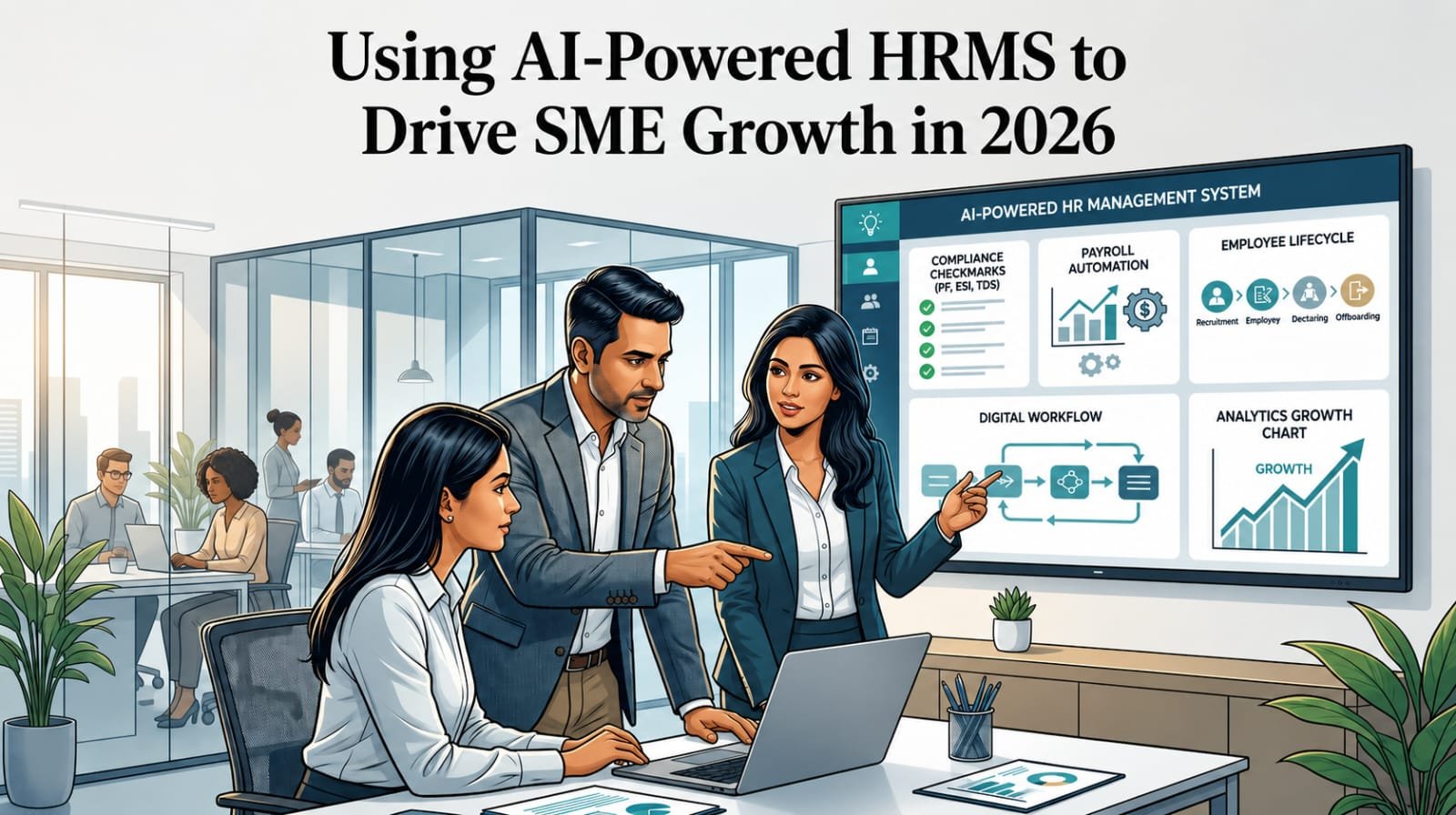
Using AI-Powered HRMS to Drive SME Growth in 2026
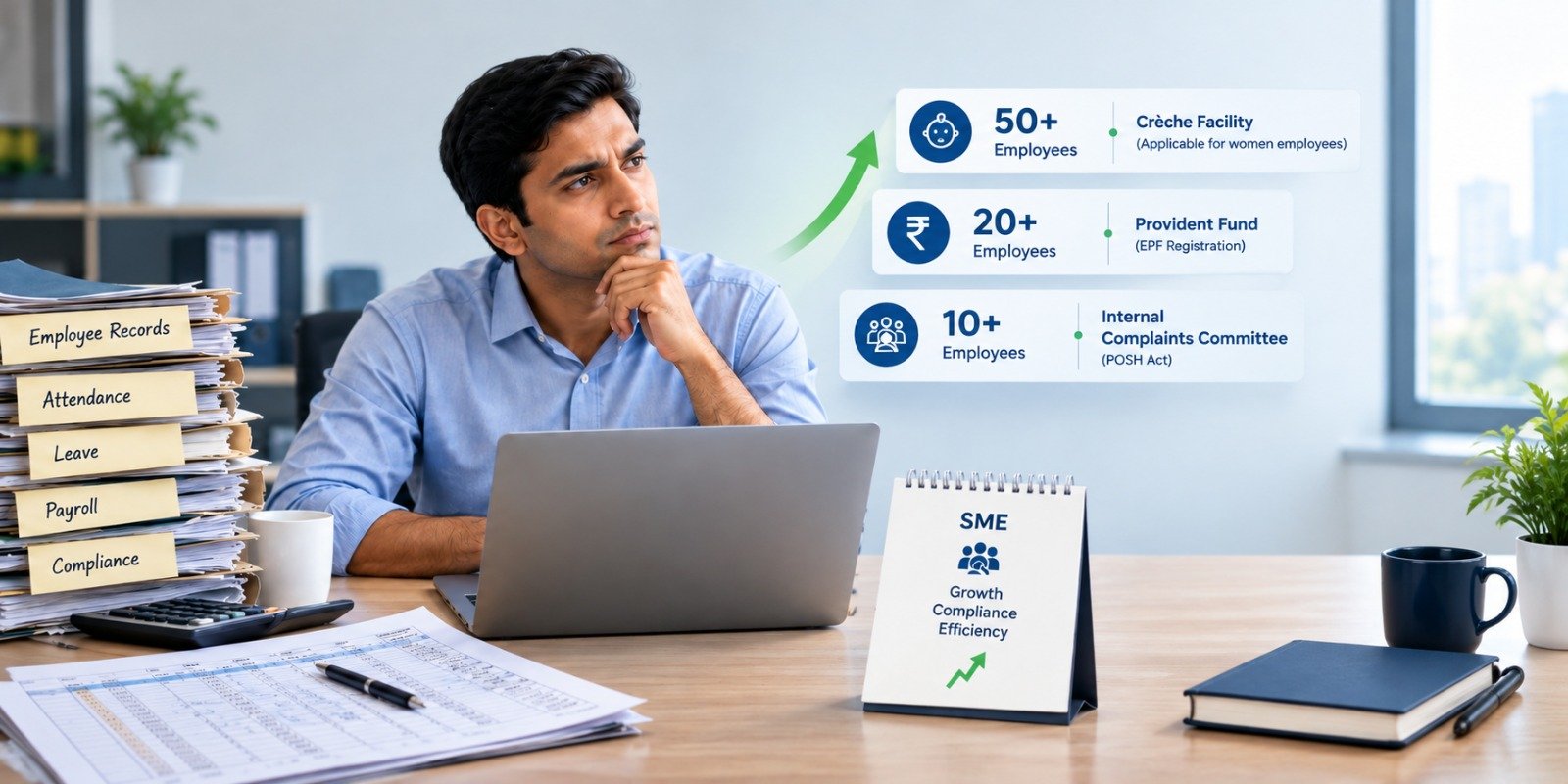
India’s SME sector employs over 11 crore people and contributes approximately 30% of GDP, according
to the Ministry of MSME. Yet a large share of these businesses still manage payroll and compliance
through spreadsheets and manual registers. In 2026, that is not just inefficient it is a measurable
business risk.
With India’s four Labour Codes advancing toward full state-level notification, the Digital Personal Data
Protection (DPDP) Act 2023 now enforceable, and the Income Tax Department’s TDS systems
increasingly automated, compliance has become complex enough that manual processes cannot
reliably keep pace.
The Compliance Landscape Has Changed
The Code on Wages 2019 mandates that Basic Salary must constitute at least 50% of total
remuneration. This directly reshapes how PF, Gratuity, Leave Encashment, and Bonus are calculated.
Simultaneously, the DPDP Act 2023 requires businesses to protect employee personal data with role-
based access controls and audit-ready records. And since Budget 2023, the New Tax Regime is the
default option, meaning payroll systems must handle TDS under Section 192 of the Income Tax Act
across two tax regimes simultaneously for employees who have opted in or out.
Each of these obligations carries penalties for non-compliance. Delayed PF challans attract interest
under EPFO rules. Misfiled TDS returns draw notices under Section 200A of the Income Tax Act. For an
SME managing this manually across even 30 employees, the risk is structural, not theoretical.

What AI Actually Does Inside a Modern HRMS
In the context of Indian SMEs, an AI-powered HRMS delivers specific, practical functions:
Automated payroll processing that reads attendance, leave, and advance data to compute gross
pay, all statutory deductions, and net take-home without manual entry.
Compliance anomaly detection that flags salary structures violating Labour Code thresholds,
missed EPFO or ESIC filing deadlines, and employees approaching gratuity eligibility.
Dual-regime TDS logic that computes projected annual tax for each employee at the start of the
financial year, adjusts monthly deductions accordingly, and generates Form 16 data as a clean
output.
Lifecycle automation from structured digital onboarding through performance management,
benefits tracking, and offboarding with data flowing across modules without re-entry.
How ABStart Addresses the SME Gap
ABStart, developed by TalentCo HR Services, is built specifically for the transition growing Indian
companies face from informal, spreadsheet-driven HR to a structured, compliance-ready operation.
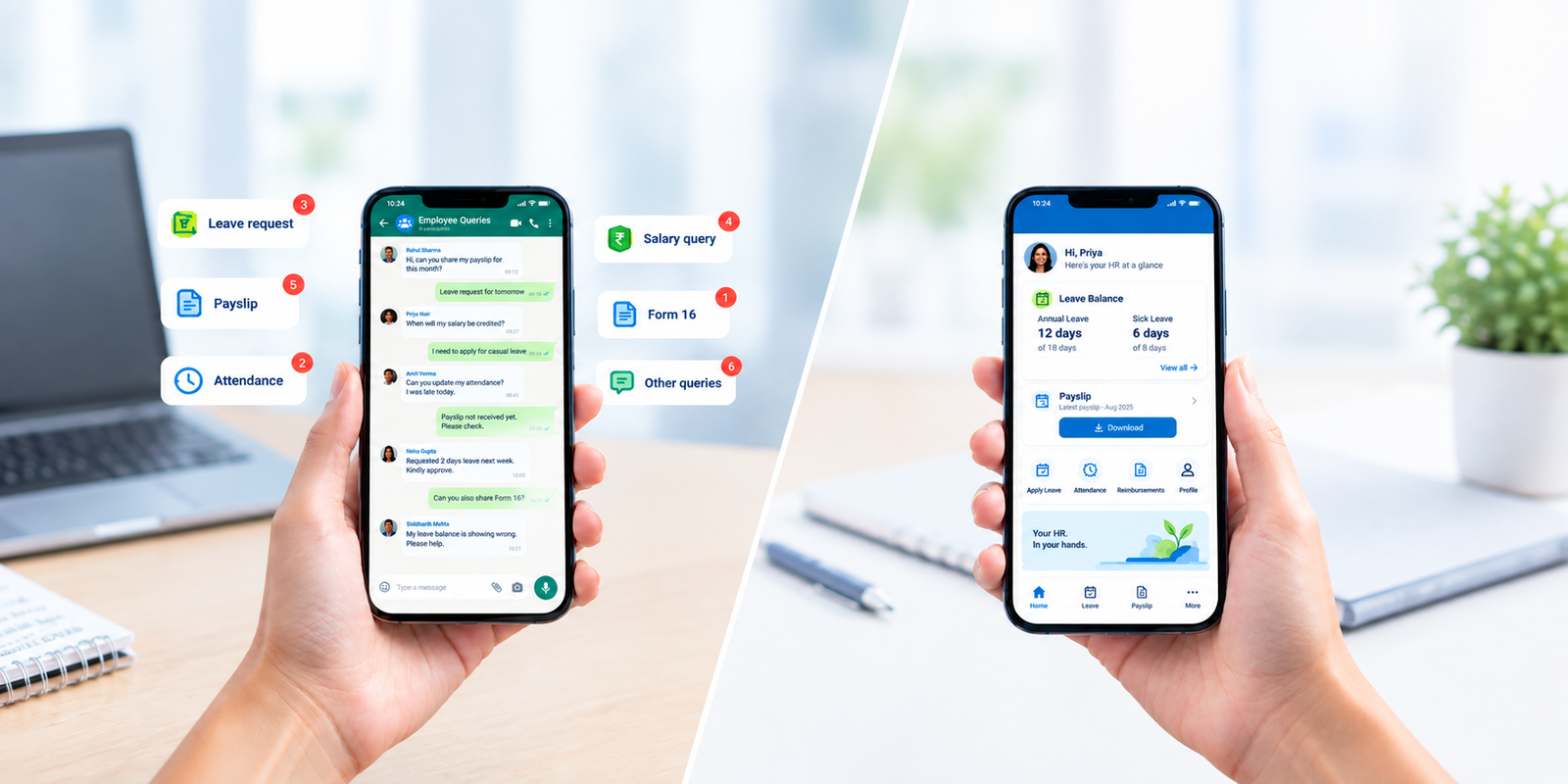
The platform covers the full employee lifecycle end to end: onboarding, attendance, leave, payroll with
built-in statutory logic, performance management, benefits administration, and clean exit workflows.
ABStart, built by TalentCo HR Services with 30+ years of HR and domain expertise, is one such platform purpose-built for Indian SMEs, combining AI-ready HRMS capabilities with deep compliance expertise. ABStart is built by HR professionals who have managed the exact challenges that manual HR creates as businesses scale. It focuses not just on features, but on people, processes, and clarity so SMEs can build a professional business culture without adding compliance overhead.
The New Tax Regime and Payroll Complexity in 2026
Since Budget 2023, the New Tax Regime has been the default option for individual taxpayers. This
means payroll systems must correctly handle employees on both regimes simultaneously, ensuring
that TDS calculations under Section 192 of the Income Tax Act reflect each employee’s declared choice.
Employees on the Old Regime claiming HRA exemptions under Section 10(13A), 80C deductions, or 80D
medical insurance benefits require a different computation path than those under the simplified New
Regime slabs.
Managing this dual-track TDS logic manually across a team of even 30 employees creates meaningful
risk. An AI-powered HRMS handles both regimes in parallel, computes projected annual tax for each
employee at the start of the financial year, adjusts monthly TDS accordingly, and reconciles
declarations at year-end generating Form 16 data as a clean output of the process rather than a
separate manual task.
Key Takeaways
• India’s Labour Codes and the DPDP Act 2023 have raised the compliance floor for every employer,
regardless of size.
• AI-powered HRMS automates payroll, TDS across both tax regimes, statutory filings, and
compliance monitoring.
• The New Tax Regime as default from FY 2023–24 adds dual-track TDS complexity that manual
payroll handles poorly.
• ABStart by TalentCo provides SMEs with end-to-end HRMS grounded in Indian HR realities, not
feature lists.
References
Ministry of MSME at a Glance: https://msme.gov.in
Code on Wages, 2019 Ministry of Labour and Employment: https://labour.gov.in
Employees’ Provident Fund Organisation (EPFO): https://www.epfindia.gov.in
Employees’ State Insurance Corporation (ESIC): https://www.esic.in
Digital Personal Data Protection Act, 2023 Ministry of Electronics and IT: https://www.meity.gov.in
Income Tax Department Section 192, TDS on Salary: https://www.incometax.gov.in
Payment of Gratuity Act, 1972, Ministry of Labour: https://labour.gov.in
PRS Legislative Research, Summary of Labour Codes: https://prsindia.org
Readers Note:
TalentCo HR Services LLP is an HR consulting and solutions company offering services across HR operations, compliance, liasoning, payroll management, and HR
technology through its proprietary platform — ABStart.
This article is intended for general informational and educational purposes only. Labour laws, tax regulations, and compliance requirements are subject to change based
on government notifications and jurisdictional updates. Readers are advised to independently verify current regulations or consult qualified professionals before making
any business or financial decisions.
Our role is to simplify and present complex HR and payroll concepts in a comprehensible manner for business owners, HR professionals, and employees.