

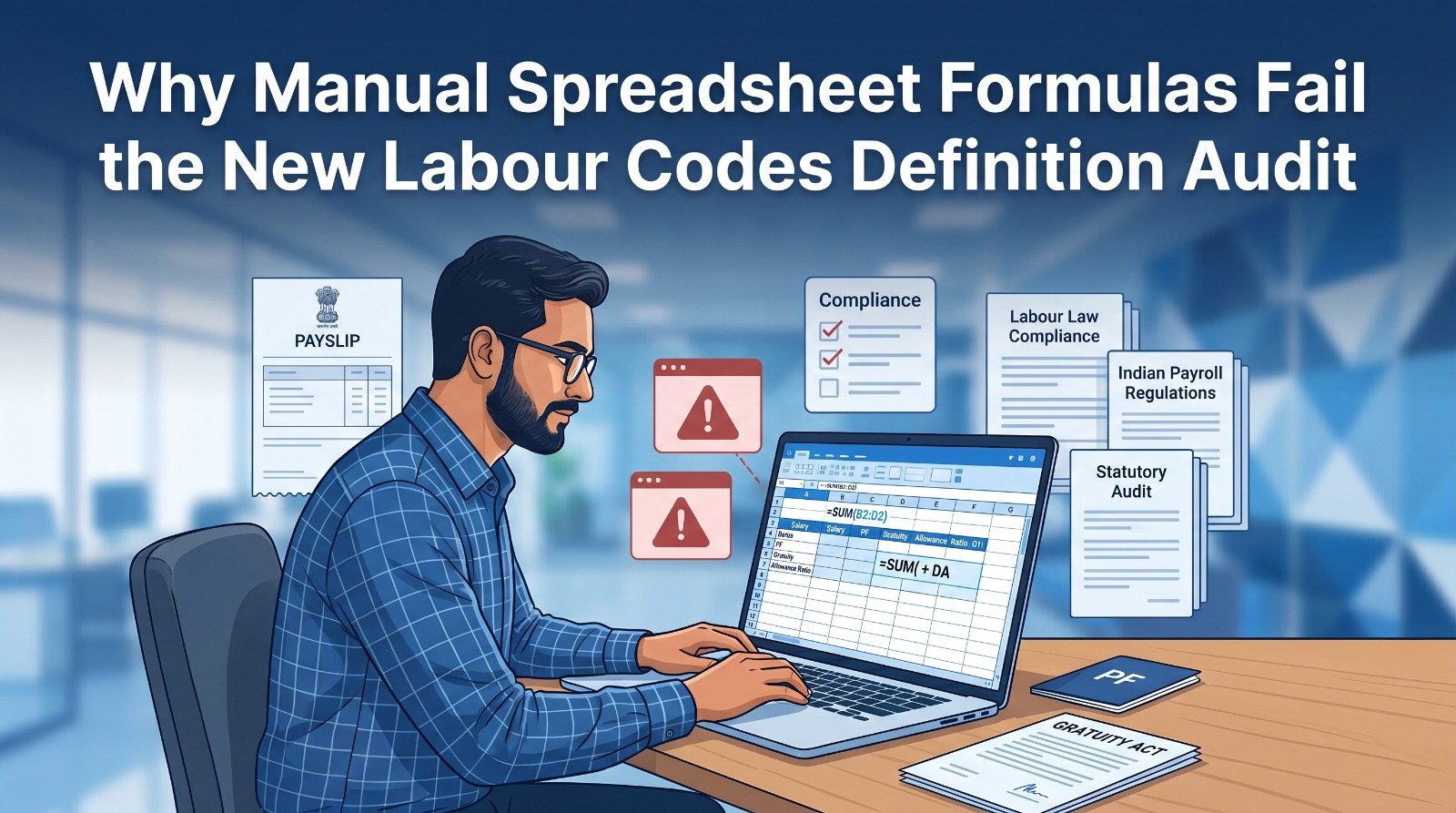
Manual spreadsheet formulas often struggle to keep pace with evolving wage definitions introduced by the Code on Wages, 2019. When this code is operationalised, Salary structures built on outdated component logic may not meet statutory audit requirements, potentially leading to retrospective liabilities for Indian SMEs.
The Compliance Gap Hidden Inside Every Salary Sheet
For years, Indian businesses structured employee salaries around a familiar objective: keep the Basic component low to reduce Provident Fund contributions. Spreadsheets enabled this easily. A formula could reduce the Basic component to 30–35% of CTC while increasing allowances to optimize cost structures and produce a payslip that looked complete.
The Code on Wages, 2019 dismantles that architecture. The Code defines wages to include all remuneration except a defined set of exclusions. Critically, those exclusions cannot exceed 50% of total remuneration. Any excess beyond the prescribed threshold may be treated as part of wages for statutory contribution calculations, as per the code for PF and gratuity calculation purposes.
A standard spreadsheet setup may not reliably enforce this boundary without continuous monitoring and updates. It calculates what it is told to calculate. Whether the resulting salary structure is compliant with the new wage definition is a legal determination that typically requires domain expertise beyond standard spreadsheet functionality.
What a Labour Code Definition Audit Examines
When EPFO or a statutory inspector conducts an audit under the new Labour Codes framework, the review is not limited to whether contributions were deposited on time. Auditors examine whether the wage definition applied by the employer matches the statutory definition. This includes:
Whether Basic wage is correctly determined in relation to total remuneration
Whether excluded allowances remain within the 50% ceiling prescribed under the Code on Wages
Whether the PF contribution base reflects the correct statutory wage
Whether gratuity has been computed on the appropriate wage definition
Whether variable pay components have been appropriately classified
Three Points Where Spreadsheet Formulas Break Down
1. Static Component Logic
Spreadsheet salary structures are typically built once and rarely revised. As legislative changes accumulate — across the Code on Wages, Code on Social Security, and ESIC regulations — the formula remains unchanged. The salary output continues to appear correct while quietly accumulating statutory misalignment.
2. No Threshold Enforcement
The 50% allowance ceiling under the Code on Wages requires active monitoring for every employee across every pay cycle. Different CTC levels, variable pay treatments, and allowance combinations all affect where an individual’s salary lands relative to that threshold. A spreadsheet formula typically lacks automated mechanisms to consistently flag such breaches without additional configuration.
3. Retrospective Liability Risk
Under Section 14B of the EPF and Miscellaneous Provisions Act, 1952, employers who have under-contributed due to an incorrect wage base face damages that can extend up to 100% of the arrears in certain cases, along with applicable interest, in addition to simple interest. When the Code on Wages alters the wage definition and an audit reveals years of miscalculated PF contributions, the liability is calculated retrospectively across every affected employee and pay period.

What Structured HR Architecture Handles Differently
Certain HRMS platforms designed for Indian statutory compliance embed wage definition logic directly into salary structure configuration. Rather than relying on a user-written formula, the system applies the Code on Wages framework at the point of salary design, ensuring that component proportions remain within compliant boundaries before payroll is processed.
For SMEs managing multiple pay bands, variable components, and frequent joiners, this automated validation layer significantly reduces a category of risk that manual spreadsheet management may struggle to address effectively. PF and ESIC contributions are calculated on the correct statutory wage. Records are audit ready. When a regulatory update occurs, the system is configured to reflect the change without relying on an HR executive to manually update every formula across every employee file.
Key Takeaways
PF and gratuity liabilities are directly affected when wage definitions are applied incorrectly. Retrospective penalties under Section 14B can equal 100% of contribution arrears.
EPFO and ESIC audit activity targeting Indian SMEs is increasing; inaccurate wage classification is a primary finding.
Manual spreadsheet formulas are static, unvalidated, and carry no mechanism to flag legislative misalignment.
Structured HRMS platforms like ABStart build statutory wage logic into salary architecture, reducing audit exposure and supporting more consistent and compliant payroll processing across pay cycles.
References
Code on Wages, 2019 – Ministry of Labour and Employment: labour.gov.in
Employees’ Provident Fund Organisation – Section 14B, EPF Act, 1952: epfindia.gov.in
Code on Social Security, 2020 – Ministry of Labour and Employment: labour.gov.in
Employees’ State Insurance Corporation – Official Portal: esic.gov.in
PRS Legislative Research – Labour Codes Summary: prsindia.org
Ministry of MSME – MSME at a Glance: msme.gov.in
Reader’s Note:
TalentCo HR Services LLP is an HR consulting and solutions company offering services across HR operations, compliance, payroll management, and HR technology through its proprietary platform — ABStart. This article is intended for general informational and educational purposes only. Labour laws, tax regulations, and compliance requirements are subject to change based on government notifications. Readers are advised to independently verify current regulations or consult qualified professionals before making any business or financial decisions