

What Is the Difference Between Section 194C and Section 194J?
Section 194C covers payments for work done under a contract, including supply of labour. Section 194J covers fees for professional or technical services. The rates differ: 1% or 2% under 194C, and 10% or 2% under 194J. From 1 April 2026, both sit under Section 393 of the Income-tax Act, 2025. The rates and thresholds carried over.
Most confusion comes from vendors who sit between the two. A staffing company, a software vendor, and a recruitment agency all “provide services”, but the TDS treatment is not always the same.
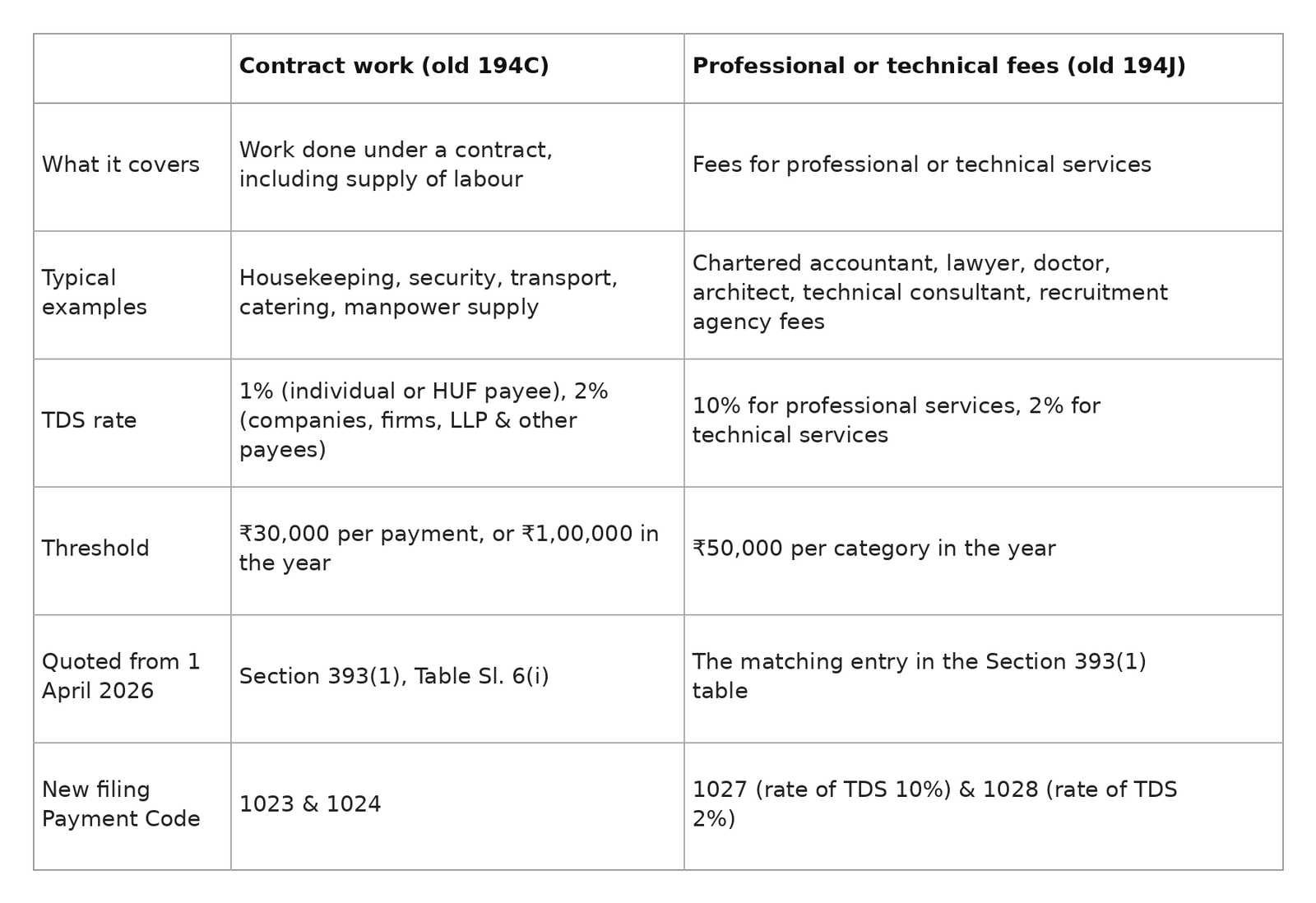
How Do You Decide Which One Applies?
Ask what you are paying for. If the vendor delivers work, labour or a routine service, it is contract work. If you are paying for expert skill or advice, it is a professional or technical fee. The agreement and scope of work decide this, not the vendor’s name or the invoice heading.
Three questions help on a first pass:
1. Is the vendor doing a task or supplying people? Cleaning, security, transport, catering and manpower supply usually point to contract work.
2. Is the vendor a professional, or giving expert advice? Legal, medical, architecture, accountancy and technical consultancy usually point to professional or technical fees.
3. Does the invoice mix both? Split it by component. Do not apply one rate to the whole invoice.
Since October 2024, the definition of “work” under 194C leaves out payments that fall under 194J. A payment cannot be both.
What Does This Look Like With Real Numbers?
These examples assume the payee is a company or firm, and that the thresholds have already been crossed.
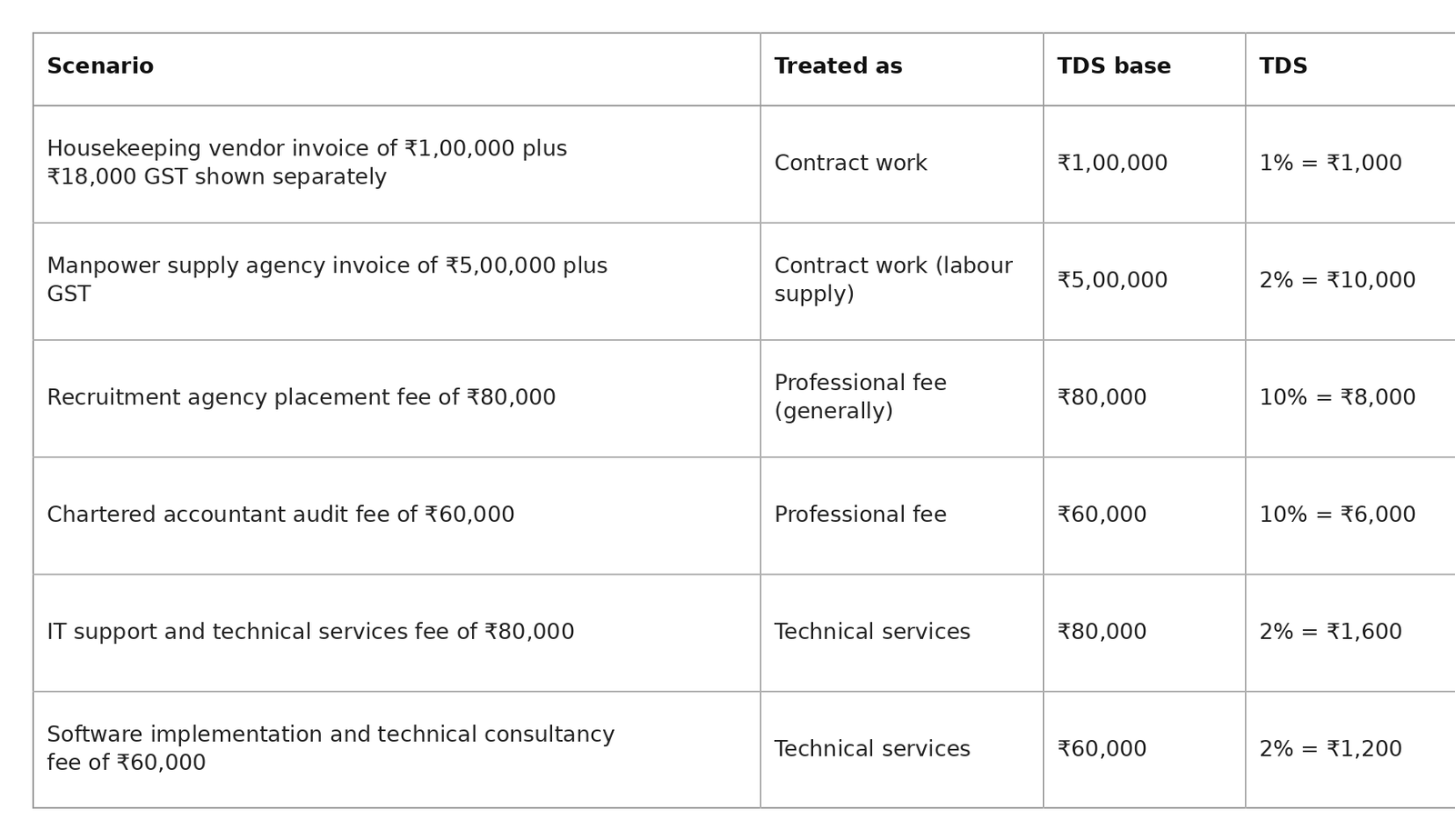
Take the manpower invoice. If someone applied the 10% professional rate by mistake, ₹50,000 would be deducted instead of ₹10,000. The vendor would be short by ₹40,000 and would ask for a correction. If the mistake runs the other way, the deductor is short-deducting, which is the costlier error.
What Changed on 1 April 2026?
The Income-tax Act, 2025 replaced the 1961 Act for payments credited or paid on or after 1 April 2026. Sections 194C and 194J are now table entries under Section 393(1). Rates and thresholds did not change. TDS returns must quote the Section 393 entry, not the old section number.
What this means in practice:
1. Payments credited or paid before 1 April 2026 stay under the old Act and the old section numbers.
2. For payments on or after that date, the Income Tax Department says to quote the relevant Section 393 table item. For contractor payments, its own example is Section 393(1), Table Sl. 6(i).
3. Quoting 194C or 194J for these payments can cause system validation errors and corrective filings.
Check that your accounting or payroll software has been updated to map vendor categories to the new entries.
What Mistakes Do Finance Teams Make Most Often?
1. Classifying by the vendor’s name. “Agency” does not automatically mean 194J, and “consultant” does not automatically mean professional fees.
2. One rate for a mixed invoice. Routine work and a consulting component need separate treatment.
3. Missing the annual threshold. Several invoices below ₹30,000 can add up past ₹1,00,000 in the year, and TDS then applies.
4. Deducting on the GST-inclusive amount. Where GST is shown separately on the invoice, TDS is calculated on the amount without GST.
5. Using old section numbers on returns for payments made after 1 April 2026.
A wrong classification leads to short deduction, which means tax shortfall and interest. The expense can also be disallowed. The bigger risk is repetition: if the same wrong treatment is applied to 40 vendors, the error repeats 40 times.
“Most classification errors we see aren’t carelessness — they’re a company applying one rate to every vendor because nobody separated ‘work’ from ‘expertise’ at the onboarding stage. That one decision, made correctly once per vendor, prevents almost every dispute we get called in to fix later.”
— Shailendra Dhamdhere
Founder, TalentCo HR Services
What Should You Do When Onboarding a New Contractor or Vendor?
1. Collect the basics. PAN, GST details and a signed agreement with a clear scope of work.
2. Classify before the first payment. Decide contract work or professional/technical fees. Write one line explaining why and keep it with the vendor record.
3. Track payments through the year. Keep a running total per vendor so the thresholds do not surprise you at year-end.
4. Review the first invoice. Split it if it mixes services, and calculate TDS on the amount excluding separately shown GST.
5. Quote the correct Section 393 entry when filing, and reconcile deductions against the quarterly return.
How Does Contract Staffing Change the TDS Picture?
When you hire through a contract staffing company, the workers are on the agency’s payroll. You receive one invoice for the service, so the TDS decision is made once, at the vendor level. It is generally treated as contract work, but confirm this against your agreement with your CA.
Engaging freelancers or individual contractors directly is different. Each person needs their own PAN, agreement, classification and threshold tracking. Companies with many such engagements often find it easier to route them through a staffing partner. TalentCo’s contract staffing service covers onboarding, payroll support, statutory compliance and documentation for contract staff.

Talk to TalentCo About Contract Staffing
References
[1] Income Tax Department, e-Filing portal, Tax Payments help page (transition to the Income-tax Act, 2025; quoting Section 393 table items): https://www.incometax.gov.in/iec/foportal/help/all-topics/e-filing-services/tax-payments
[2] India Briefing, “Section 393 of Income Tax Act 2025 Explained: FAQs for Deductors”: https://www.india-briefing.com/news/section-393-income-tax-act-2025-tds-rules-rates-compliance-guide-44450.html/
TalentCo HR Services LLP is an HR consulting and solutions company offering HR operations, compliance, payroll management, contract staffing and recruitment services. This article is for general information only. Tax laws and TDS provisions may change. Please consult a qualified chartered accountant or tax professional before deciding the TDS treatment for a specific payment.