

Payroll compliance is a critical operational responsibility for small businesses in India, yet it is often mishandled. Most defaults occur not due to negligence, but because the regulatory framework is complex, multi-layered, and frequently changes at both state and central levels. According to the Employees’ Provident Fund Organisation (EPFO) and the Ministry of Labour and Employment, small businesses default on thousands of crores in payroll obligations each year. With stricter enforcement under India’s new Labour Codes, the financial, legal, and reputational costs of non-compliance are increasing.
This article outlines five common payroll mistakes made by small businesses in India, explains why they occur, and provides the specific steps required to address each one.
1. Non-Compliance with EPF and ESIC Contributions
Among the most frequently observed payroll compliance failures is the incorrect or delayed registration and contribution under the Employees’ Provident Fund and the Employees’ State Insurance schemes. Under the Employees’ Provident Funds and Miscellaneous Provisions Act, 1952, any establishment with 20 or more employees is required to register with the EPFO and contribute 12% of each employee’s basic salary towards the Provident Fund. Under the Employees’ State Insurance Act, 1948, businesses with 10 or more employees are required to register with ESIC and make contributions towards medical and disability coverage.
Common errors include delayed registration, miscalculating PF on an incorrect wage base, and excluding eligible contract staff. EPFO may levy damages for delays in depositing contributions, making timely compliance essential for employers. ESIC defaults attract penalties under Section 85, including possible prosecution.
Fix: Register with EPFO and ESIC as soon as the applicable employee threshold is crossed. Review the payroll structure to confirm that PF is being calculated on the correct wage components. Businesses that have delayed registration should approach the respective authorities proactively both EPFO and ESIC provide regularization provisions that are considerably less burdensome than a formal audit, allowing businesses to rectify errors with reduced penalties and legal risk.
2. Incorrect TDS Deduction on Salaries
Tax Deducted at Source on salary income, governed by Section 192 of the Income Tax Act, is among the more technically complex payroll obligations and one where processing errors are common across small businesses.
Most errors occur when employers deduct TDS without collecting investment declarations from employees or apply the wrong tax regime. Since the new tax regime became the default under Budget 2023, some businesses still process payroll under the old regime without confirming employee preferences. According to the Income Tax Department of India, TDS defaults attract interest under Sections 201 and 234E, plus penalties that may equal the total TDS amount. The consequences include unexpected tax demands for employees and short-deduction notices for the business.
Fix: At the beginning of each financial year, collect Form 12BB from all employees to record their investment declarations and confirm their chosen tax regime either physically or digitally through email or payroll software. Use payroll software that calculates TDS monthly based on projected annual income and adjusts as declarations are updated. TDS returns in Form 24Q must be filed on time every quarter without exception.
3. Non-Compliance with Applicable Minimum Wage
Minimum wage compliance in India is more nuanced than a single national standard. Applicable wages vary by state, industry sector, and employee skill category and state governments revise these figures periodically, in many cases twice a year.
Under the Minimum Wages Act, 1948 now being consolidated under the Code on Wages, 2019 employers are legally required to pay at least the applicable scheduled minimum wage. A business in Maharashtra and one in Tamil Nadu may face different wage obligations for the same role and skill level. Salaries fixed at onboarding and left unrevised can leave employees underpaid and the business legally exposed often without either party being aware.
Fix: Subscribe to notifications from the relevant State Labour Department and check the Labour Department portal at least once every six months. Build a biannual salary review into the HR calendar to ensure all employee compensation remains aligned with the latest applicable minimum wage revisions.
4. Mismanaging Statutory Bonus and Leave Encashment
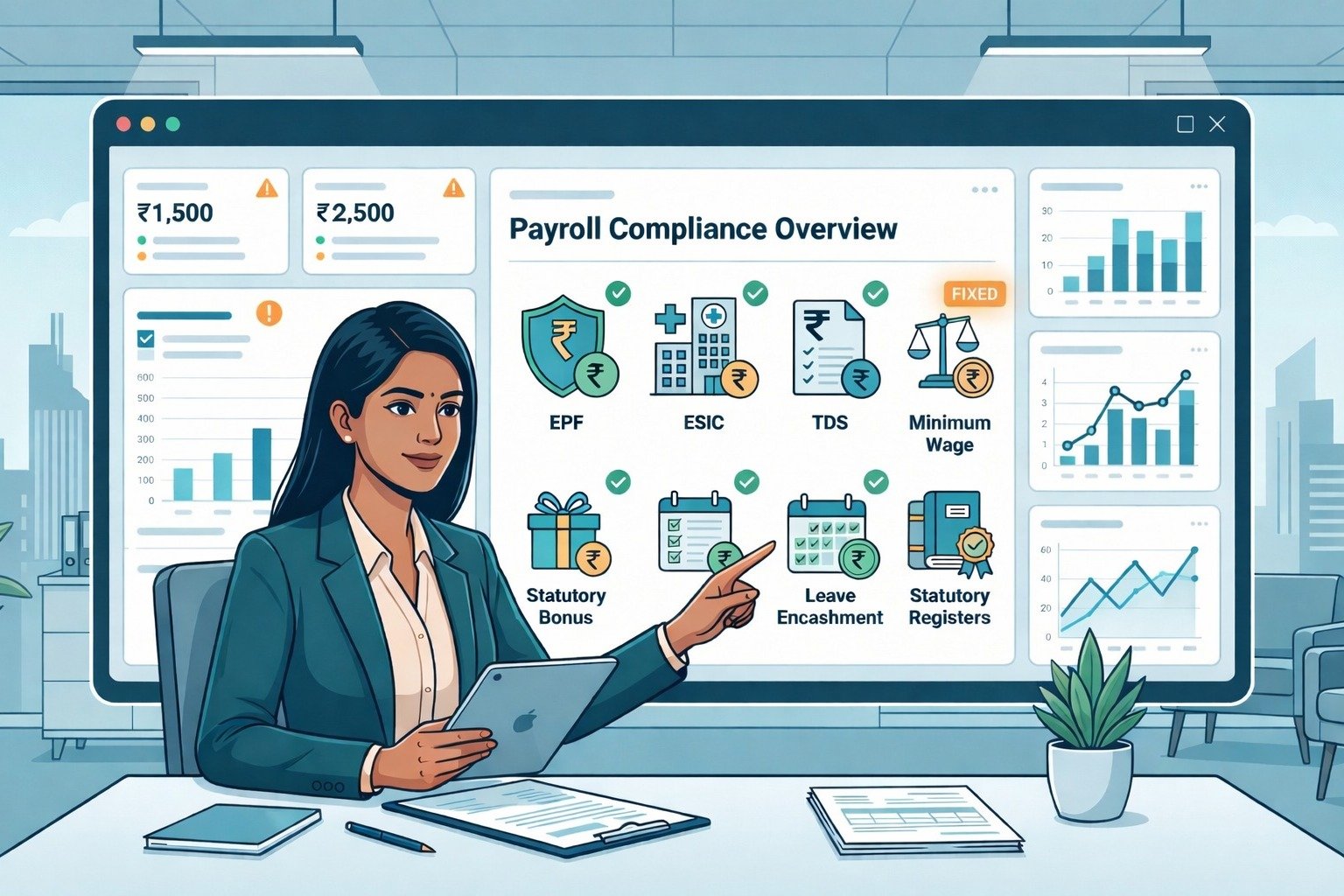
Statutory bonus and leave encashment are frequently treated as discretionary payments payable based on business performance or individual circumstance. This is a misconception that carries significant legal and financial risk. Under the Payment of Bonus Act, 1965, any establishment with 20 or more employees is required to pay annual bonus to eligible employees regardless of whether the business turned a profit. Separately, earned leave encashment at the point of resignation or retirement carries specific obligations under the Shops and Establishments Act of the relevant state. When these liabilities are not accounted for in advance, businesses face both legal exposure and sudden cash flow pressure when the obligation falls due.
Fix: Treat statutory bonus and leave encashment as monthly accruals within the payroll budget not year-end decisions. Maintain a leave ledger for each employee and reconcile it every quarter. Once the business crosses the 20-employee mark, bonus provisions should be factored into the financial plan immediately.
5. Running Payroll Without Maintaining Statutory Registers
A common situation in small businesses is managing payroll through spreadsheets which, while functional for salary disbursement, do not meet the statutory recordkeeping requirements under Indian labour law. Consider a manufacturing business that processes payroll on time each month, makes PF deposits without delay, and pays all salaries correctly. During a labour inspection, the inspector requests attendance records linked to salary payments, a wage register in the prescribed format, and proof of overtime calculations as required under the Payment of Wages Act, 1936. A spreadsheet-based system typically cannot produce any of these in the required statutory format. The resulting compliance fees, consultant costs, and management disruption are entirely avoidable with the right systems in place.
Under Indian labour law, employers are required to maintain specific registers in prescribed formats including the Wage Register, Leave Register, Attendance Register, and Muster Roll. While digital formats are accepted in most states, these records must be maintained consistently and be available for inspection at any time.
Fix: Transition from spreadsheets to a compliant payroll software solution that auto-generates statutory registers in the required formats including Form A (Muster Roll), Register of Wages, and Register of Deductions. Indian-built platforms such as Keka, GreytHR, Zoho Payroll, and RazorpayX Payroll are designed for local compliance and generate these registers automatically.
Why Getting Payroll Right Matters
Payroll errors in India carry consequences that extend beyond financial penalties. A notice from the EPFO, a TDS default flagged by the Income Tax Department, or a failed labour inspection can disrupt business operations, affect employee confidence, and consume significant management time often at the most operationally inconvenient moments.
The five areas outlined above are among the most common compliance gaps observed across small businesses in India and each one is addressable with the right processes, tools, and awareness. For businesses looking to scale, getting payroll compliance right early is not just a legal requirement. It is a foundation for operational stability and organizational credibility.
Reviewing current payroll processes against applicable statutory requirements is a practical and low-cost starting point. Where gaps exist, addressing them proactively before an inspection or notice arrives is always the more cost-effective approach.
References
[1] Employees’ Provident Fund Organisation (EPFO) – Official Portal: www.epfindia.gov.in
[2] EPFO FAQ – PF Contributions and Registration: epfindia.gov.in/site_en/FAQ.php
[3] Ministry of Labour and Employment, Government of India: www.labour.gov.in
[4] Income Tax Department – Section 192 TDS on Salary: www.incometax.gov.in
[5] Payment of Bonus Act, 1965 – Chief Labour Commissioner: clc.gov.in – Payment of Bonus Act
[6] Payment of Wages Act, 1936 – Chief Labour Commissioner: clc.gov.in – Payment of Wages Act
[7] India Code – Payment of Bonus Act, 1965 (Legislative): indiacode.nic.in – Payment of Bonus Act
[8] Labour Bureau – Payment of Wages Act Reports: labourbureau.gov.in
Reader Note
TalentCo HR Services LLP is an HR consulting and solutions company offering services across HR operations, compliance, liasoning, payroll management, and HR technology through its proprietary platform — ABStart. This article is intended for general informational and educational purposes only. Labour laws, tax regulations, and compliance requirements are subject to change based on government notifications and jurisdictional updates. Readers are advised to independently verify current regulations or consult qualified professionals before making any business or financial decisions. Our role is to simplify and present complex HR and payroll concepts in a comprehensible manner for business owners, HR professionals, and employees.