

TalentCo HR Services LLP

CTC vs. Take-Home Salary

One of the most common points of confusion for working professionals in India is the difference between the CTC mentioned in an offer letter and the amount that actually gets credited to their bank account each month. This article breaks down the structure of CTC, explains each component clearly, and helps readers understand where their salary goes and why.

What Is CTC?

CTC is an acronym for Cost to Company. It represents the total annual expenditure an employer incurs on an employee. This includes not just the monthly salary, but also contributions toward statutory savings, benefits, and other allowances.
When a company states a CTC of ₹20 LPA (Lakhs Per Annum), it means the total cost of employing that individual across all heads, some of which are paid monthly, some held for the future, and some directed toward statutory obligations.
CTC is not the same as the amount deposited into an employee’s account each month. That figure is called take-home salary or in-hand salary, and it is always lower than CTC.

Components of CTC

 1) Basic Salary

Basic salary is the fixed core component of the compensation structure. It is usually between 40% and 50% of the total CTC and is fully taxable under Indian income tax law.

Under the Code on Wages, 2019, the government mandated that the basic salary must be at least 50% of total remuneration. This move was intended to reduce the practice of artificially suppressing Basic salary to lower statutory contributions like the Provident Fund, Gratuity, Leave encashment, Bonus, etc.

2) House Rent Allowance (HRA)

HRA is a component provided to help employees meet rental expenses. It is typically calculated as a percentage of Basic salary:
      • 50% of the basic salary for employees in metro cities (Mumbai, Delhi, Kolkata, Chennai)
      • 40% of the basic salary for employees in non-metro locations
HRA is partially exempt from income tax for employees who pay rent, subject to conditions specified under Section 10(13A) of the Income Tax Act. Employees living in their own homes or with family without paying rent do not qualify for this exemption, and the full HRA becomes taxable in their case.

3) Special Allowance

Special allowance is the residual amount that fills the gap between the defined components and the total CTC. It is fully taxable and does not carry any specific statutory benefit or exemption. Its presence in the salary structure primarily serves to complete the CTC computation.

4) Provident Fund (PF)

Employees’ Provident Fund (EPF) is a statutory savings mechanism governed by the Employees’ Provident Fund and Miscellaneous Provisions Act, 1952. Both the employer and the employee contribute 12% of the employee’s Basic salary to the EPF account each month.
The employer’s contribution of 12% is included within the CTC figure. This is a significant reason why the CTC appears higher than the actual take-home amount. These funds are accessible to the employee upon retirement, resignation after a qualifying period, or under specific permitted withdrawal conditions.
With higher Basic salaries under the new Labour Codes, EPF contributions increase proportionally, strengthening long term financial security even if short-term take-home is marginally lower.

5) Gratuity

Gratuity is a statutory benefit payable under the Payment of Gratuity Act, 1972. It is a lump sum amount paid by the employer when an employee leaves the organization after completing at least five continuous years of service. It is calculated as 15 days’ Basic salary for every year of completed service. Although gratuity accrues over the tenure of employment, it forms part of the CTC structure from day one.

6) Other Allowances and Benefits

CTC may also include the following components, depending on the employer’s salary policy:
    • Medical Allowance – provided for healthcare-related expenses
    • Conveyance Allowance – for commuting costs
    • Leave Travel Allowance (LTA) – partially exempt from tax for eligible travel within India
    • Performance Bonus – variable pay linked to individual or company performance
The inclusion and value of these components vary by organization, role, and industry sector.

CTC, Take home salary, In Hand Salary, HRA, EPF, Gratuity, PF, TDS, Tax

Deductions That Reduce Take-Home Salary

1) Tax Deducted at Source (TDS)

Employers are required to deduct income tax at source before crediting the monthly salary. The amount deducted depends on the employee’s total taxable income for the year and the tax regime they have opted for. (Ref: Section 192, Income Tax Act)
As of Budget 2023, the New Tax Regime is the default option. Employees may, however, opt for the Old Tax Regime if it is more beneficial, given deductions available under sections such as 80C, 80D, and exemptions like HRA.

2) Professional Tax

Professional tax is a state-level levy applicable in several Indian states. The amount typically ranges between ₹150 and ₹200 per month, depending on the state and income bracket. It is a relatively minor deduction but is reflected on every payslip.

3) Employee’s PF Contribution

As noted above, 12% of the basic salary is deducted from the employee’s gross pay each month and deposited into their EPF account. While this amount belongs to the employee, it is not immediately accessible and forms part of their long term savings.

How Take-Home Salary Is Calculated

The following formulas provide a standard framework for understanding the relationship between CTC and take home salary: 

Gross Salary = CTC − Employer’s PF Contribution − Gratuity − Other Non-Cash Benefits
Take-Home Salary = Gross Salary − (Employee’s PF + TDS + Professional Tax)

For illustrative purposes: on a CTC of ₹10 LPA, the monthly take-home salary typically falls in the range of ₹65,000 to ₹72,000, depending on the city of residence, applicable tax regime, and specific salary structure. Actual figures will vary based on individual circumstances and employer policy.

Impact of the New Labour Codes

The Government of India has consolidated multiple labour laws into four new Labour Codes: the Code on Wages, the Industrial Relations Code, the Code on Social Security, and the Occupational Safety, Health and Working Conditions Code. Once fully implemented, these codes are expected to bring meaningful changes to how salary structures are designed: 

    • Higher Basic salary thresholds will lead to proportionally higher PF, Gratuity, Leave encashment and bonus contributions. 
    • Clearer definitions of wages will reduce ambiguity in how CTC is structured.
    • Extended social security coverage for gig and platform workers. 

Employees may notice a slight reduction in short-term take-home salary as Basic salary proportions increase. However, this also means stronger statutory savings and greater long-term financial security.

Key Takeaways

Understanding the structure of CTC helps employees make informed financial decisions, from tax planning to evaluating job offers. The key distinctions to remember are:
    • CTC is the employer’s total cost of employment — it is not the same as take-home salary.
    • Several components within CTC are directed toward future savings or statutory obligations.
    • Deductions, including TDS, employee PF, and professional tax, reduce the gross salary to the amount actually received.
    • The New Tax Regime is the default option from FY 2023-24 onwards, though employees may evaluate the Old Regime based on their eligible deductions.
    • The new Labour Codes, once implemented, will further reshape salary structures across organisations.
 

References

[1] Code on Wages, 2019 – Ministry of Labour and Employment (Official Act): labour.gov.in – The Code on Wages, 2019
[2] Employees’ Provident Fund Organisation (EPFO) – Official Website: www.epfindia.gov.in
[3] EPFO – About EPFO and EPF Act, 1952: epfindia.gov.in/site_ en/AboutEPFO.php
[4] Income Tax Department – Section 10(13A) HRA Exemption & Section 80C: incometax.gov.in
[5] Income Tax Department – Official Portal: www.incometax.gov.in
[6] Ministry of Labour and Employment – Labour Reforms Overview (PIB): pib.gov.in – Labour Reforms: Code on Wages & Four Labour Codes
[7] Code on Wages 2019 – PRS Legislative Research Summary: prsindia.org – Code on Wages, 2019
[8] Payment of Gratuity Act – Ministry of Labour: www.labour.gov.in

 
Readers Note:

TalentCo HR Services LLP is an HR consulting and solutions company offering services across HR operations, compliance, liasoning, payroll management, and HR technology through its proprietary platform — ABStart.
This article is intended for general informational and educational purposes only. Labour laws, tax regulations, and compliance requirements are subject to change based on government notifications and jurisdictional updates. Readers are advised to independently verify current regulations or consult qualified professionals before making any business or financial decisions.
Our role is to simplify and present complex HR and payroll concepts in a comprehensible manner for business owners, HR professionals, and employees.

The 2026 HR Checklist : Preparing for New Indian Labour Codes & FY Transition

Things are looking bright for India’s Labour compliance system in 2026. What was supposed to be a complicated affair due to the adherence to 29 different central labour laws, filing multiple returns, and maintenance of separate registers isn’t there anymore. Moreover, confusion used to arise since an employee could fall under different definitions of “wages”, “worker”, and “establishment” depending on the law applied, increasing litigation and compliance costs for employers. Also, workers found it difficult to navigate all the rights and obligations clearly.

According to the Ministry of Labour and Employment, this framework is fragmented and outdated, and hence, changes are being introduced for all the good reasons. The government consolidated 29 central laws into four labour codes. The objectives are to simplify compliance, standardise definitions, and expand social security coverage. Its implementation was done on 21 November 2025 nationwide. This marks one of the biggest labour law reforms since independence.

For HR professionals, what does this mean? With this fresh regime, they must act now to align people strategy, payroll, contracts, policies, and governance. Well, if you are willing to know the various facets of this legal update, this blog will be immensely helpful for you.

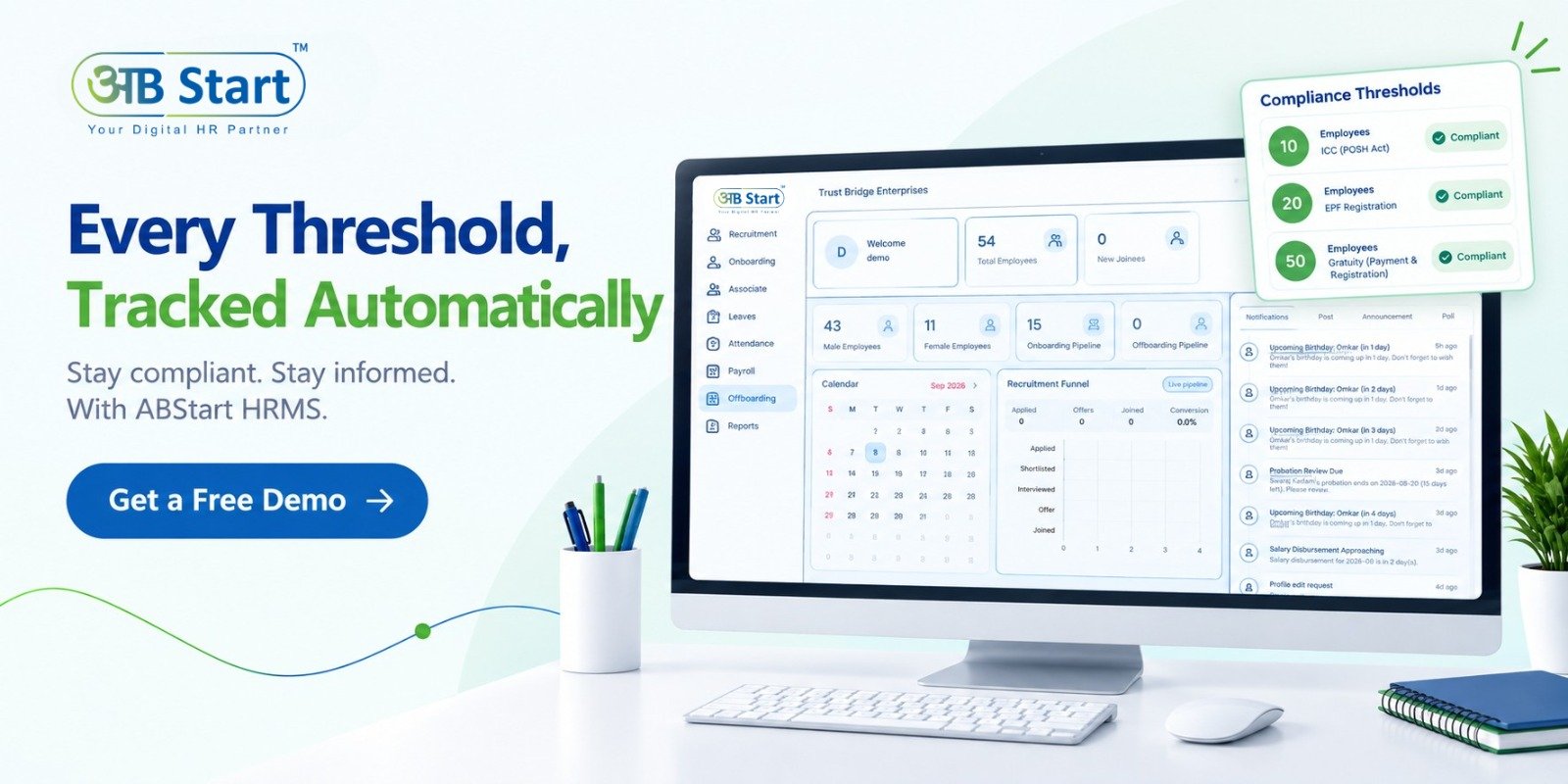
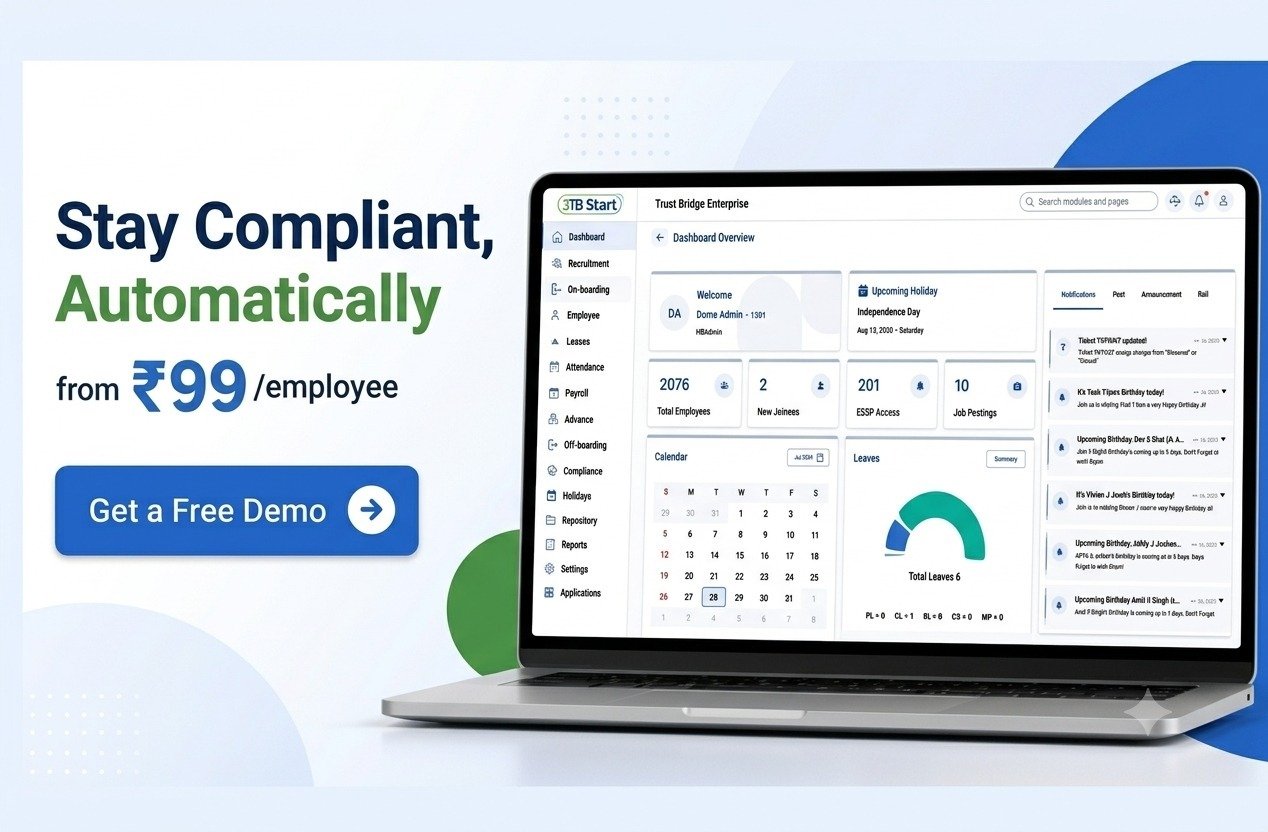
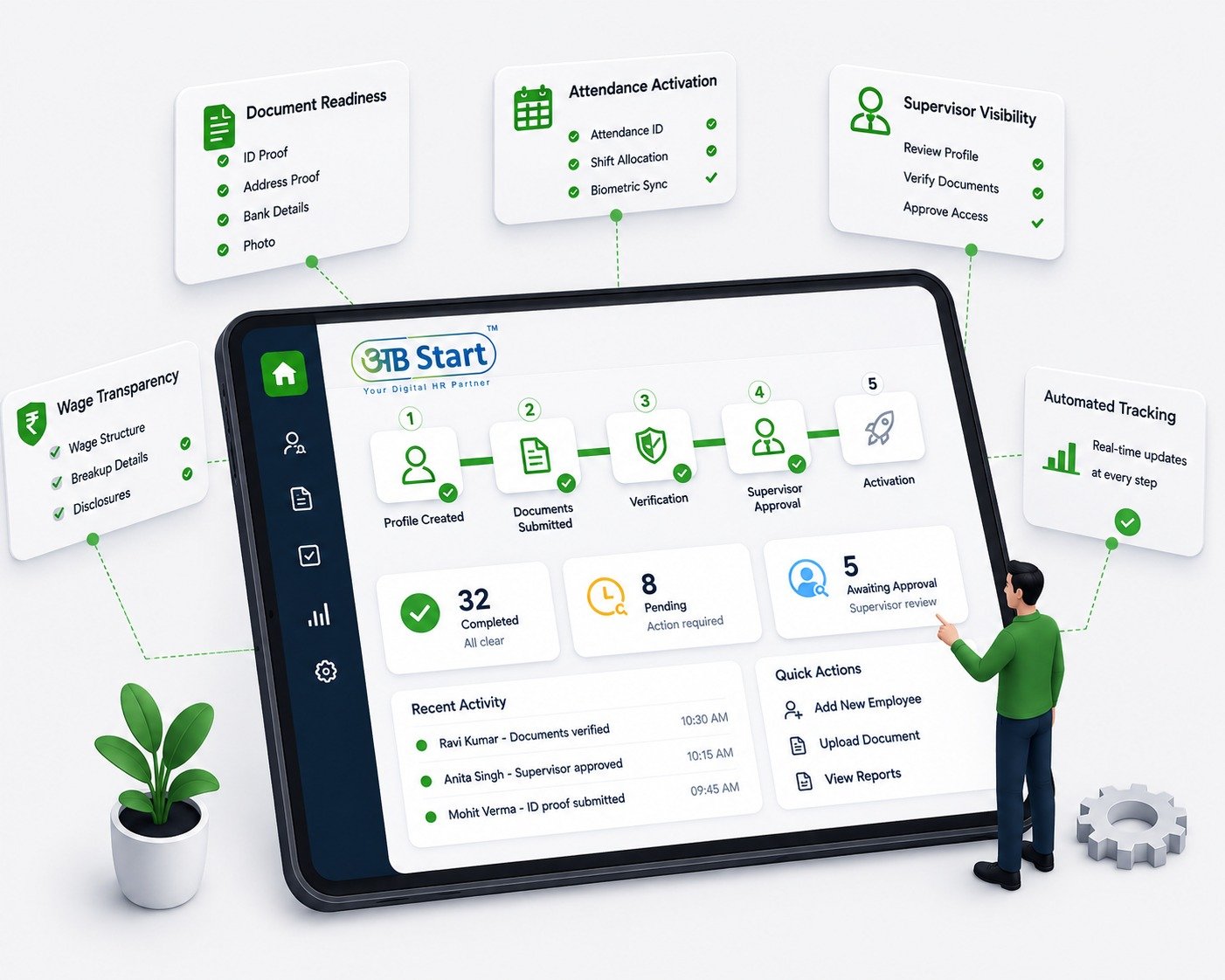
Aligning your payroll and contracts with these four codes is a massive manual undertaking. This is exactly why we built ABStart, a product-led, end-to-end HRMS specifically targeted to HR managers and founders to automate 2026 Labour Code compliance from day 1.

Labour Code Basics: What HR Professionals Need to Understand

To prepare effectively, first understand what’s changed at the law level.

Four Labour Codes Now in Force (Nov 21, 2025)
  •    1) Code on Wages, 2019
  •   2) Code on Social Security, 2020
  •   3) Occupational Safety, Health & Working Conditions Code, 2020
  •  4) Industrial Relations Code, 2020

These codes replace old laws such as the Minimum Wages Act, ESI Act, PF Act, Factories Act, and many more.

Fact Employers will still see old laws apply only until corresponding state-level rules under the new codes are notified and take effect. Most large states are in the final stage of notification as of early 2026.

Immediate Compliance Actions (Next 0–3 Months)

These are some of the few basic items every HR team must do to stay compliant in FY 2026–27:

  1. 1) Update Contracts & Appointment Letters

It has become necessary for HR teams to provide appointment letters to all workers (full-time, part-time, contract, gig platform, and even informal).

At the same time, workers must be given a compliant employment letter that includes:

  •   i) Wage structure (basic pay, allowances),
  •   ii) Employment category (permanent, fixed-term, gig, etc.),
  •   iii)Social security entitlements.

If stored securely, digital and scanned copies are also acceptable.

  1. 2) Review Wage Structures & Payroll

At least 50% of total remuneration must be defined as ‘wage’ (basic + dearness allowance + specified allowances). It’s something clearly highlighted under the updated Code on Wages.

This has a huge payroll impact:

  •    i) This uniform wage definition sets the standard for PF, gratuity, bonus, and leave encashment calculations.
  •    ii) Overtime must be paid at double the normal rate beyond standard hours.


Manually recalculating the 50% wage rule is prone to error. ABStart’s payroll engine automatically flags non-compliant salary structures and suggests corrections to meet the Code on Wages standards.

  1. 3) Document Working Hours & Overtime Policies

The new rules will provide workers all sorts of freedom and flexibility. The guidelines allow:

  •    i) Flexible daily hours: 8–12 hours,
  •    ii) Total work capped at 48 hours/week,
  •    iii) Mandatory overtime at double the hourly wage.


Being an employer, your role will include the following:

  •    i) Update internal policies and communicate clearly to workers;
  •    ii) Attendance and overtime records must be maintained digitally.
Mid-Term Actions (3–6 Months)

Naturally, you will prefer to embed compliance into HR & operations for transparency. How is that possible? These strategic actions can be your call:

  1. 1) Train HR, Payroll & Legal Teams

The law reframes:

  •    i) What’s the definition of a worker? (Gig and platform workers are now explicitly covered),
  •    ii) Wages: How it’s defined
  •    iii) What constitutes PF and ESIC eligibility.

Understanding these changes isn’t easy for HR and finance teams. For that to happen, they need to undergo internal training, compliance workshops, or expert sessions.

  1. 2) Digitise Records & Create a Compliance Repository

The codes encourage digital record-keeping, web-based inspections, and risk-based compliance checks.

Therefore, your tech stack should support:

  •    i) Appointment letters & contracts archive,
  •    ii) Payroll and wages data,
  •    iii) Working hours and overtime logs,
  •    iv) Gratuity and statutory calculations.


When this happens, inspections become easier, and audit risk is also fairly reduced.

  1. 3) Revise Policies for Safety, Welfare & Leave

The Occupational Safety, Health, and Working Conditions Code adds:

  •    i) Annual free health check-ups for workers aged 40+ (or defined categories),
  •    ii) Safety standards across sectors,
  •    iii) Updated leave entitlements (e.g., paid leave after 180 days of service).


Your job will be to:

  •    i) Update your internal safety and welfare policies accordingly;
  •    ii) Supervisors must be trained on record-keeping and compliance


  1. 4) Assess Fixed-Term Worker Benefits

Fixed-term employees can now reap the benefits of gratuity after 1 year of service. Previously, the scenario was different. At that time, the time period was 5 years.

This raises long-term costs in project-based workforces. So, you have to update workforce planning and accrual systems to forecast liabilities.

Ongoing & Long-Term Checklist

Labour compliance is a continuous process. Hence, HR professionals need to focus on certain aspects. What are they? Let’s have a look:

  1. 1) Monitor State Rule Notifications

Though national codes took effect in Nov 2025, it doesn’t guarantee that state-specific rules will be the same. Hence, it’s essential on their part to conduct these activities:

  •    i) Subscribe to the official gazette;
  •    ii) Engage with local legal advisors;
  •    iii) When new rules are published, compliance checklists must be updated.


  1. 2) Audit HR & Payroll Quarterly

Internal or third-party audits are beneficial since they enable you to catch errors early and reduce penalties. Consider these aspects:

  •    i) Payroll accuracy,
  •    ii) Contract compliance,
  •    iii) Social security coverage,
  •    iv) Working hours enforcement.
 

  1. 3) Communicate Changes to Employees

More often, this is overlooked but vital. There must be a clear employee communication plan that unfolds the intricacies relating to:

  •    i) New wage structures,
  •    ii) Overtime rules,
  •    iii) Health & safety measures,
  •    iv) PF/ESIC updates.
Special Focus Areas for HR
  1. 1) Gig, Platform & Informal Workers

The Code on Social Security formally recognizes and considers the interests of these worker categories. Unlike the previous law, this guideline brings them under statutory welfare schemes. The tasks on your part will be to:

  •    i) Identify such workers in your firm;
  •    ii) Document their contracts and contributions;
  •    iii) Ensure social security is enabled.


  1. 2) Industrial Relations & Dispute Handling

As the name suggests, industrial relations are governed by the Industrial Relations Code. It redefines strike notice periods, recognition of unions, and dispute mechanisms. This pushes for modern, facilitated dialogues rather than adversarial engagements. For aligning with this code, you have to:

  •    i) Review grievance redressal processes;
  •    ii) Align policies with new IR dispute timelines.


  1. 3) Gender & Work-Life Policies

Another area the code emphasizes is that the pay structure will be the same for equal work. It also allows women to work in night shifts with safety measures. So, these are some of the actions needed:

  •    i) Update gender policies;
  •    ii) Focus on consent and safety protocols.
Final Thoughts

Whatever the size of your business, you can’t bypass the latest labour laws. If you do, be ready to pay a penalty for it in the long run. This way, you can safeguard the rights of your employees while staying compliant with the legal protocols. Risks will also be mitigated significantly, and more importantly, you can promote a positive work environment.
Apart from these, if you adhere to these regulations, there are fewer chances of administrative errors and any sort of disputes. It goes a long way since the HR teams can concentrate more on strategic initiatives like talent development and workforce planning.

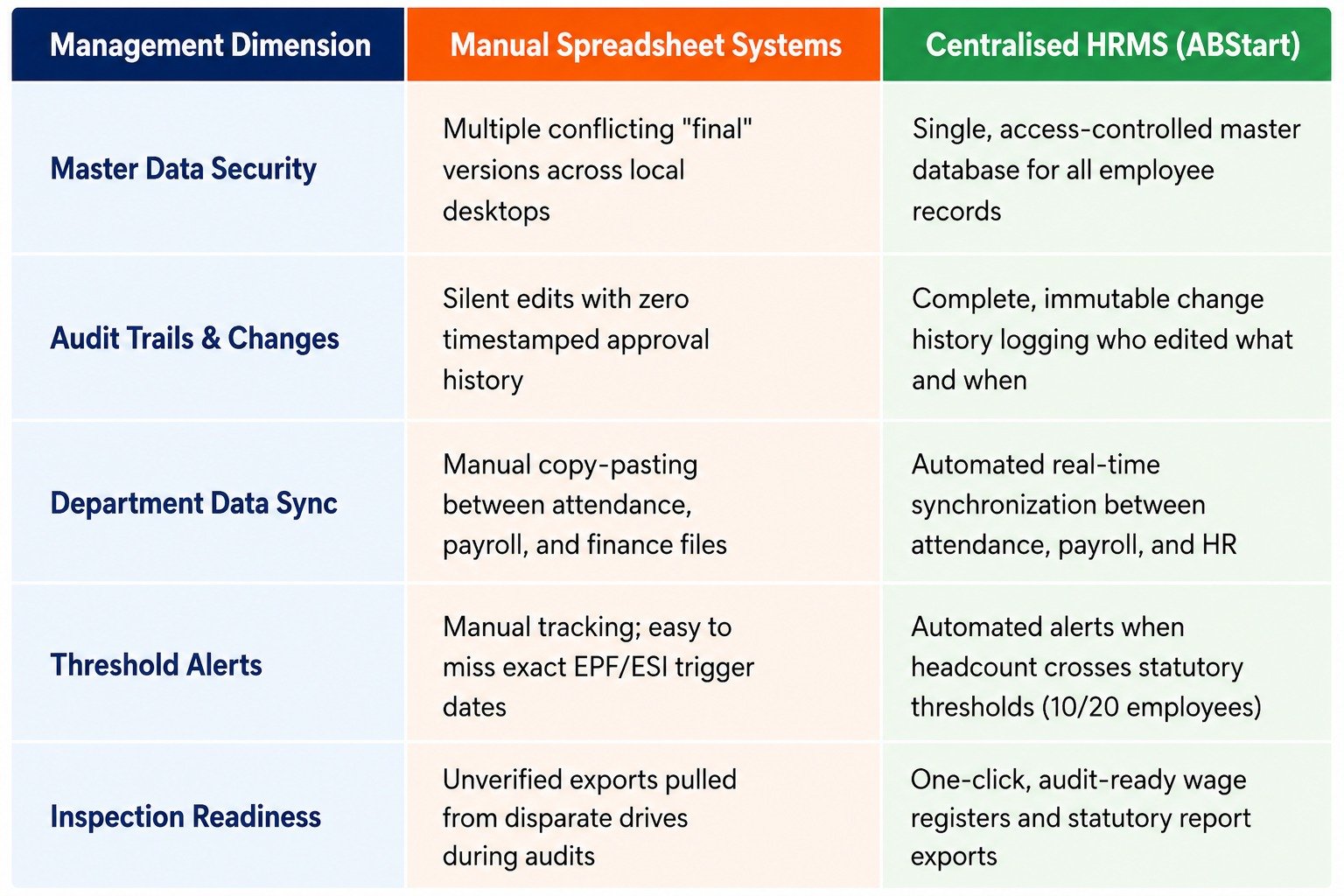
The 2026 Labour Codes are too complex for spreadsheets and basic HR tools. As you transition into the new Financial Year, you need a partner that scales with you. ABStart will help Indian SMEs manage this transition with no employee capping and end-to-end automation. Stop worrying about penalties and start focusing on growth.

One Size Fits None: Why your Company needs a truly customizable HRMS

The growth of a company depends on several factors. From expanding the areas of operation to increasing headcount, everything contributes to the change of pace. However, along with these, you have to weigh in the importance of having a customisable HRMS for startups. Most solutions come with features that limit their capabilities as your business scales. As a result, you will remain on the end of a paywall that can increase your expenditure.

Take a look at why your firm needs a truly customizable HRMS tool and how it will affect your day-to-day operations.

What are the Issues with Rigid HR Systems?

Most HR tools are designed with a fixed structure. The tools work under the assumption that all companies follow the same structure. However, in reality, employee structures, growth patterns, and management vary from company to company. While a startup may begin with a tool that offers simple features for attendance and payroll management, its needs might change later. In such situations, a company may face certain issues such as:

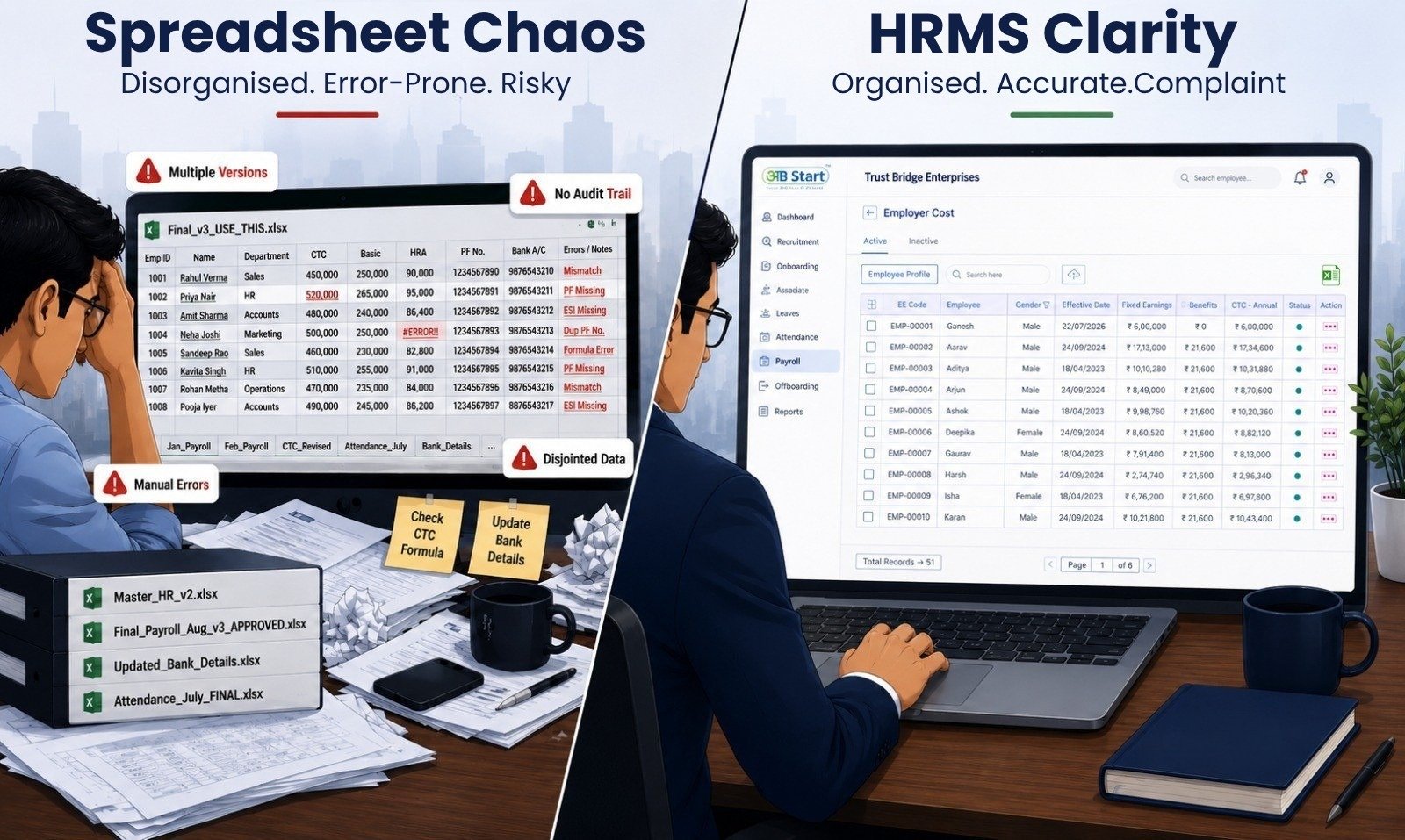
  • 1) Disorganized HR data spread across spreadsheets and payroll vendors.
  • 2) The payroll process is breaking due to manual adjustments or arrears.
  • 3) Managers affected by handling approvals from fragmented systems.
  • 4) Pricing models that do not evolve with the employee growth of the business.


With this fragmentation in focus, your business may be affected by unnecessary operational friction that can limit growth. Your HR team will spend more time managing systems than doing their work.

How Customizable HRMS Works for Startups and Growing Businesses?

If you own a startup or a small to medium-sized business, you may not need a complex HR system from day one. However, when your team grows, you need to ensure that your HRMS solution can grow with you. Here’s where you understand the importance of scalable HR solutions for mid-sized firms.

With a flexible HRMS tool, you can configure your workflows according to your internal approval structures. From leave requests to employee updates, your HR tool can follow different approval layers according to your needs. It should also manage bulk assignment of leaves, shift changes and other complex operations. When your tool evolves with the available HR infrastructure, it can stay stable while your company grows.

The Role of Integrated HRMS and Payroll System for Business Operations

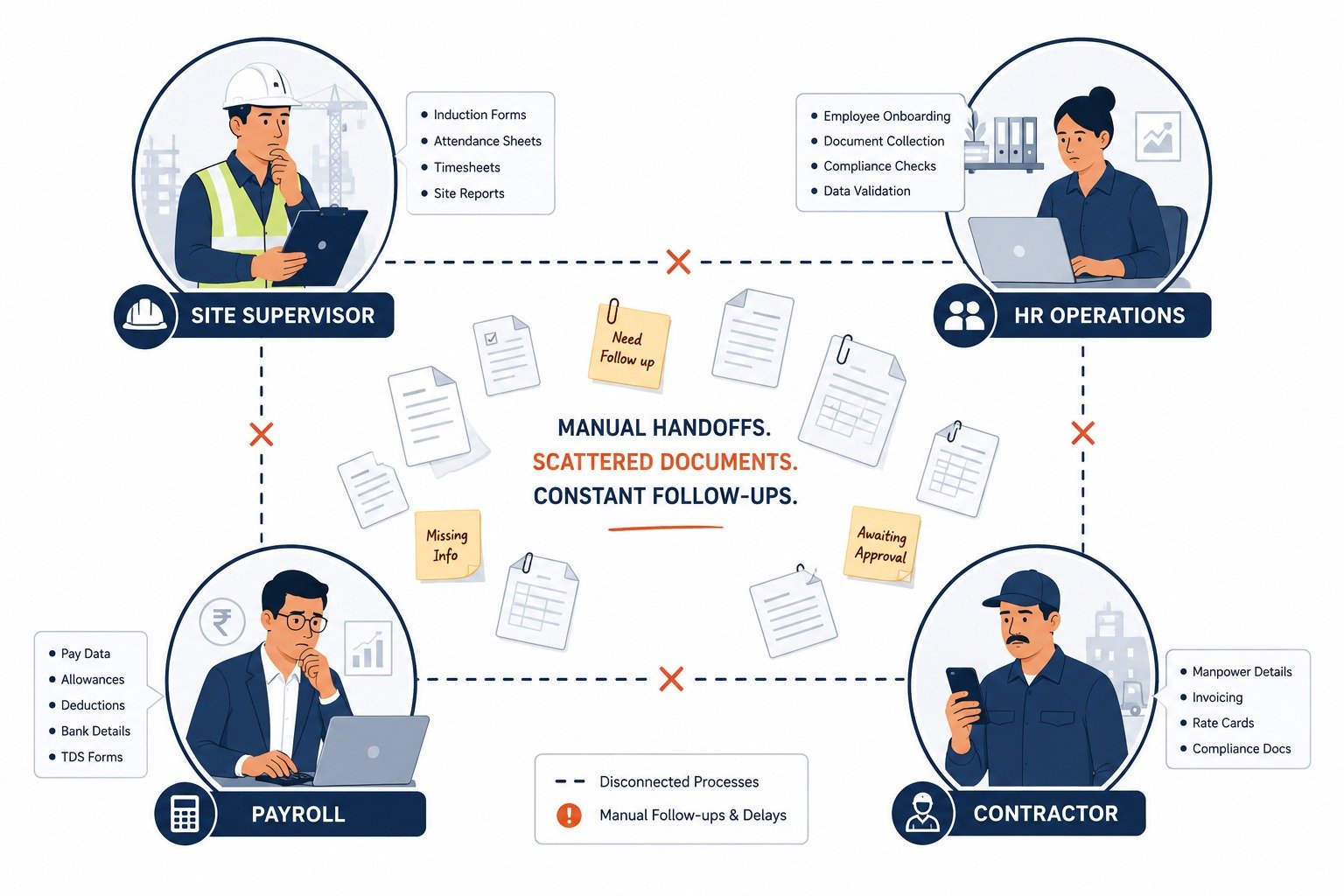
Disconnected HR tools can kill productivity and bring in roadblocks in your HR team’s operations. With an all-in-one HR and payroll software, you can consolidate all the operations into a single platform. It will connect employee data management, attendance tracking, and payroll processing together, so that your HR professionals do not work with multiple tools for data processing.

Along with simplifying HR operations, a complete HR tool can adjust all the compliance-related factors. It eliminates the need for manual coordination in every step of your HR team’s operations. You can align the tool with the recent Labour regulations and codes of your country, which can help your company remain compliant with the statutory requirements.

How ABStart Fits Your Requirement for a Scalable HR Software?

Most popular HRMS tools have employee capping, which can be quite expensive for small to medium-sized businesses to sustain. While choosing a solution, you can look for ABStart, an end-to-end HRMS in India that addresses the common challenges. You can start with our software with a very small workforce. Instead of forcing offices to meet minimum employee requirements, we offer a scalable solution. This helps it operate without the need to migrate to another system.

Our software can handle all the HR management tasks, including payroll management, attendance checking, and leave approval. You can perform all tasks more reliably without needing to cross-check everything. Your managers can also have access to the tool, which can standardize the process without adding to the administrative workload. Our tool grows with your company, gradually introducing more structured processes as your company paces forward.

Final Thoughts

While a rigid HRMS tool may seem like a solution in the first stage, it will gradually showcase problems. To outgrow these issues, you need a proper HRMS solution. Here’s where ABStart comes through. Our customizable HRMS solution ensures your HR infrastructure evolves without the issue of costly migration or operational disruptions.


Frequently Asked Questions
  1. 1) What is the Ideal HRMS Software Price in India for Growing Businesses?

 The pricing of an HRMS software cannot be absolute. It will depend on various factors such as employee count, customization needs, and operation. To match all these criteria, businesses should look for HRMS software that scales without increasing price.

  1. 2) Why is Integrated HRMS and Payroll Important?

Integration of HRMS and payroll is important, as it ensures employee data, payroll, and compliance remain connected. This can reduce manual errors and administrative delays.

  1. 3) How Does a Scalable HRMS Help Mid-sized Companies?

A consolidated HR tech stack for SMEs supports bulk administrative actions and structured approvals. It also offers centralized reporting that supports the expansion of an organization.

New Indian Labour Codes reshaping Indian HR

New Labour Codes 2025 explained in the simplest way possible. Important for every HR professional…

Once got through it. 💬 Share it with your HR team

And if you need support navigating the transition, TalentCo HR Services is here to help ensure the shift happens smoothly with the least impact on your workforce.

11 payroll mistakes that cost companies time and money

Most salaries hit accounts next weekend.

But payroll? That’s where many companies slip : quietly, repeatedly, and expensively. From outdated bonus rules to underpaid gratuity and missed PF filings, payroll mistakes aren’t just technical errors.

We’ve compiled a sharp breakdown of the 11 payroll mistakes companies still make and how to fix them.

✔ If you’re in HR, treat it as a weekend checklist.
✔ If you’re an employee, learn what your payslip should include.
✔ If you’re a founder, send it to your finance head before month-end.

Why do some Manufacturing Enterprises run smoother than others?

Why do some Manufacturing Enterprises  run smoother than others?
Because as organizations scale, people don’t break, systems do…
We see it every day.

Across industries, companies reach out when efficiency slips in payroll, compliance, or systems, where HR processes should hold it together.


Supply chain delays today don’t just impact revenue, they disrupt sustainability, and business trust.

Supply chain delays today don’t just impact revenue, they disrupt sustainability goals, delivery commitments, and business trust.

As volatility grows from tariff changes to policy uncertainty, leaders everywhere are rethinking how resilient their operations truly are.

With two-thirds of CEOs now viewing supply chain realignment as an opportunity, India is uniquely positioned to lead but only if the on-ground workforce stays dependable.

That’s where TalentCo steps in.
For one global chemical manufacturer, we became an extension of their supply chain ensuring agility, compliance, and a workforce that scaled seamlessly with demand.

Top reasons why Mergers and Acquisitions test more than strategy. 

Mergers and acquisitions test more than strategy. They test people, culture, and alignment. In Pharma, integration is as critical as innovation.

What happens when a legacy company, a global investor, and a growth mandate come together? The story that followed became one of India’s most remarkable transformations.

We were part of that journey.

#1 Reason Supply Chains Break

Does your Supply Chain Manager or HR head know the #1 reason supply chains break?

It’s missing workforce.
One planner. One shift lead or logistics coordinator. That’s all it takes to disrupt the entire flow. If your teams are stretched, inconsistent, or constantly firefighting… this is your early sign.

DM us to see how we manage end-to-end supply chain teams for emerging quick commerce brands.

Labour Codes 2025 for Employers

Employers, the 2025 Labour Codes come with meaningful updates you’ll want to understand and not rush.

While we all wait for the final central and state instructions, this is the window to get your audits, records, payroll mapping and internal taskforce in place.

Read the fine print before making any policy moves. And if you’re the one managing HR for your teams, and want a clear 30-day readiness plan, DM us we can guide you through it responsibly and without disruption.


Streamline HR Operations

Discover how TalentCo can help reduce HR costs, ensure compliance, and build efficiency across your workforce.

Primary HR Need(s)

We respect your privacy. Your details will only be used to connect you with relevant HR solutions. No Spam ever.