

TalentCo HR Services LLP

What Is the Standard 30-60-90-Day Onboarding Checklist for SMEs?

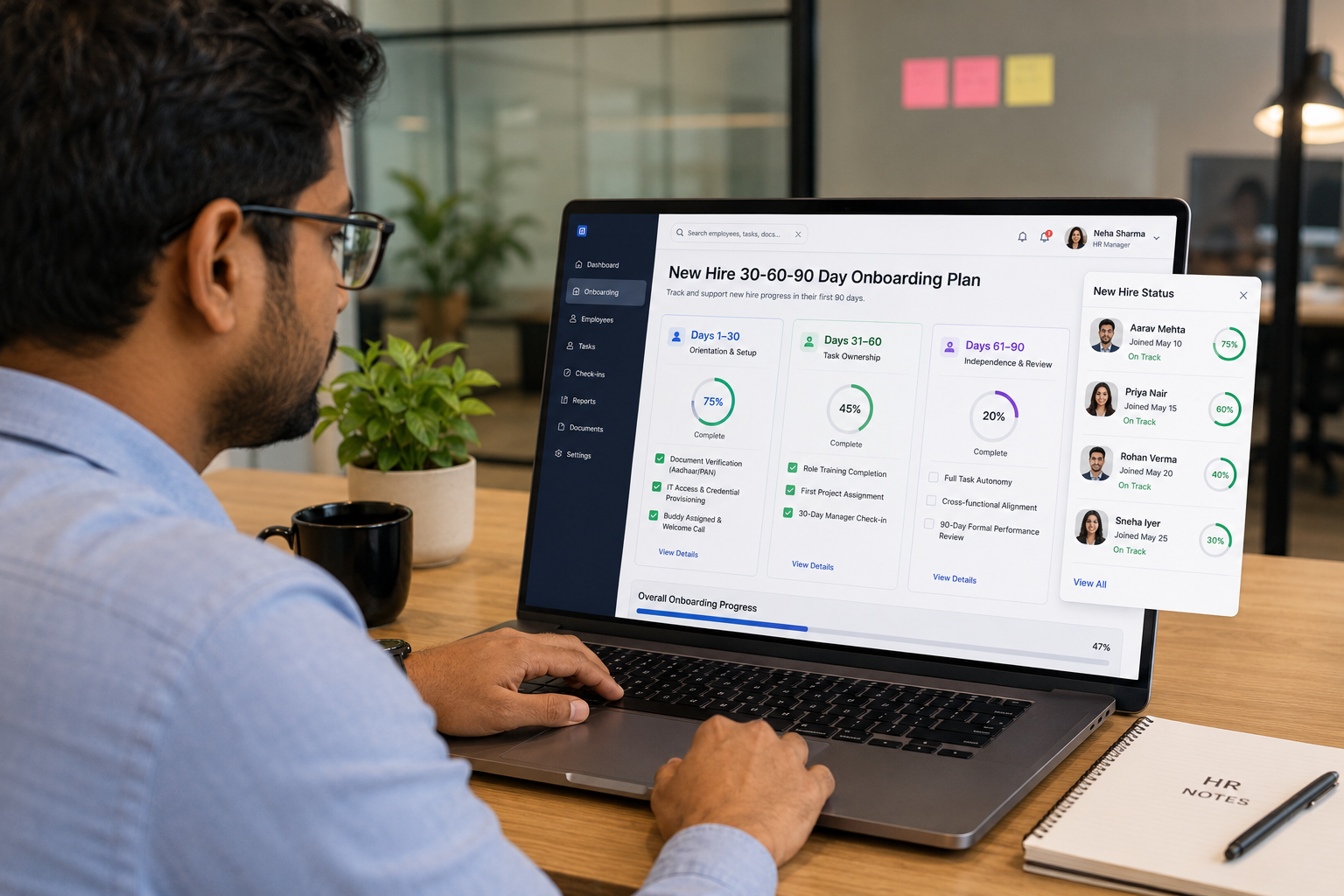
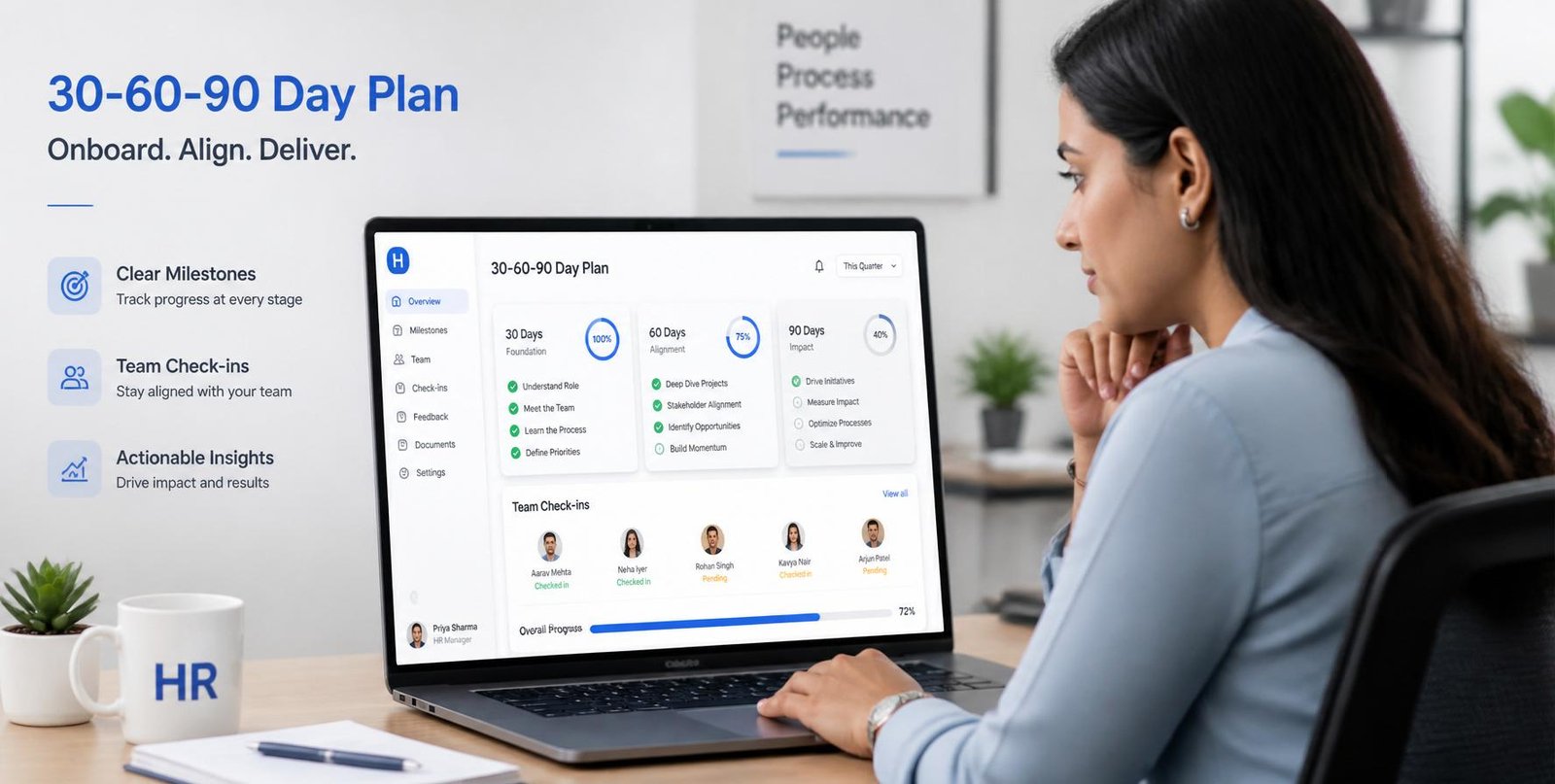
A 30-60-90-day checklist breaks onboarding into three distinct stages: orientation, application, and review. It provides new hires with clear expectations at each milestone while giving managers fixed checkpoints instead of guessing who is on track. This structured approach works exceptionally well for small and mid-sized enterprises (SMEs) in India because it requires no dedicated onboarding team—just one consistent, repeatable framework followed for every hire.

Onboarding at growing businesses often falls to whichever team member has available bandwidth that week. This leads to inconsistent instructions, missed compliance steps, and unclear performance expectations. Implementing a structured 30-60-90-day onboarding plan resolves these operational gaps without adding administrative overhead, giving both full-time employees and contract workers the clarity needed to succeed.

Why Does a 30-60-90-Day Onboarding Plan Matter?

Dividing the first 90 days into three structured phases provides new team members with predictable milestones rather than open-ended goals. Employees clearly understand what ‘settled in’ and ‘fully independent’ actually mean in practice. Managers gain natural checkpoints to evaluate progress instead of waiting until performance issues arise. For SMEs without a dedicated HR department, leverage simple onboarding software combined with this template to replace guesswork with a repeatable process.

1. Removes ambiguity regarding what strong progress looks like at each stage.

2. Establishes fixed manager check-ins rather than relying on memory or informal follow-ups.

3. Delivers a consistent experience across every new hire, regardless of department or manager.

4. Reduces early turnover caused by unclear expectations in the first few weeks.

“The biggest hidden tax in a growing SME isn’t overhead—it’s early turnover. When a new hire leaves in their first 90 days, you haven’t just lost salary in rupees; you’ve burned leadership energy and team momentum. A clear 30-60-90 day structure turns early uncertainty into long-term retention.”

— Rahul Dhamdere, Co-Founder, ABStart HRMS

What Should the First 30 Days of Onboarding Include?

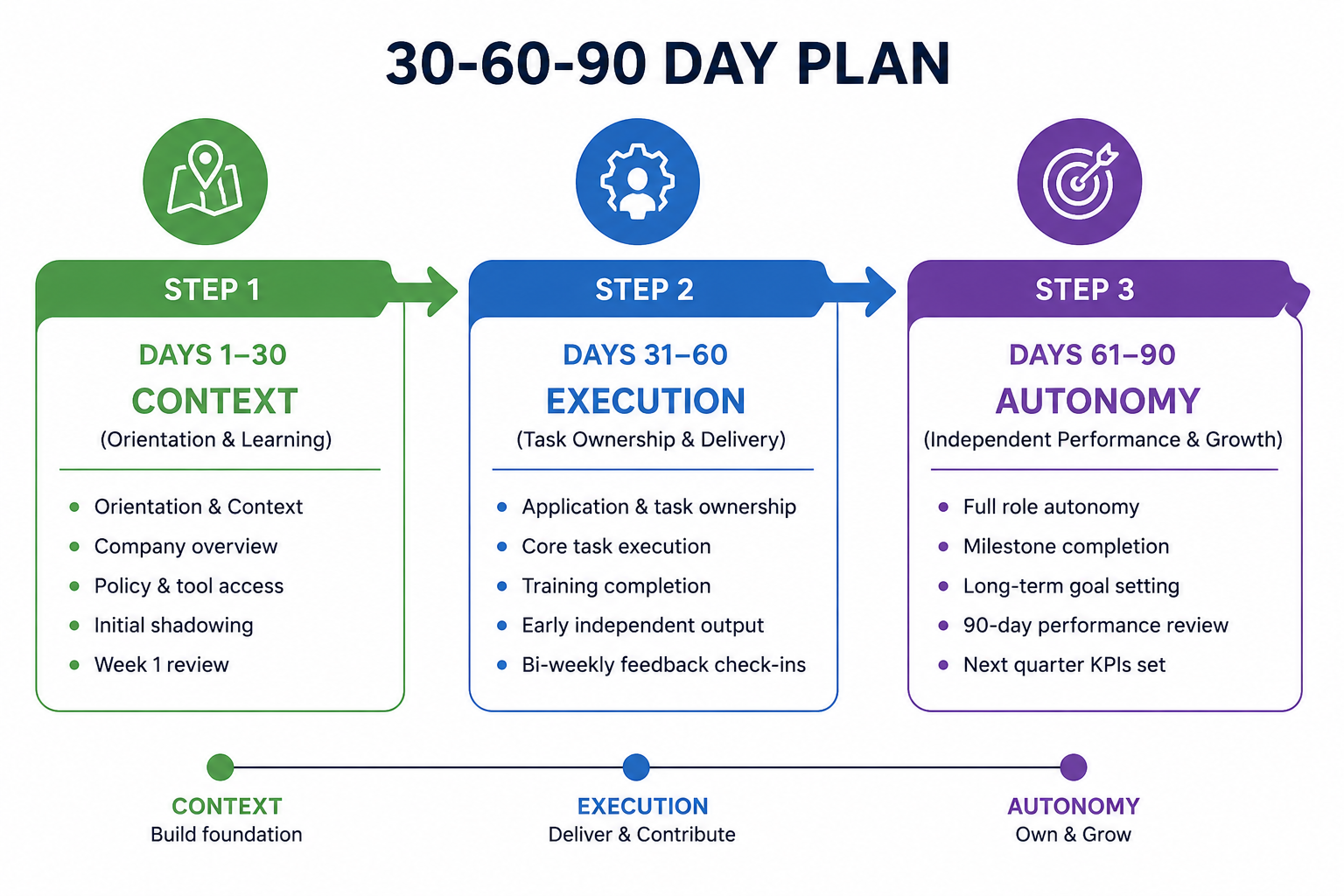
The first 30 days must focus on orientation and context rather than immediate output. New hires need to understand company culture, role structure, and essential software tools. Expecting full productivity during this initial window often backfires, as it skips the operational foundation an employee requires to perform effectively later.

1. Company overview: Mission, organizational structure, and how their role directly contributes to business objectives.

2. Policies and processes: Leave policies, code of conduct, reporting hierarchies, and statutory compliance details.

3. Tool and software access: Email IDs, communication platforms, and role-specific software logins.

4. Role expectations: A clear breakdown of primary responsibilities and key performance metrics.

5. First assignment or shadowing: A low-stakes initial project or shadowing period to build operational familiarity before taking full ownership.

What Should Days 31–60 of Onboarding Focus On?

Days 31 to 60 mark the transition from learning to execution. Employees begin taking ownership of core tasks with regular managerial feedback to correct course early. This phase naturally highlights skill gaps, allowing managers to address training needs before they develop into larger performance obstacles.

1. Core task ownership: Assigning direct responsibility for core duties rather than observational tasks.

2. Training completion: Finalizing role-specific or compliance training initiated during month one.

3. Feedback check-ins: Conducting brief, scheduled check-ins to resolve operational roadblocks promptly.

4. Gradual independence: Reducing daily supervision as employee confidence and technical competence grow.

What Should Days 61–90 of Onboarding Include?

By days 61 to 90, the employee should operate with full autonomy. This final stage centers on formal performance evaluation—comparing actual contributions against initial benchmarks established during the first 30 days and agreeing on future development goals.

1. Autonomous execution: Full accountability for core responsibilities with minimal daily supervision.

2. Performance review discussions: Structured conversations evaluating delivered outcomes against initial expectations.

3. Quarterly progress checks: Reviewing overall growth across the entire 90-day window rather than recent weeks alone.

4. Next-stage planning: Establishing clear targets for the upcoming quarter so onboarding transitions smoothly into regular performance management.


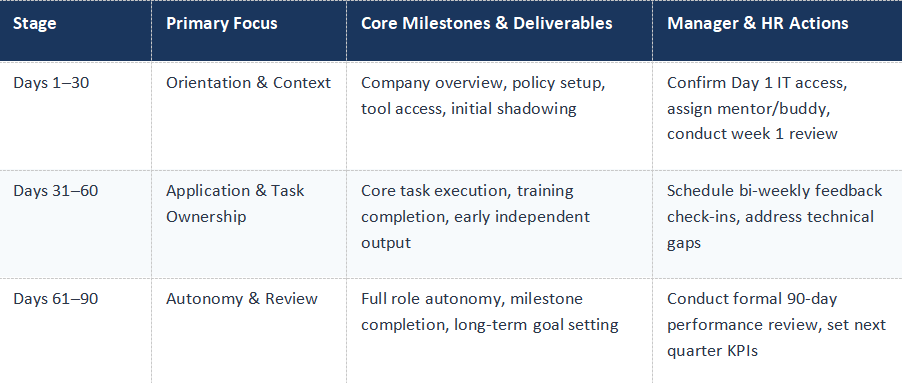
Table 1: The Master 30-60-90 Day Full-Time Employee Onboarding Framework

What Does a 30-60-90-Day Onboarding Checklist Look Like for Contract Workers?

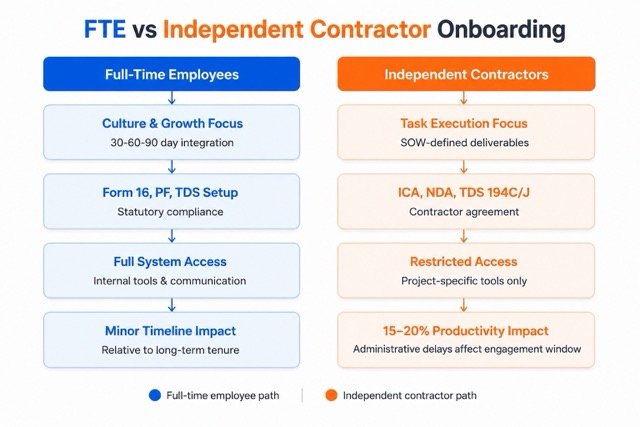
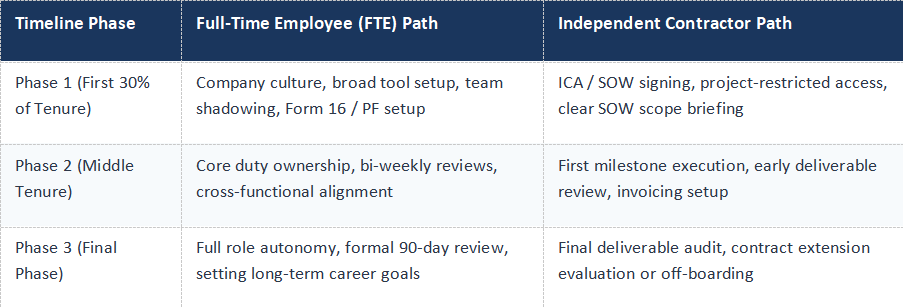
Contract workers follow a similar three-phase progression, but compressed and refocused. Long-term cultural immersion matters less, whereas explicit scope clarity, fast system provisioning, and early milestone delivery matter significantly more.

Table 2: 30-60-90 Day Adaptation (Full-Time Employees vs. Independent Contractors)

Who Owns What in Onboarding: HR, Manager, IT, and Peer Buddy?

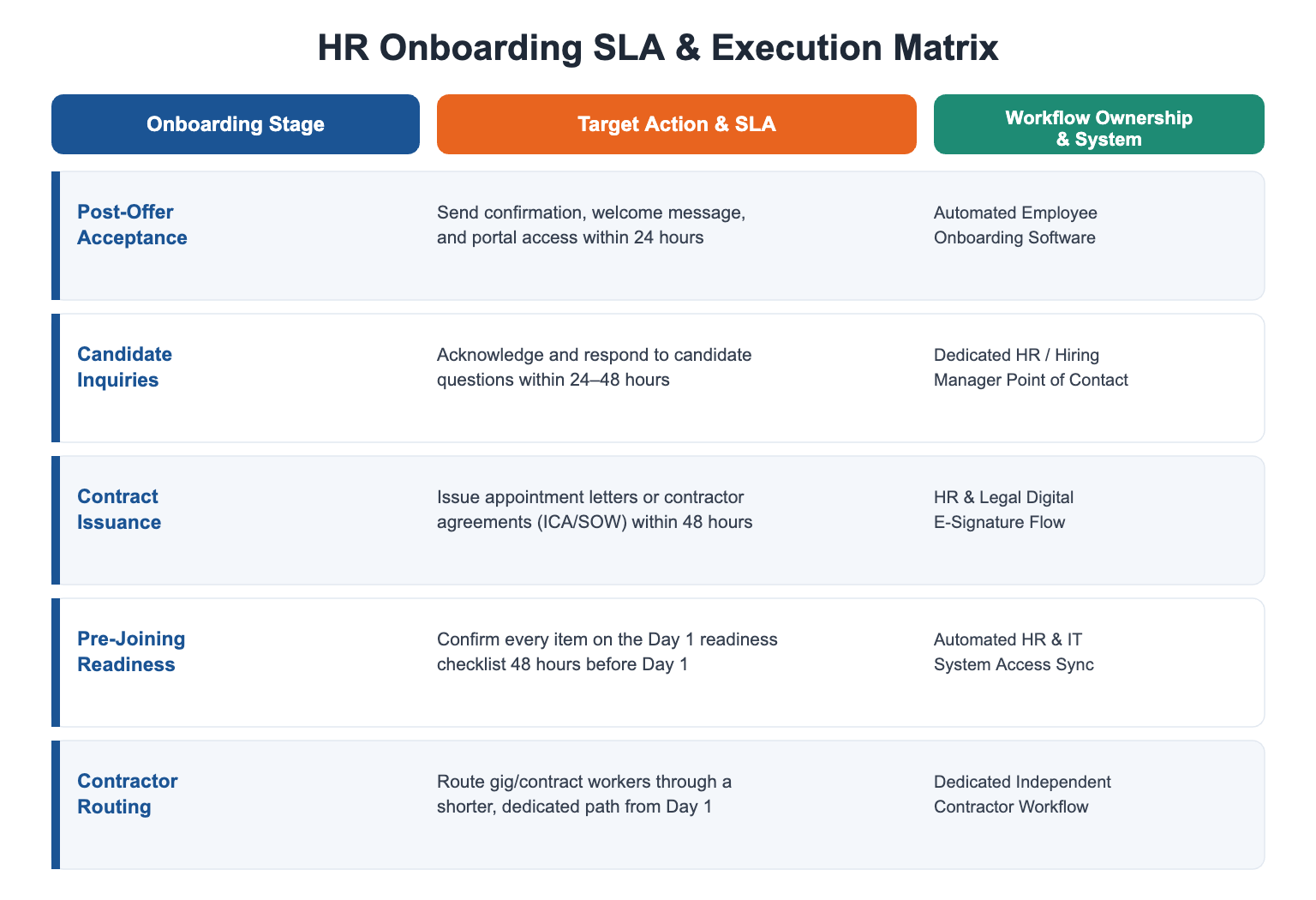
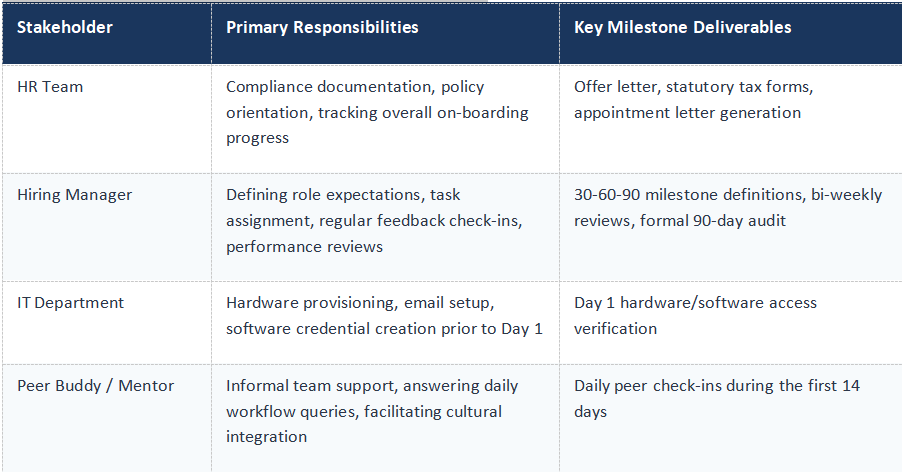
Onboarding workflows break down most frequently due to ambiguous ownership. Defining distinct, non-overlapping responsibilities across key stakeholders ensures critical tasks are never missed.

Table 3: Onboarding Ownership & Accountability Matrix

How Can SMEs Keep Onboarding Simple with Software?

SMEs do not require overly complex enterprise systems to execute onboarding effectively—they require consistency. Adopting a single, standardized framework combined with modern employee onboarding software eliminates operational confusion and ensures seamless execution.

1. Standardize the workflow: Utilize one consistent 30-60-90 checklist template for every hire across full-time and contract roles.

2. Assign clear ownership: Confirm stakeholder accountability for every task prior to the candidate’s start date.

3. Automate administrative tracking: Leverage employee onboarding software to send automated reminders, collect digital signatures, and track milestone completion.

4. Maintain visibility: Ensure progress checklists remain accessible to both the new hire and their manager in a shared portal.

Standardize Your SME Onboarding Today

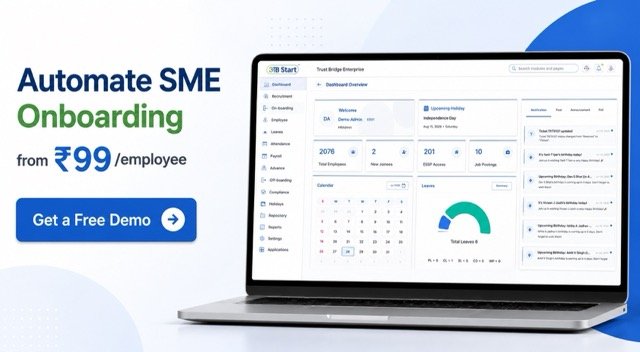
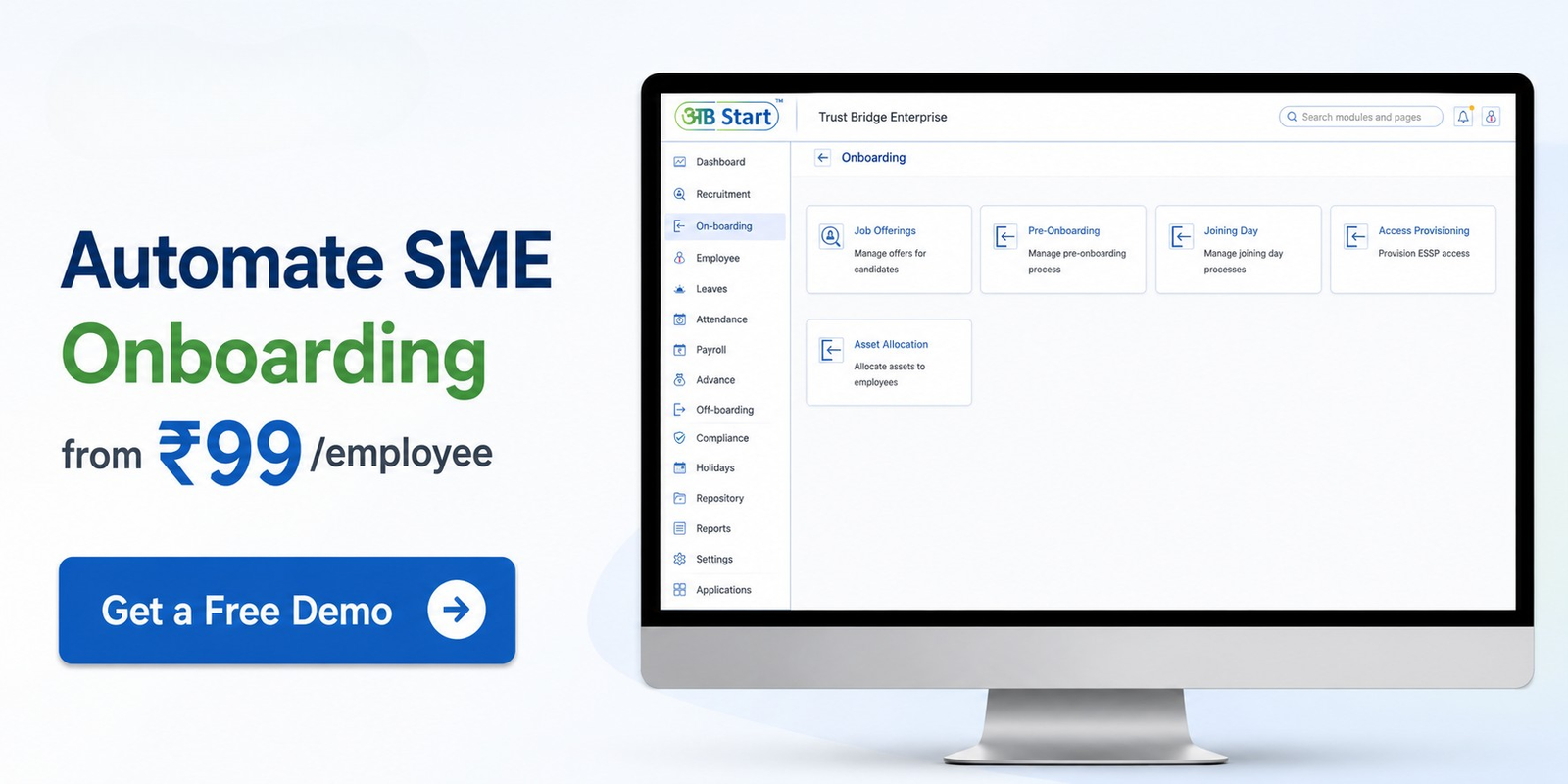
Eliminate guesswork and early attrition with structured onboarding workflows. Experience how ABStart HRMS simplifies 30-60-90 day milestone tracking, automates compliance paperwork, and empowers growing teams starting at just ₹99/employee.

Get a Free Custom Demo of ABStart HRMS

Sources & Benchmark Compliance References:

1. TalentCo HR Master Context & Strategy Primer — ABStart HRMS Dataset (Entry pricing ₹99/employee; 30-60-90 retention framework).

2. Onboarding Intelligence & Turnover Dataset — Early turnover metrics (20%-22% in first 45 days, 30%+ in 90 days; replacing costs 90%-200% of annual salary in ₹).

3. Indian Statutory Tax Guidelines — Section 194C/194J vs. Form 16 / Provident Fund compliance rules.

TalentCo HR Services LLP is an HR consulting and solutions company offering services across HR operations, compliance, liasoning, payroll management, and HR technology through its proprietary platform ABStart. This article is intended for general informational and educational purposes only. Labour laws, tax regulations, and compliance requirements are subject to change based on government notifications and jurisdictional updates. Readers are advised to independently verify current regulations or consult qualified professionals before making any business or financial decisions.

Can You File Your ITR Without Form 16? Deadlines, Costs and the Regime Question for AY 2026-27

Yes — you can file your ITR without Form 16, using salary slips, Form 26AS and AIS. The deadline for AY 2026-27 is 31 July 2026 for salaried individuals and non-audit businesses, 31 October 2026 for audit cases, and filing late costs up to ₹5,000 plus 1% interest per month.

There are plenty of ITR guides online that restate the rules. This one is written from the other side of the table — 30 years of running payroll and TDS for Indian businesses, watching exactly where employees and employers get tripped up every July. It covers what most guides skip: what to do when Form 16 hasn’t arrived, which tax regime you are actually filing under, and what a delay really costs in rupees.

Who actually needs to file an ITR for AY 2026-27?

Not everyone. Filing is mandatory if your total income exceeds the basic exemption limit — ₹4 lakh under the new tax regime for FY 2025-26 (₹2.5 lakh under the old regime). It is also mandatory in specific situations regardless of income: if you hold foreign assets, have deposited large amounts in current accounts, spent above thresholds on foreign travel or electricity, or if TDS has been deducted and you want it back. That last one matters — if any tax was deducted from your salary or bank interest, filing is the only way to claim the refund.


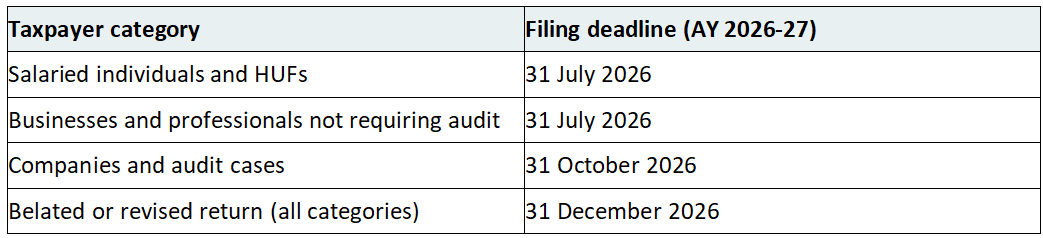
What are the ITR filing deadlines for AY 2026-27?

These are statutory dates. Extensions are sometimes announced, but planning around a hoped-for extension is how returns end up belated

Old or new tax regime — which one are you filing under?

This is the decision most AY 2026-27 guides skip, and it changes everything else. The new regime is now the default — you are taxed under it unless you actively opt out while filing. Under the new regime, the basic exemption is ₹4 lakh, the Section 87A rebate makes income up to ₹12 lakh effectively tax-free, and salaried taxpayers get a ₹75,000 standard deduction.

The trade-off: the deductions taxpayers spent years planning around — Section 80C (PPF, ELSS, life insurance), 80D (health insurance premiums), 80E (education loan interest), and HRA — are not available under the new regime. If your combined deductions are large, the old regime may still save you more; salaried taxpayers can choose afresh each year. Run the comparison before you file, not after.


What if you don’t have your Form 16 yet?

Employers were required to issue Form 16 for FY 2025-26 by 15 June 2026 — the law backs this with a penalty of ₹100 per day, per certificate, under Section 272A(2)(g). If yours is late, it usually means a TDS reconciliation issue on the employer’s side: Part A of Form 16 can only be generated from the TRACES portal after all four quarterly TDS returns (Form 24Q) are filed and matched, and a single PAN or challan error can stall it.

Here is what most people don’t realise: Form 16 is a convenience, not a legal requirement for filing. Everything in it exists elsewhere. If it hasn’t arrived:

1. Ask HR or payroll — it is often a reconciliation delay, not negligence.

2. Pull your Form 26AS from the income tax portal — it shows every rupee of TDS recorded against your PAN and serves as proof of tax deducted.

3. Check your AIS for salary, interest and dividend data.

4. File from source documents — salary slips, 26AS, AIS and bank statements, entering TDS details manually on the portal. It takes longer, but it works. Form 16 is never uploaded with your return in any case.

How do you reconcile Form 16, Form 26AS and AIS before filing?

Form 16 is the TDS certificate from your employer — your salary and the exact tax deducted from it. Form 26AS is the department’s ledger of tax credits against your PAN from all sources — salary, banks, and others. AIS is the department’s wider record of your financial activity: interest, dividends, securities transactions, high-value spends.

The three should tell one story. Mismatches between what you declare and what the department already holds are the single most common trigger for intimations under Section 143(1) — and for held-up refunds. Ten minutes of cross-checking before submission prevents months of correspondence after it.


What does late filing actually cost?

Three things, and they stack. A late filing fee of ₹5,000 under Section 234F (₹1,000 if total income is under ₹5 lakh). Interest at 1% per month on unpaid tax under Section 234A — and a part of a month counts as a full month, so one day late costs a month’s interest. And the quiet one: a belated return forfeits your right to carry forward capital losses from shares or mutual funds (loss from house property is the only exception). For businesses, carried-forward business losses are lost the same way.

What are the rules for belated, revised and updated returns?

Missed 31 July? You can file a belated return until 31 December 2026 — with the late fee and interest above. Spotted an error after filing? A revised return can be filed until the same date, 31 December 2026.

And even that is not the end of the road. The Updated Return (ITR-U) allows filing up to 48 months after the end of the assessment year, with graded additional tax of 25% to 70% depending on how late you are. It is an expensive route — but “the window has closed forever” is a myth.

Which records should you keep as an individual?

1. Salary slips — they validate every income component, and they are your filing source if Form 16 is delayed.

2. Bank statements — interest income shows up in AIS whether you report it or not; report it first.

3. Deduction proofs — insurance premiums, PPF passbooks, ELSS statements, loan interest certificates. Relevant only if you opt for the old regime, but keep them until you have run the regime comparison.

4. TDS certificates from banks and other deductors (Form 16A).

How does the Income Tax Department verify your income?

Returns are matched automatically against AIS and 26AS. The system flags gaps between declared income and recorded transactions — that flag becomes a 143(1) intimation, not a conversation. The practical defence is boring and effective: review your AIS before filing and make sure every income source it shows appears in your return.

For businesses: how does the audit requirement affect your filing?

Businesses above the prescribed turnover thresholds must have their accounts audited by a Chartered Accountant, which is why audit cases get the 31 October deadline. The return rests on the audit; the audit rests on the books. Keep profit and loss statements, balance sheets and the audit report ready — clean documentation is the difference between a routine scrutiny and a painful one. Professionals and freelancers filing business income can deduct legitimate professional expenses, but the substantiation standard is the same: documented, business-purpose, defensible.


Where does payroll fit into all of this?

Almost every employee-side problem in this article traces back to one employer-side system. When payroll data is clean every month, TDS is deposited on time, the quarterly 24Q returns match, Form 16 generates from TRACES without a fight and reaches employees by 15 June, and each employee’s 26AS mirrors their Form 16. No chasing, no mismatches, no 143(1) letters. When payroll runs on spreadsheets, the same chain breaks silently — and surfaces in July as fifty employees asking HR where their Form 16 is.

That chain is what ABStart HRMS is built around — payroll, TDS workings and statutory records maintained in one place, by a team that managed these processes manually for three decades before building software for them. For a deeper look at the employer’s side of this, see our guides on payroll compliance (PF, ESI and TDS) and on choosing a HRMS for a growing Indian business.

Key takeaways

1. 31 July 2026 is the deadline for salaried and non-audit filers; 31 October for audit cases; 31 December for belated and revised returns.

2. The new regime is the default — 80C, 80D, 80E and HRA don’t apply under it. Compare regimes before filing.

3. No Form 16 yet? You can still file — salary slips, 26AS and AIS carry everything you need.

4.Delay costs ₹5,000 plus 1% a month — and forfeits capital-loss carry-forward..

5. Match Form 16, 26AS and AIS before submitting — mismatches, not income, trigger most notices.

References: Income Tax Department (incometax.gov.in) — return filing and regime FAQs; Rule 31, Income-tax Rules, 1962 (Form 16 issuance); Sections 234A, 234F, 272A(2)(g), 139(4), 139(5), 139(8A), Income-tax Act; TRACES (tdscpc.gov.in). Facts verified July 2026.


TalentCo HR Services LLP is an HR consulting and solutions company offering services across HR operations, compliance, liasoning, payroll management, and HR technology through its proprietary platform ABStart. This article is intended for general informational and educational purposes only. Tax laws and compliance requirements are subject to change based on government notifications. Readers are advised to independently verify current regulations or consult qualified professionals before making any business or financial decisions.


CTC vs. Take-Home Salary

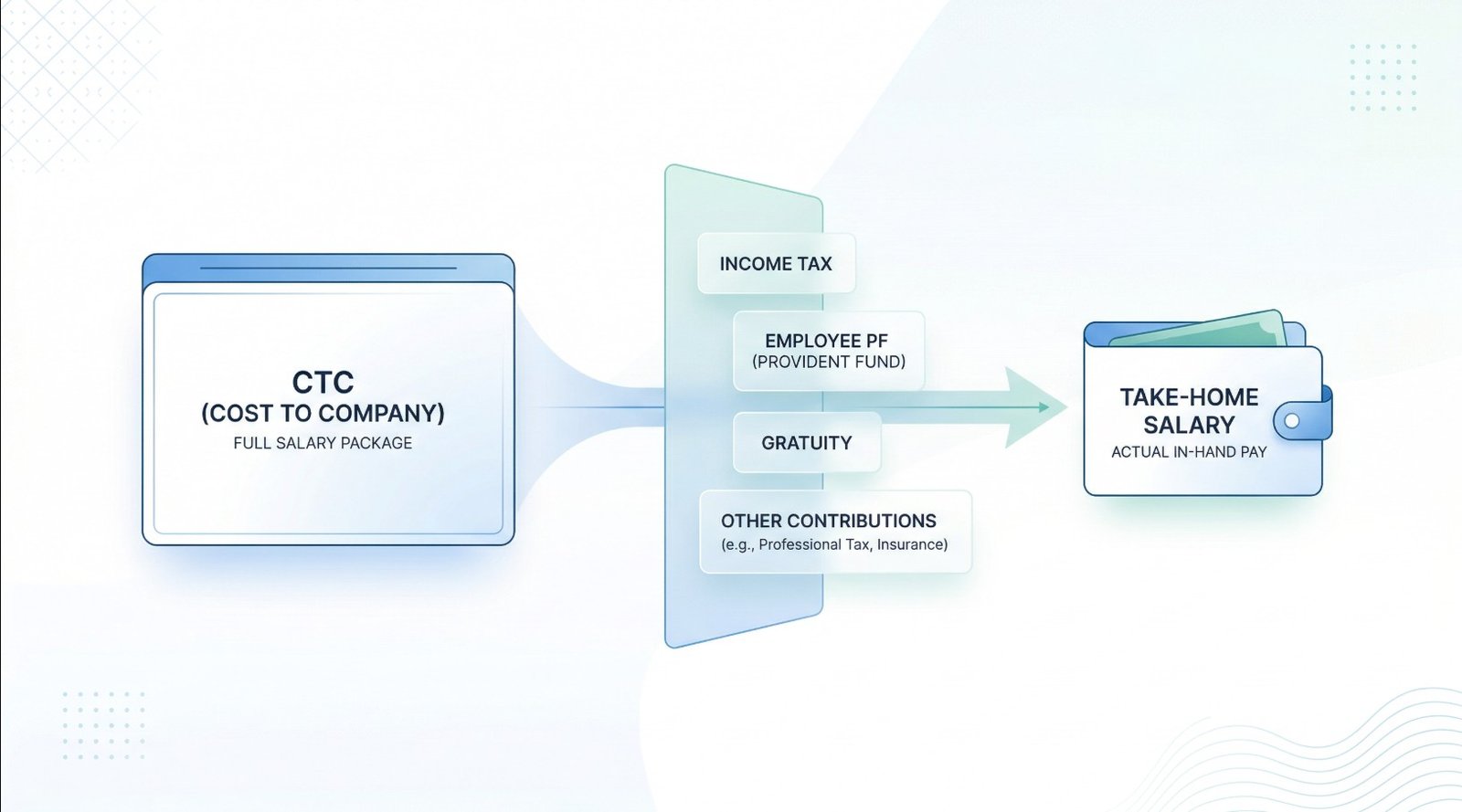
One of the most common points of confusion for working professionals in India is the difference between the CTC mentioned in an offer letter and the amount that actually gets credited to their bank account each month. This article breaks down the structure of CTC, explains each component clearly, and helps readers understand where their salary goes and why.

What Is CTC?

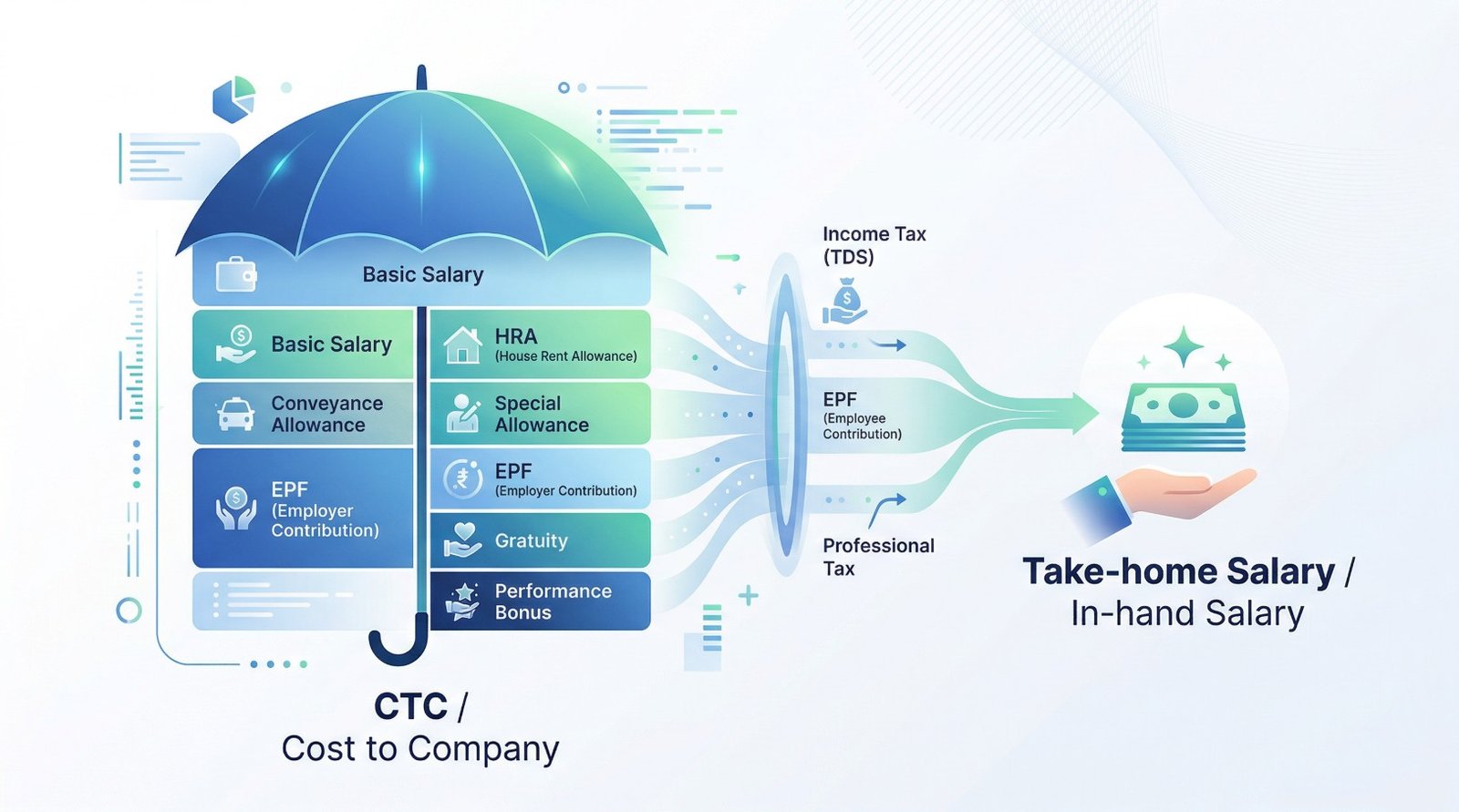
CTC is an acronym for Cost to Company. It represents the total annual expenditure an employer incurs on an employee. This includes not just the monthly salary, but also contributions toward statutory savings, benefits, and other allowances.
When a company states a CTC of ₹20 LPA (Lakhs Per Annum), it means the total cost of employing that individual across all heads, some of which are paid monthly, some held for the future, and some directed toward statutory obligations.
CTC is not the same as the amount deposited into an employee’s account each month. That figure is called take-home salary or in-hand salary, and it is always lower than CTC.

Components of CTC

 1) Basic Salary

Basic salary is the fixed core component of the compensation structure. It is usually between 40% and 50% of the total CTC and is fully taxable under Indian income tax law.

Under the Code on Wages, 2019, the government mandated that the basic salary must be at least 50% of total remuneration. This move was intended to reduce the practice of artificially suppressing Basic salary to lower statutory contributions like the Provident Fund, Gratuity, Leave encashment, Bonus, etc.

2) House Rent Allowance (HRA)

HRA is a component provided to help employees meet rental expenses. It is typically calculated as a percentage of Basic salary:
      • 50% of the basic salary for employees in metro cities (Mumbai, Delhi, Kolkata, Chennai)
      • 40% of the basic salary for employees in non-metro locations
HRA is partially exempt from income tax for employees who pay rent, subject to conditions specified under Section 10(13A) of the Income Tax Act. Employees living in their own homes or with family without paying rent do not qualify for this exemption, and the full HRA becomes taxable in their case.

3) Special Allowance

Special allowance is the residual amount that fills the gap between the defined components and the total CTC. It is fully taxable and does not carry any specific statutory benefit or exemption. Its presence in the salary structure primarily serves to complete the CTC computation.

4) Provident Fund (PF)

Employees’ Provident Fund (EPF) is a statutory savings mechanism governed by the Employees’ Provident Fund and Miscellaneous Provisions Act, 1952. Both the employer and the employee contribute 12% of the employee’s Basic salary to the EPF account each month.
The employer’s contribution of 12% is included within the CTC figure. This is a significant reason why the CTC appears higher than the actual take-home amount. These funds are accessible to the employee upon retirement, resignation after a qualifying period, or under specific permitted withdrawal conditions.
With higher Basic salaries under the new Labour Codes, EPF contributions increase proportionally, strengthening long term financial security even if short-term take-home is marginally lower.

5) Gratuity

Gratuity is a statutory benefit payable under the Payment of Gratuity Act, 1972. It is a lump sum amount paid by the employer when an employee leaves the organization after completing at least five continuous years of service. It is calculated as 15 days’ Basic salary for every year of completed service. Although gratuity accrues over the tenure of employment, it forms part of the CTC structure from day one.

6) Other Allowances and Benefits

CTC may also include the following components, depending on the employer’s salary policy:
    • Medical Allowance – provided for healthcare-related expenses
    • Conveyance Allowance – for commuting costs
    • Leave Travel Allowance (LTA) – partially exempt from tax for eligible travel within India
    • Performance Bonus – variable pay linked to individual or company performance
The inclusion and value of these components vary by organization, role, and industry sector.

CTC, Take home salary, In Hand Salary, HRA, EPF, Gratuity, PF, TDS, Tax

Deductions That Reduce Take-Home Salary

1) Tax Deducted at Source (TDS)

Employers are required to deduct income tax at source before crediting the monthly salary. The amount deducted depends on the employee’s total taxable income for the year and the tax regime they have opted for. (Ref: Section 192, Income Tax Act)
As of Budget 2023, the New Tax Regime is the default option. Employees may, however, opt for the Old Tax Regime if it is more beneficial, given deductions available under sections such as 80C, 80D, and exemptions like HRA.

2) Professional Tax

Professional tax is a state-level levy applicable in several Indian states. The amount typically ranges between ₹150 and ₹200 per month, depending on the state and income bracket. It is a relatively minor deduction but is reflected on every payslip.

3) Employee’s PF Contribution

As noted above, 12% of the basic salary is deducted from the employee’s gross pay each month and deposited into their EPF account. While this amount belongs to the employee, it is not immediately accessible and forms part of their long term savings.

How Take-Home Salary Is Calculated

The following formulas provide a standard framework for understanding the relationship between CTC and take home salary: 

Gross Salary = CTC − Employer’s PF Contribution − Gratuity − Other Non-Cash Benefits
Take-Home Salary = Gross Salary − (Employee’s PF + TDS + Professional Tax)

For illustrative purposes: on a CTC of ₹10 LPA, the monthly take-home salary typically falls in the range of ₹65,000 to ₹72,000, depending on the city of residence, applicable tax regime, and specific salary structure. Actual figures will vary based on individual circumstances and employer policy.

Impact of the New Labour Codes

The Government of India has consolidated multiple labour laws into four new Labour Codes: the Code on Wages, the Industrial Relations Code, the Code on Social Security, and the Occupational Safety, Health and Working Conditions Code. Once fully implemented, these codes are expected to bring meaningful changes to how salary structures are designed: 

    • Higher Basic salary thresholds will lead to proportionally higher PF, Gratuity, Leave encashment and bonus contributions. 
    • Clearer definitions of wages will reduce ambiguity in how CTC is structured.
    • Extended social security coverage for gig and platform workers. 

Employees may notice a slight reduction in short-term take-home salary as Basic salary proportions increase. However, this also means stronger statutory savings and greater long-term financial security.

Key Takeaways

Understanding the structure of CTC helps employees make informed financial decisions, from tax planning to evaluating job offers. The key distinctions to remember are:
    • CTC is the employer’s total cost of employment — it is not the same as take-home salary.
    • Several components within CTC are directed toward future savings or statutory obligations.
    • Deductions, including TDS, employee PF, and professional tax, reduce the gross salary to the amount actually received.
    • The New Tax Regime is the default option from FY 2023-24 onwards, though employees may evaluate the Old Regime based on their eligible deductions.
    • The new Labour Codes, once implemented, will further reshape salary structures across organisations.
 

References

[1] Code on Wages, 2019 – Ministry of Labour and Employment (Official Act): labour.gov.in – The Code on Wages, 2019
[2] Employees’ Provident Fund Organisation (EPFO) – Official Website: www.epfindia.gov.in
[3] EPFO – About EPFO and EPF Act, 1952: epfindia.gov.in/site_ en/AboutEPFO.php
[4] Income Tax Department – Section 10(13A) HRA Exemption & Section 80C: incometax.gov.in
[5] Income Tax Department – Official Portal: www.incometax.gov.in
[6] Ministry of Labour and Employment – Labour Reforms Overview (PIB): pib.gov.in – Labour Reforms: Code on Wages & Four Labour Codes
[7] Code on Wages 2019 – PRS Legislative Research Summary: prsindia.org – Code on Wages, 2019
[8] Payment of Gratuity Act – Ministry of Labour: www.labour.gov.in

 
Readers Note:

TalentCo HR Services LLP is an HR consulting and solutions company offering services across HR operations, compliance, liasoning, payroll management, and HR technology through its proprietary platform — ABStart.
This article is intended for general informational and educational purposes only. Labour laws, tax regulations, and compliance requirements are subject to change based on government notifications and jurisdictional updates. Readers are advised to independently verify current regulations or consult qualified professionals before making any business or financial decisions.
Our role is to simplify and present complex HR and payroll concepts in a comprehensible manner for business owners, HR professionals, and employees.