TalentCo HR Services LLP

Payroll Compliance in India for SMEs – What it actually looks like on the ground

There are plenty of guides online that explain what PF, ESI, and TDS are. Most of them read like a government circular; technically correct, practically useless for someone who has to actually run payroll for 80 employees by the 7th of every month.

This is not that kind of guide. What follows is based on 30 years of managing HR and payroll for Indian businesses  across manufacturing, services, retail, and FMCG; and what that experience has shown us about where SMEs consistently go wrong, and why.

The Three Compliance Areas That Catch Indian SMEs Off Guard

1. PF: It’s Not Just About the Percentage

Most business owners know that PF involves a 12% employee contribution and a 12% employer contribution. What they often don’t know is that the employer’s 12% is split; 8.33% goes to the Employee Pension Scheme (EPS) and 3.67% goes to the EPF account directly. This split matters when an employee resigns or claims their PF, and getting it wrong in your payroll system creates reconciliation problems that are painful to undo.

The other thing SMEs consistently get wrong: the definition of “basic wages” for PF calculation. Structuring salaries with inflated allowances to keep basic pay low and therefore reduce PF liability is a common practice. But EPFO has been scrutinising this more closely in recent years, and a salary structure that doesn’t hold up to audit can expose the employer to back-contributions plus interest plus penalty under Section 14B of the EPF Act, 1952.

Under the Code on Wages, 2019, the definition of wages has been standardised, and allowances exceeding 50% of total remuneration are to be included in the wage base for PF calculation. Businesses that haven’t reviewed their salary structures in light of this are carrying compliance risk they may not be aware of.

2. ESI: The Coverage Threshold Trips People Up

ESI applies to employees earning up to ₹21,000 per month (₹25,000 for persons with disability). The moment an employee’s salary crosses this threshold mid-year due to an increment, they move out of ESI coverage. Managing this transition manually, across multiple employees at different increment dates, is where errors compound.

The contribution rates are 0.75% from the employee and 3.25% from the employer on ESI-applicable wages. Errors in coverage including employees who should be covered but aren’t. This can trigger liability during ESIC inspections. For SMEs without a dedicated compliance team, these inspections can arrive with very little notice.

3. TDS on Salary: The Form 16 Pressure Point

TDS on salaries under Section 192 of the Income Tax Act requires the employer to deduct tax at source based on the employee’s projected annual income, factoring in their declared investments and exemptions. The challenge for SMEs: employees often submit their investment declarations late, change their declarations mid-year, or submit inaccurate figures  leaving the payroll team to recalculate and adjust deductions every month.

Getting TDS wrong doesn’t just affect the employee’s tax return. It creates a liability for the employer and affects Form 16 issuance. For businesses that run payroll on spreadsheets, reconciling TDS across an entire financial year is one of the most time-consuming exercises in the HR calendar.

Why manual payroll makes all of this worse

The problem with spreadsheet-based payroll isn’t that people don’t know the rules. It’s that spreadsheets don’t enforce them. When PF calculation logic is embedded in a formula that someone built three years ago, and that person has since left, no one questions whether the formula is still correct. When ESI coverage lists aren’t automatically updated at increment time, employees fall through the gap. When TDS projections aren’t recalculated when an employee changes their investment declaration, the error carries forward for months.

These aren’t hypothetical scenarios. They’re the situations that HR managers call us about often after an EPFO or ESIC notice has already arrived.

What Compliance-Ready payroll Actually Looks Like

A structured HRMS built for Indian compliance handles the following automatically:

1. PF calculation based on the correct wage definition under the Code on Wages, with the EPS/EPF split calculated accurately for every employee

2. ESI coverage tracking that flags employees approaching or crossing the ₹21,000 threshold and adjusts their coverage status

3. TDS projection that recalculates each month based on updated investment declarations, ensuring deductions stay accurate across the financial year

4. Challans and returns:ECR for EPFO, ESI returns, and Form 24Q for TDS generated in the correct format for filing

5. Audit-ready payslips and statutory records maintained in a format that withstands regulatory scrutiny

ABStart, an HRMS built by TalentCo HR Services, is designed around exactly this compliance architecture because it was built by HR professionals who have managed these processes manually for decades and understood precisely where the gaps are.

The Compliance questions every Indian SME should be asking right now

Before your next payroll cycle, it’s worth asking:

1. Is your basic wage structure compliant with the Code on Wages definition? Have you reviewed it since the Labour Codes were operationalised?

2. Are all eligible employees covered under ESI, including those who joined recently or got increments this quarter?

3. Is your TDS projection being recalculated monthly, or is it set at the beginning of the year and left unchanged?

4. Are your EPFO and ESIC challans being filed on time; PF by the 15th of the following month, ESI by the 15th as well?

5. Do you have audit-ready payslips and statutory records for the last three years?

If the honest answer to any of these is “I’m not sure”, that’s where a structured HRMS pays for itself.

Key Takeaways

1. PF errors often stem from incorrect salary structuring and outdated wage definitions; not just calculation mistakes.

2. ESI coverage gaps at increment time are one of the most common and preventable compliance failures in Indian SMEs.

3. TDS on salary requires monthly recalculation as employee declarations change; a manual process that is difficult to sustain accurately at scale.

4. Structured HRMS platforms built for Indian compliance handle challan generation, returns, and audit-ready records automatically.

5. Compliance risk compounds silently in spreadsheet-based payroll; it’s usually only visible when a notice arrives.

References

[1] Employees’ Provident Fund Organisation (EPFO) – Section 14B, EPF Act, 1952: epfindia.gov.in

[2] Code on Wages, 2019 – Ministry of Labour and Employment: labour.gov.in

[3] ESIC – Employees’ State Insurance Corporation Official Portal: esic.gov.in

[4] Income Tax Act, 1961 – Section 192, TDS on Salary: incometax.gov.in

[5] Code on Social Security, 2020 – Ministry of Labour and Employment: labour.gov.in

[6] PRS Legislative Research – Labour Codes Summary: prsindia.org

TalentCo HR Services LLP is an HR consulting and solutions company offering services across HR operations, compliance, liasoning, payroll management, and HR technology through its proprietary platform ABStart. This article is intended for general informational and educational purposes only. Labour laws, tax regulations, and compliance requirements are subject to change based on government notifications and jurisdictional updates. Readers are advised to independently verify current regulations or consult qualified professionals before making any business or financial decisions.

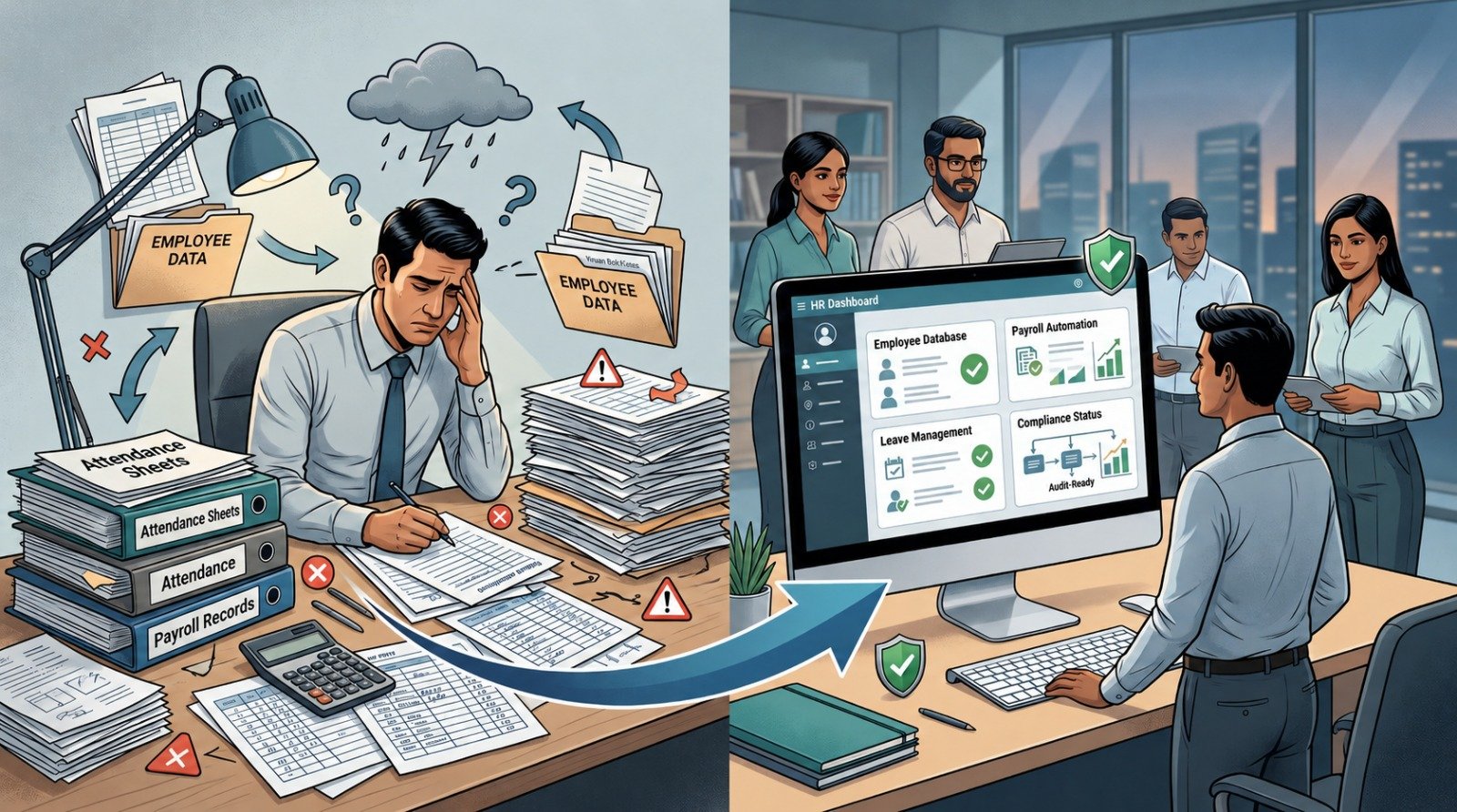
How to Digitalise HR in your Indian SME : A Step-by-Step guide

Starting a digital HR journey does not require a full system overhaul. Indian SMEs can begin by digitising payroll, statutory compliance, and employee records using purpose-built HRMS platforms. This structured transition reduces legal exposure under the EPF Act, Labour Codes, and the DPDP Act, 2023, while improving operational efficiency without disrupting day-to-day business.

For many growing Indian businesses, the decision to move away from manual HR processes feels larger than it needs to. The assumption is often that digitising HR means replacing everything at once — new software, new workflows, new training, new costs. In practice, the transition can begin with a single function and expand from there. What matters is that the move happens before the compliance consequences of staying on spreadsheets become unavoidable.

Why Indian SMEs Keep delaying Their HR digitalisation (And Why That’s Getting Riskier)

The hesitation is understandable. HR systems in most Indian SMEs have evolved informally, built around the preferences of whoever manages them. Payroll runs on Excel. Leave is tracked over email. Attendance is maintained in a register or a shared sheet. These systems work until they don’t.

The compliance environment in 2026 has made the cost of staying informal measurably higher. The four Labour Codes covering wages, industrial relations, social security, and occupational safety are being operationalised in stages, altering how wages are defined, how PF is calculated, and what records must be maintained. The Digital Personal Data Protection (DPDP) Act, 2023, now governs how employee data is stored and processed. Regulatory scrutiny around EPFO and ESIC compliance for SMEs has increased in recent years.

A structured HRMS transition does not require replacing all of this overnight. It requires identifying where the exposure is greatest and starting there.


Where Should an Indian SME Start Its HRMS Transition?

1. Payroll and Statutory Compliance First

Payroll is where manual errors carry the most direct financial and legal risk. Under Section 14B of the EPF Act, 1952, employers may face significant financial penalties for delayed or inaccurate contributions. Misapplied TDS slabs under Section 192 of the Income Tax Act add further exposure. Starting digital HR with payroll automation immediately reduces the most quantifiable risk category.

A structured HRMS platform handles EPF, ESIC, professional tax, and TDS calculations automatically, generates audit-ready payslips, and maintains records in a format that withstands regulatory scrutiny.

2. Employee Data and DPDP Compliance

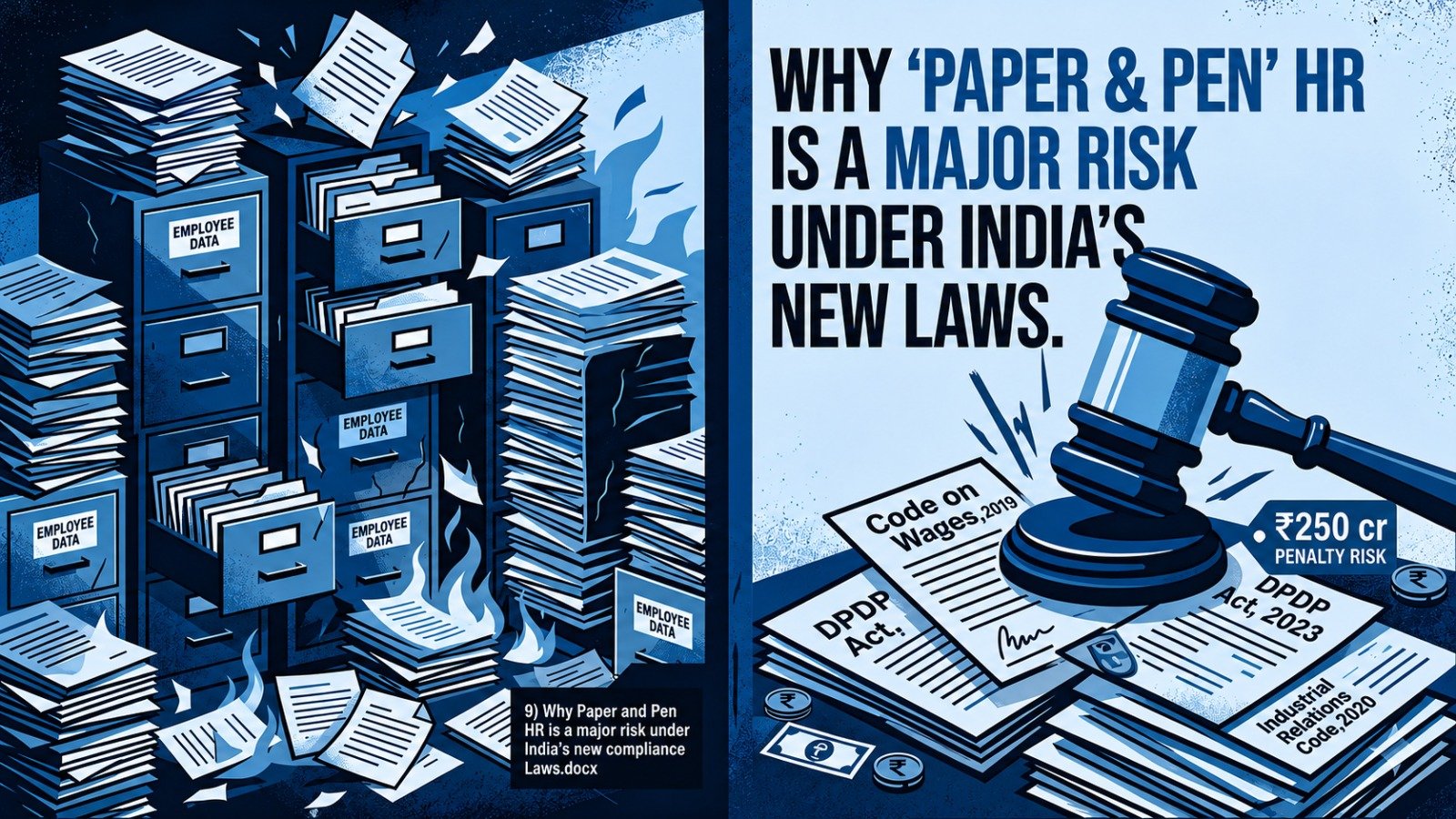
The DPDP Act, 2023, requires that employee personal data including Aadhaar numbers, bank details, and health records — be stored securely, processed with documented consent, and deleted when no longer required. Maintaining employee data in unsecured spreadsheets or shared drives may increase compliance and data-security risks under the DPDP Act, 2023. The Act introduces substantial financial penalties for serious data protection violations.

Transitioning employee records to a structured HRMS with role-based access and encrypted storage addresses this risk without requiring any other operational change at the outset.

3.  Attendance and Leave Management

Attendance discrepancies can frequently contribute to payroll disputes and reconciliation challenges in SMEs. Under the Code on Wages, 2019, payment of wages must align with documented attendance and leave records. Digitising attendance and leave management creates a verifiable audit trail, reduces month-end reconciliation time, and minimises the conditions for employee disputes.

What a Phased HRMS Implementation Looks Like for an SME

A practical digital HR transition for an Indian SME does not need a six-month implementation plan. A phased model can look like this:

  • Phase 1: Migrate payroll to a structured HRMS. Establish correct salary architecture aligned with the Code on Wages. Automate EPF, ESIC, TDS, and professional tax.
  • Phase 2: Digitise employee records and data storage. Establish DPDP-compliant data handling with access controls.
  • Phase 3: Move attendance, leave management, and onboarding onto the platform. This phase helps improve day-to-day HR efficiency and reduces administrative workload over time.
  •  

Platforms like ABStart, built specifically for growing Indian companies and managed by TalentCo HR Services, support this phased approach. The platform covers end-to-end HRMS functions  from employee onboarding and lifecycle management to statutory compliance automation and payroll processing — within an architecture designed around India’s regulatory requirements. Backed by over 30 years of HR leadership, ABStart is built by HR professionals with extensive experience managing compliance and workforce operations for Indian businesses.

The Cost of Waiting to Digitise HR

Manual HR processes carry a visible cost in time and a less visible cost in risk. HR personnel managing spreadsheet-based payroll spend significant hours each month on reconciliation and statutory filing — hours that could be redirected to people development or business growth. As labour law reforms continue to evolve, businesses may benefit from reviewing and aligning their salary structures proactively. Businesses that begin their digital HR transition now are not just gaining efficiency ; they are building systems that can better support future compliance and operational requirements.

Key Takeaways

  • 1) A digital HR transition does not require a full-scale overhaul. Beginning with payroll and statutory compliance addresses the highest-risk area first.
  • 2) The DPDP Act, 2023, highlights the importance of secure employee data storage and stronger data protection practices.
  • 3) The Code on Wages, 2019, and the four Labour Codes require salary structures that manual spreadsheets cannot maintain accurately at scale.
  • 4) EPFO and ESIC audit scrutiny of SMEs is increasing. Accurate, audit-ready records are no longer a best practice — they are a regulatory requirement.
  • 5) Purpose-built HRMS platforms like ABStart allow growing Indian companies to transition in phases, without disrupting operations.


References

[1] Code on Wages, 2019 – Ministry of Labour and Employment: labour.gov.in

[2] Employees’ Provident Fund Organisation (EPFO) – Section 14B, EPF Act, 1952: epfindia.gov.in

[3] Digital Personal Data Protection Act, 2023 – Ministry of Electronics and IT: meity.gov.in

[4] Code on Social Security, 2020 – Ministry of Labour and Employment: labour.gov.in

[5] ESIC – Employees’ State Insurance Corporation Official Portal: esic.gov.in

[6] Ministry of MSME – MSME at a Glance: msme.gov.in

[7] PRS Legislative Research – Labour Codes Summary: prsindia.org


TalentCo HR Services LLP is an HR consulting and solutions company offering services across HR operations, compliance, liasoning, payroll management, and HR technology through its proprietary platform ABStart. This article is intended for general informational and educational purposes only. Labour laws, tax regulations, and compliance requirements are subject to change based on government notifications and jurisdictional updates. Readers are advised to independently verify current regulations or consult qualified professionals before making any business or financial decisions.

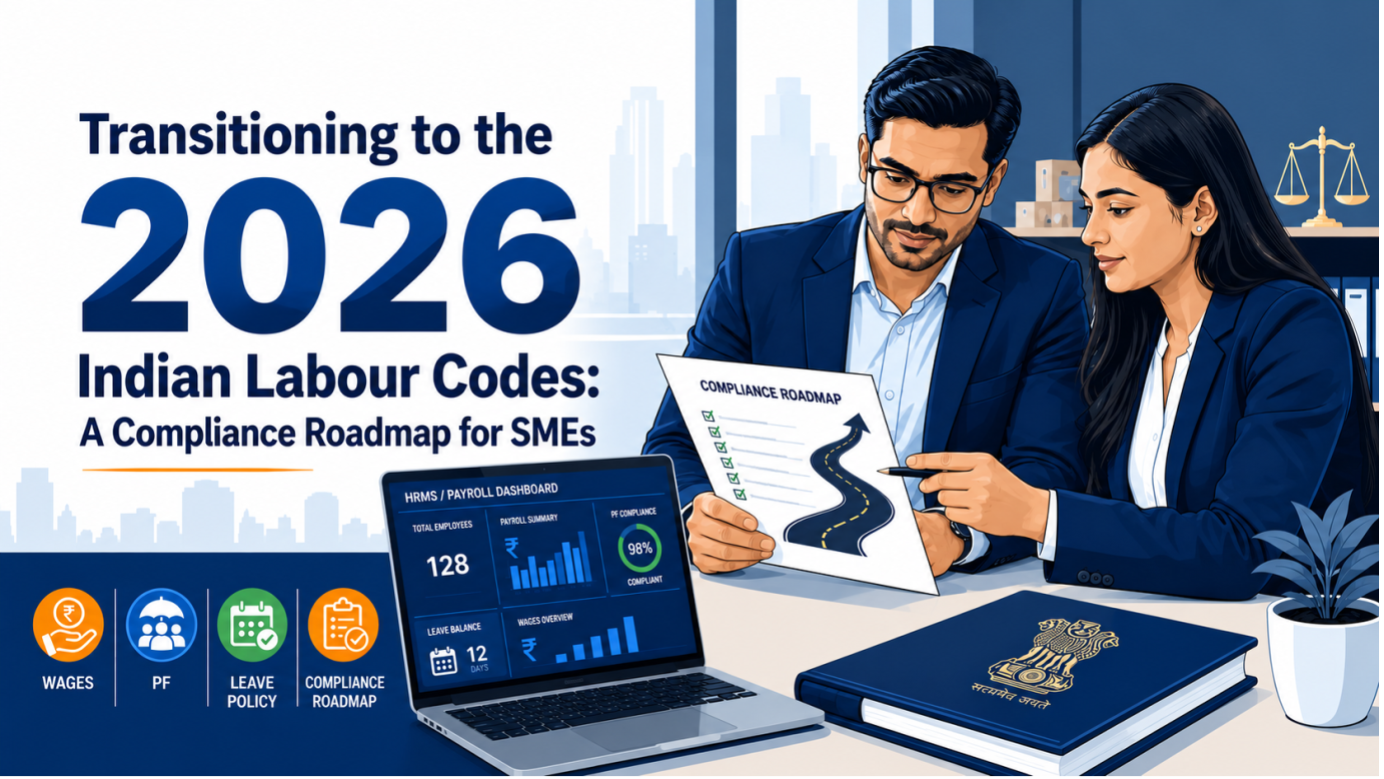
Transitioning to the 2026 Indian Labour Codes: A Compliance Roadmap for SMEs

India’s four Labour Codes have been passed by Parliament. Several states have already published their draft rules, and the central government has indicated intent to operationalize the Codes, with implementation timelines dependent on state-level rule finalisation. For Indian SMEs, this is no longer just a future concern — it requires proactive preparation from businesses ahead of implementation that demands structured action.

Understanding What Has Changed

The four Labour Codes — the Code on Wages, 2019; the Industrial Relations Code, 2020; the Code on Social Security, 2020; and the Occupational Safety, Health and Working Conditions Code, 2020 — consolidate 29 existing central labour laws. The changes they introduce are not cosmetic.

The Code on Wages, 2019, introduces a revised definition of wages with specified inclusions and exclusions, along with a 50% threshold for allowable exclusions. This may impact how PF contributions are computed, as wage structures align with the revised definition. Under the new definition, if allowances beyond the excluded categories exceed 50% of total CTC, the excess must be treated as wages, increasing the PF base. For organisations that have structured salary to keep Basic low, this will require a fundamental redesign.

The Code on Social Security, 2020, expands the ambit of EPF and ESI coverage. It also introduces new categories of workers, including gig and platform workers, into the social security framework. SMEs working with contract and gig labour must account for these obligations as rules are notified.

Where the Compliance Gap Is Largest for SMEs

Most Indian SMEs face three concentrated areas of risk under the new framework:

  • Salary structure misalignment: CTC templates designed to minimise PF deductions will not hold under the new wage definition. Retrospective liability for PF arrears under Section 14B of the EPF Act, 1952, can attract damages of up to 100% of the arrears due.
  • Leave and working hours: The Codes standardise definitions for working hours, overtime thresholds, and leave entitlements. SMEs operating on informal leave policies without documented records will find it difficult to demonstrate compliance during audits.
  • DPDP Act obligations on employee data: The Digital Personal Data Protection Act, 2023, requires that employee data — including Aadhaar, bank details, and health records — is stored securely, processed lawfully, and deleted when no longer required. Unsecured or poorly managed data storage practices may not meet these standards.

A Practical Compliance Roadmap

The transition to Labour Code compliance does not need to be disruptive. It does, however, need to be structured. The following sequence is a practical starting point for SMEs:

  1. Audit your current salary architecture: Map each CTC component against the new wage definition under the Code on Wages. Identify whether Basic salary, as currently structured, meets the 50% threshold requirement.
  2. Recalculate PF and ESI liability: Once wage definitions are corrected, rerun PF and ESI calculations. Determine whether contribution amounts will change and plan for the revised employer cost.
  3. Document all leave and attendance policies: Convert informal leave practices into written, time-stamped policies. Ensure attendance and leave records are maintained digitally and are audit-ready.
  4. Secure employee personal data: Move employee data from unencrypted shared files or email threads to a system that provides access controls, audit logs, and defined data retention policies.
  5. Update employment contracts and standing orders: The Industrial Relations Code alters provisions around notice periods, layoffs, and standing orders. Contracts should be reviewed by a qualified HR or legal professional and updated accordingly.

The Role of Structured HR Systems

Structured HRMS platforms built for Indian compliance — such as ABStart, are designed around these regulatory requirements. Its payroll engine automates PF, ESI, and TDS calculations, and its record-keeping module maintains audit-ready documentation. For SMEs looking to move from manual spreadsheets to a compliant operation, this kind of purpose-built infrastructure reduces both the transition effort and the ongoing compliance risk.

Key Takeaways

  • The four Labour Codes are passed legislation; full enforcement is expected to deepen through 2026 as states finalise rules.
  • Salary structures that suppress Basic wages to reduce PF liability will be directly non-compliant with the Code on Wages, 2019.
  • Regulatory scrutiny may increase as compliance frameworks evolve; inaccurate contribution records carry significant retrospective penalties.
  • The DPDP Act, 2023, makes informal employee data storage in spreadsheets a compliance liability — penalties for non-compliance can be significant, depending on the severity of the violation.
  • Structured HRMS platforms purpose-built for Indian regulatory requirements, like ABStart, convert compliance risk into controlled, audit-ready processes.

References


Reader’s Note: TalentCo HR Services LLP is an HR consulting and solutions company offering services across HR operations, compliance, payroll management, and HR technology through its proprietary platform — ABStart. This article is intended for general informational and educational purposes only. Labour laws, tax regulations, and compliance requirements are subject to change based on government notifications and jurisdictional updates. Readers are advised to independently verify current regulations or consult qualified professionals before making any business or financial decisions.


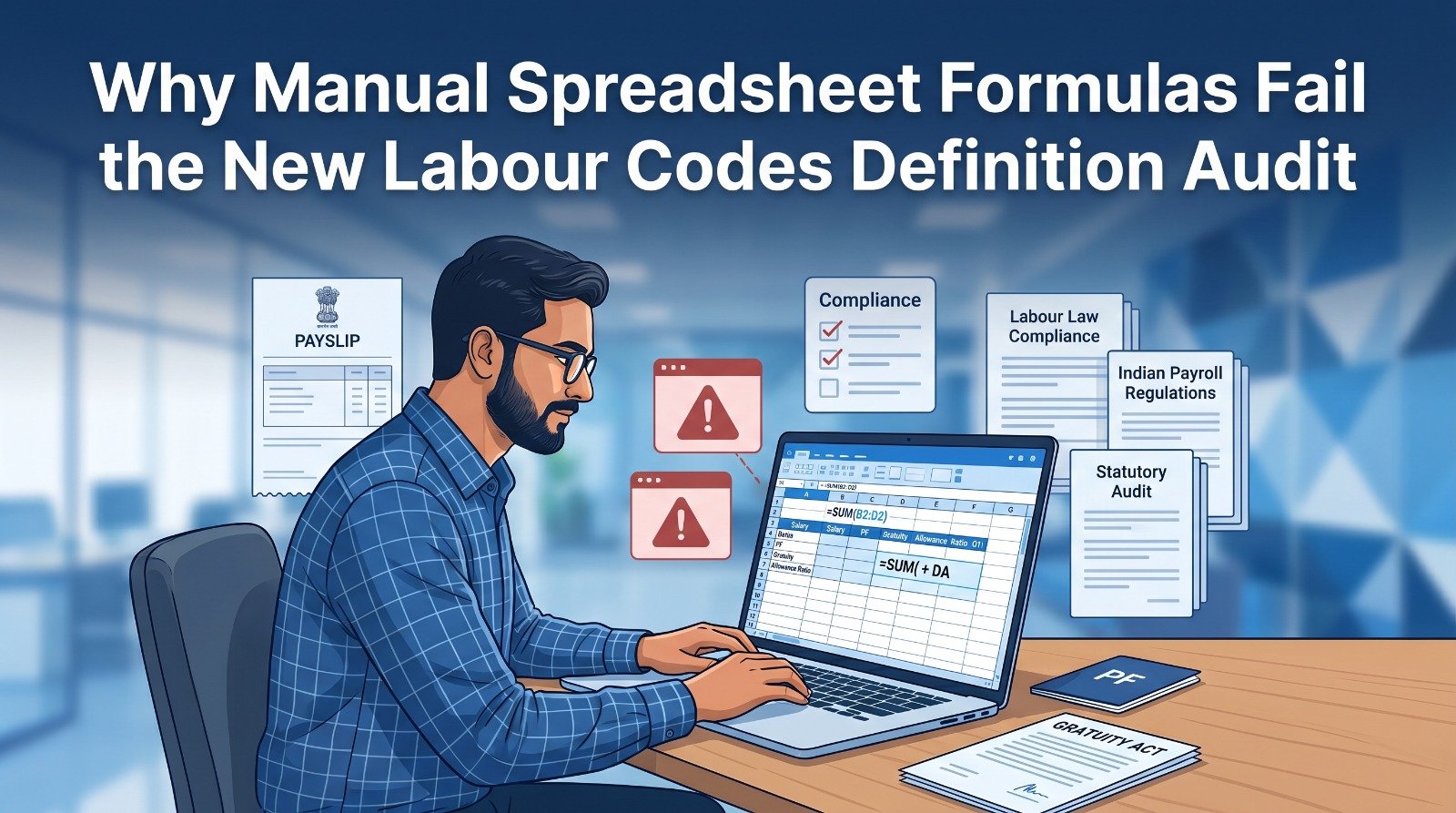
Why Manual Spreadsheet Formulas Fail the New Labour Codes Definition Audit

Manual spreadsheet formulas often struggle to keep pace with evolving wage definitions introduced by the Code on Wages, 2019. When this code is operationalised, Salary structures built on outdated component logic may not meet statutory audit requirements, potentially leading to retrospective liabilities for Indian SMEs.

The Compliance Gap Hidden Inside Every Salary Sheet

For years, Indian businesses structured employee salaries around a familiar objective: keep the Basic component low to reduce Provident Fund contributions. Spreadsheets enabled this easily. A formula could reduce the Basic component to 30–35% of CTC while increasing allowances to optimize cost structures and produce a payslip that looked complete.

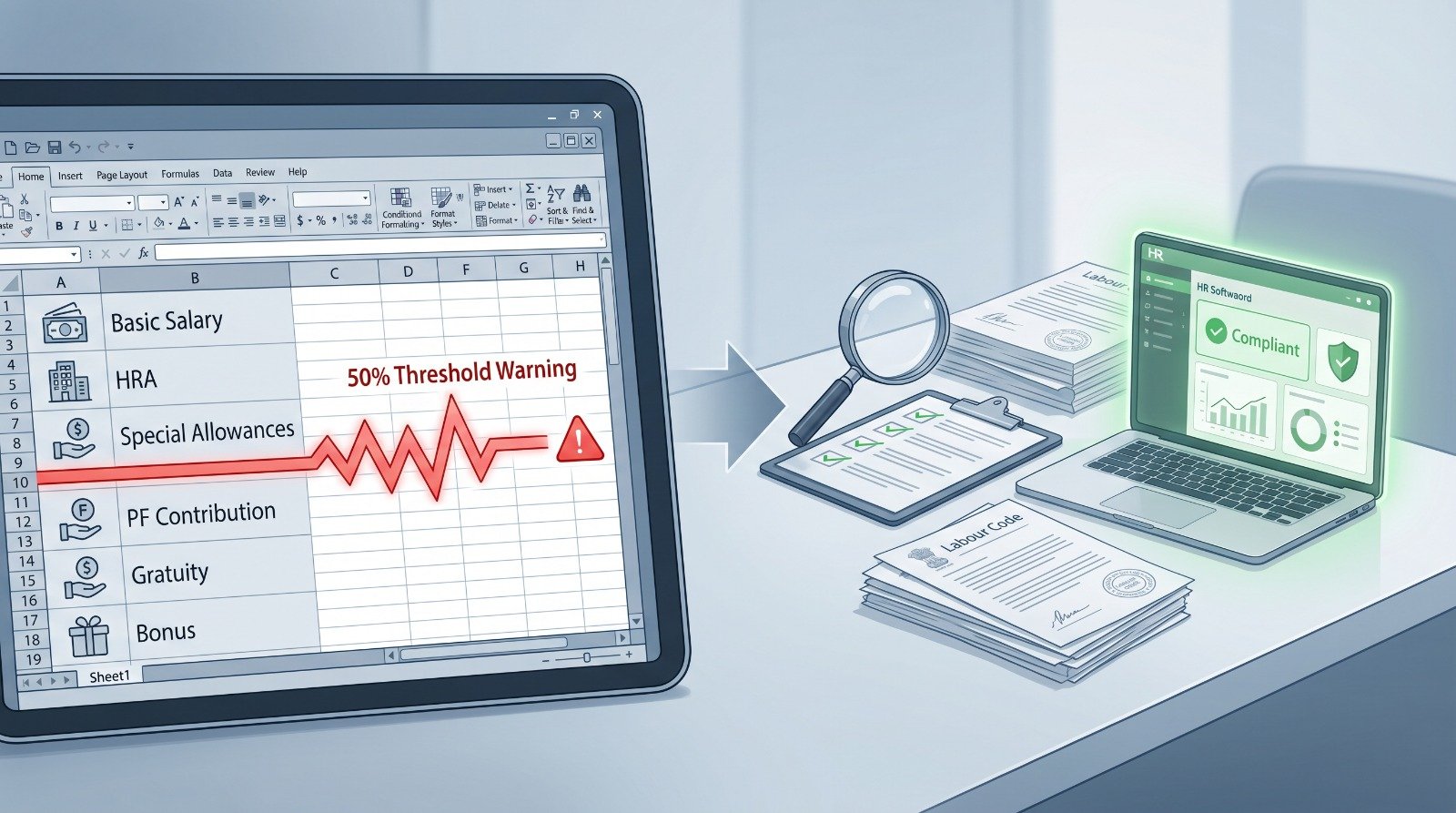
The Code on Wages, 2019 dismantles that architecture. The Code defines wages to include all remuneration except a defined set of exclusions. Critically, those exclusions cannot exceed 50% of total remuneration. Any excess beyond the prescribed threshold may be treated as part of wages for statutory contribution calculations, as per the code for PF and gratuity calculation purposes.

A standard spreadsheet setup may not reliably enforce this boundary without continuous monitoring and updates. It calculates what it is told to calculate. Whether the resulting salary structure is compliant with the new wage definition is a legal determination that typically requires domain expertise beyond standard spreadsheet functionality.

What a Labour Code Definition Audit Examines

When EPFO or a statutory inspector conducts an audit under the new Labour Codes framework, the review is not limited to whether contributions were deposited on time. Auditors examine whether the wage definition applied by the employer matches the statutory definition. This includes:

Whether Basic wage is correctly determined in relation to total remuneration

Whether excluded allowances remain within the 50% ceiling prescribed under the Code on Wages

Whether the PF contribution base reflects the correct statutory wage

Whether gratuity has been computed on the appropriate wage definition

Whether variable pay components have been appropriately classified

Three Points Where Spreadsheet Formulas Break Down
1. Static Component Logic

Spreadsheet salary structures are typically built once and rarely revised. As legislative changes accumulate — across the Code on Wages, Code on Social Security, and ESIC regulations — the formula remains unchanged. The salary output continues to appear correct while quietly accumulating statutory misalignment.

2. No Threshold Enforcement

The 50% allowance ceiling under the Code on Wages requires active monitoring for every employee across every pay cycle. Different CTC levels, variable pay treatments, and allowance combinations all affect where an individual’s salary lands relative to that threshold. A spreadsheet formula typically lacks automated mechanisms to consistently flag such breaches without additional configuration.

3. Retrospective Liability Risk

Under Section 14B of the EPF and Miscellaneous Provisions Act, 1952, employers who have under-contributed due to an incorrect wage base face damages that can extend up to 100% of the arrears in certain cases, along with applicable interest, in addition to simple interest. When the Code on Wages alters the wage definition and an audit reveals years of miscalculated PF contributions, the liability is calculated retrospectively across every affected employee and pay period.

Manual Spreadsheet, HRMS, Audit, New Labour Codes, Regulation, Compliance, Payslip
What Structured HR Architecture Handles Differently

Certain HRMS platforms designed for Indian statutory compliance embed wage definition logic directly into salary structure configuration. Rather than relying on a user-written formula, the system applies the Code on Wages framework at the point of salary design, ensuring that component proportions remain within compliant boundaries before payroll is processed.

For SMEs managing multiple pay bands, variable components, and frequent joiners, this automated validation layer significantly reduces a category of risk that manual spreadsheet management may struggle to address effectively. PF and ESIC contributions are calculated on the correct statutory wage. Records are audit ready. When a regulatory update occurs, the system is configured to reflect the change without relying on an HR executive to manually update every formula across every employee file.

Key Takeaways

PF and gratuity liabilities are directly affected when wage definitions are applied incorrectly. Retrospective penalties under Section 14B can equal 100% of contribution arrears.

EPFO and ESIC audit activity targeting Indian SMEs is increasing; inaccurate wage classification is a primary finding.

Manual spreadsheet formulas are static, unvalidated, and carry no mechanism to flag legislative misalignment.

Structured HRMS platforms like ABStart build statutory wage logic into salary architecture, reducing audit exposure and supporting more consistent and compliant payroll processing across pay cycles.

References

Code on Wages, 2019 – Ministry of Labour and Employment: labour.gov.in

Employees’ Provident Fund Organisation – Section 14B, EPF Act, 1952: epfindia.gov.in

Code on Social Security, 2020 – Ministry of Labour and Employment: labour.gov.in

Employees’ State Insurance Corporation – Official Portal: esic.gov.in

PRS Legislative Research – Labour Codes Summary: prsindia.org

Ministry of MSME – MSME at a Glance: msme.gov.in

Reader’s Note:

TalentCo HR Services LLP is an HR consulting and solutions company offering services across HR operations, compliance, payroll management, and HR technology through its proprietary platform — ABStart. This article is intended for general informational and educational purposes only. Labour laws, tax regulations, and compliance requirements are subject to change based on government notifications. Readers are advised to independently verify current regulations or consult qualified professionals before making any business or financial decisions

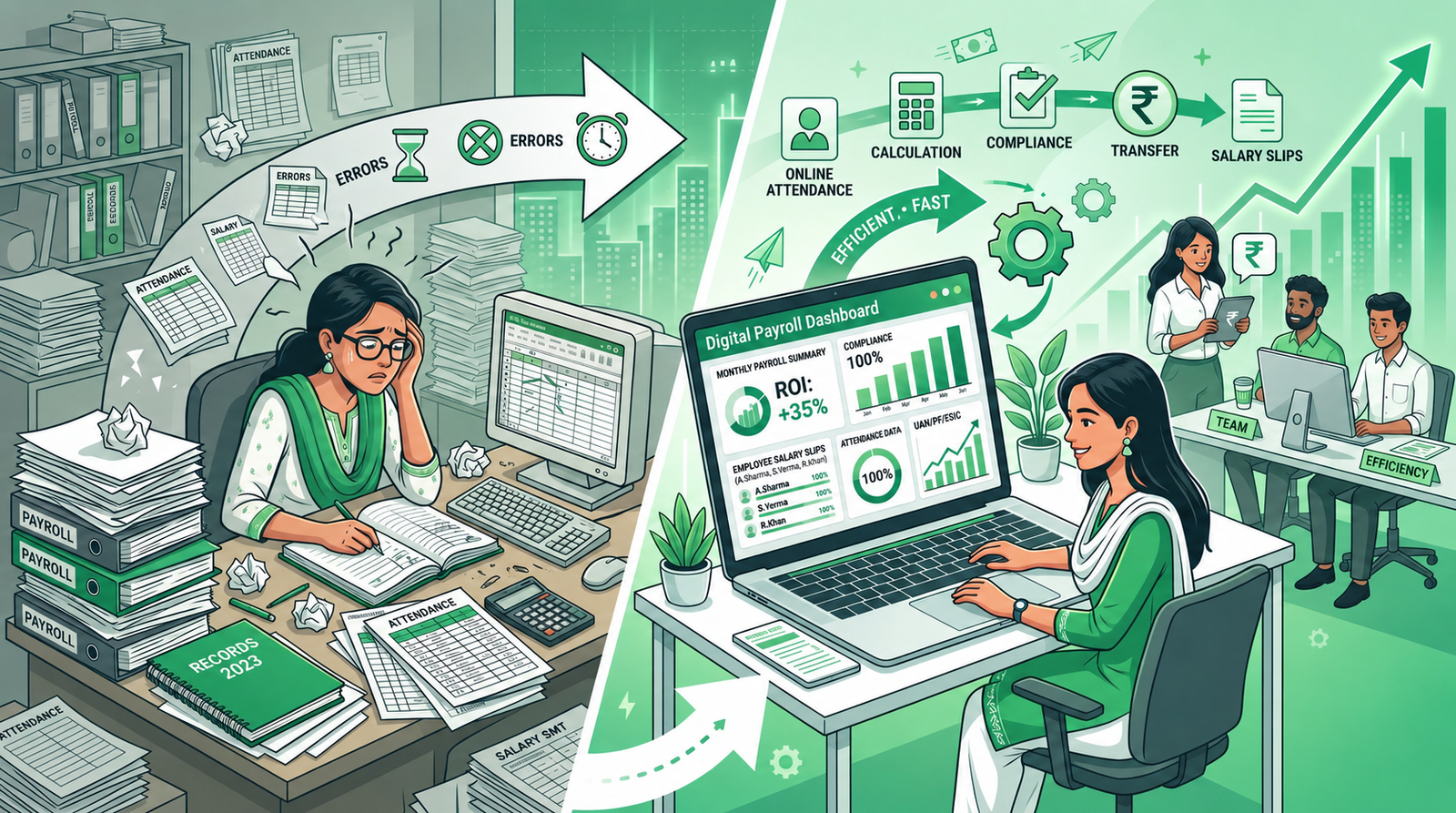
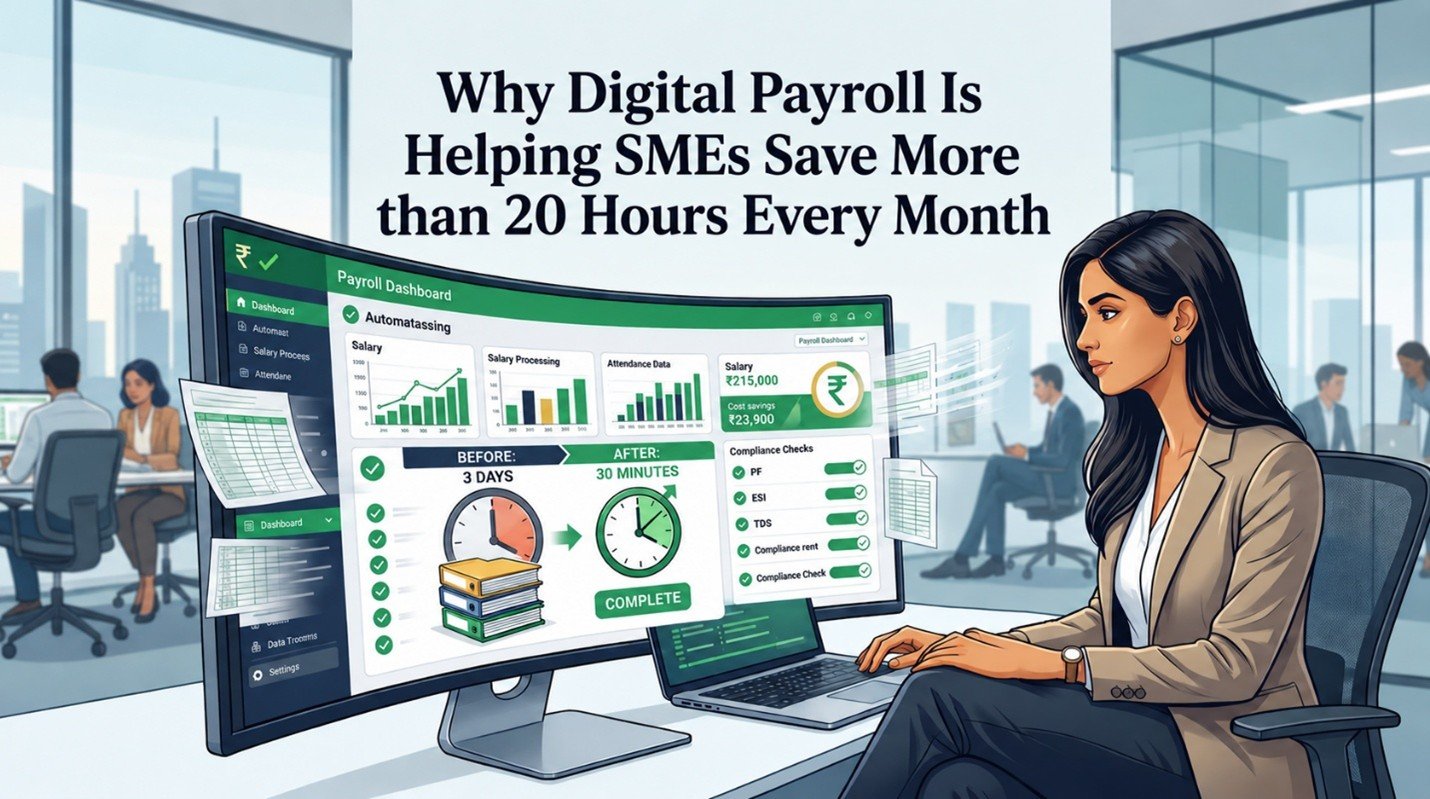
Why Digital Payroll Is Helping SMEs Save More than 20 Hours Every Month

The Hidden Time Tax on Indian SME Payroll

Ask any HR manager at a 50-person Indian company how long payroll takes each month. The honest answer is rarely flattering. Between reconciling attendance records, verifying leave balances, calculating variable pay, applying the correct professional tax slabs across states, and manually filing PF and ESIC challan data, a typical payroll cycle can consume up to 2–3 working days in many manually operated SMEs, sometimes more.

This trend is widely observed across the MSME sector. India’s MSME sector employs over 11 crore people according to the Ministry of MSME, and many of these businesses still rely on spreadsheets for HR and payroll operations. The hidden cost is enormous: skilled HR time redirected away from hiring, engagement, and performance into data entry and error-correction.

In 2026, this is no longer just an efficiency problem. It is a compliance exposure.

What Digital Payroll Actually Changes

The shift to a structured HRMS platform like ABStart does not simply speed up existing processes it fundamentally restructures them. Here is what the operational difference looks like in practice:

Attendance and leave data flow directly into payroll calculation, significantly reducing the need for manual reconciliation.

Salary components are pre-mapped to statutory definitions under the Code on Wages, 2019, helping ensure more accurate PF, ESIC, and professional tax

Payslips are generated and distributed automatically no formatting, no printing, no manual

PF and ESIC challans are prepared from live payroll data, reducing filing time significantly, often from hours to a much shorter duration.

Audit-ready records are maintained automatically, available for EPFO or ESIC inspection without any manual document assembly.

The result: can reduce monthly processing time from multiple days to a few hours, depending on company size and processes.


Manual HR, Digital HR, Digital Payroll, Tax,
Quantifying the ROI: Beyond Time Savings

Efficiency is only one part of the return. The more consequential ROI of digital payroll lies in statutory risk avoidance.

Under Section 14B of the EPF and Miscellaneous Provisions Act, 1952, employers face damages of up to 100% of the arrears due for delayed or incorrect PF contributions. For a company with 40 employees where even a modest payroll error leads to arrears; penalties in such cases can be substantial and, in some scenarios, comparable to the cost of an annual HRMS subscription.

Under the DPDP Act, 2023, maintaining employee personal data Aadhaar numbers, bank details, salary records stored without adequate safeguards may increase the risk of non-compliance with data protection requirements. Penalties for significant data breaches can reach up to ₹250 crore, highlighting the importance of robust data protection practices.

The four Labour Codes, when fully operationalised, will are expected to require salary structures aligned with the Code on Wages definition, which may require adjustments for some SMEs. Companies running on structured digital payroll are likely to adapt faster, while others may require significant effort to align.

ABStart: Built for This Transition

ABStart, the HRMS platform developed by TalentCo HR Services, is built specifically for Indian SMEs navigating this transition. The platform automates PF, ESIC, and TDS calculations, supports DPDP-aligned data storage practices, generates audit-ready records, and supports salary structures aligned with the Code on Wages framework.

The platform is not designed to replicate enterprise HR software at a smaller scale. It is designed around the actual regulatory and operational realities that Indian growing companies face in 2026: multi-state professional tax applicability, EPFO and ESIC portal integration, and Labour Code-aligned wage definitions all within a single, accessible system.

Key Takeaways

Manual payroll in Indian SMEs routinely consumes 2–3 working days per month; structured digital payroll can be completed much faster, often within a few hours

Statutory errors under the EPF Act carry damages that can go up to 100% of arrears depending on the duration of default due often exceeding the annual cost of an HRMS platform.

DPDP Act, 2023, makes unencrypted storage of employee data in spreadsheets a direct compliance

Labour Code alignment, particularly under the Code on Wages, 2019, requires structured salary architectures that manual systems cannot reliably maintain.

Platforms like ABStart convert payroll from a monthly liability into a controlled, audit-ready, time-efficient process.

References

Ministry of MSME – MSME at a Glance: gov.in

Employees’ Provident Fund Organisation – Section 14B, EPF Act, 1952: gov.in

Code on Wages, 2019 – Ministry of Labour and Employment: gov.in

Digital Personal Data Protection Act, 2023 – Ministry of Electronics and IT: gov.in

ESIC – Employees’ State Insurance Corporation Official Portal: gov.in

Code on Social Security, 2020 – Ministry of Labour and Employment: gov.in

Income Tax Department – TDS on Salary, Section 192: gov.in

Reader’s Note:

TalentCo HR Services LLP is an HR consulting and solutions company offering services across HR operations, compliance, liasoning, payroll management, and HR technology through its proprietary platform — ABStart. This article is intended for general informational and educational purposes only. Labour laws, tax regulations, and compliance requirements are subject to change based on government notifications and jurisdictional updates. Readers are advised to independently verify current regulations or consult qualified professionals before making any business or financial decisions.
A New Era of Protection for Gig Workers and Platform Workers.


The Code on Social Security, 2020 marks a significant step towards recognizing and protecting gig and platform workers in India. It introduces a structured social security framework that includes worker registration, welfare fund contributions by platforms, and benefits such as insurance, health coverage, maternity support, and pension assistance. With implementation efforts already underway in several states, these reforms aim to bring greater security, inclusion, and dignity to India’s growing gig workforce.

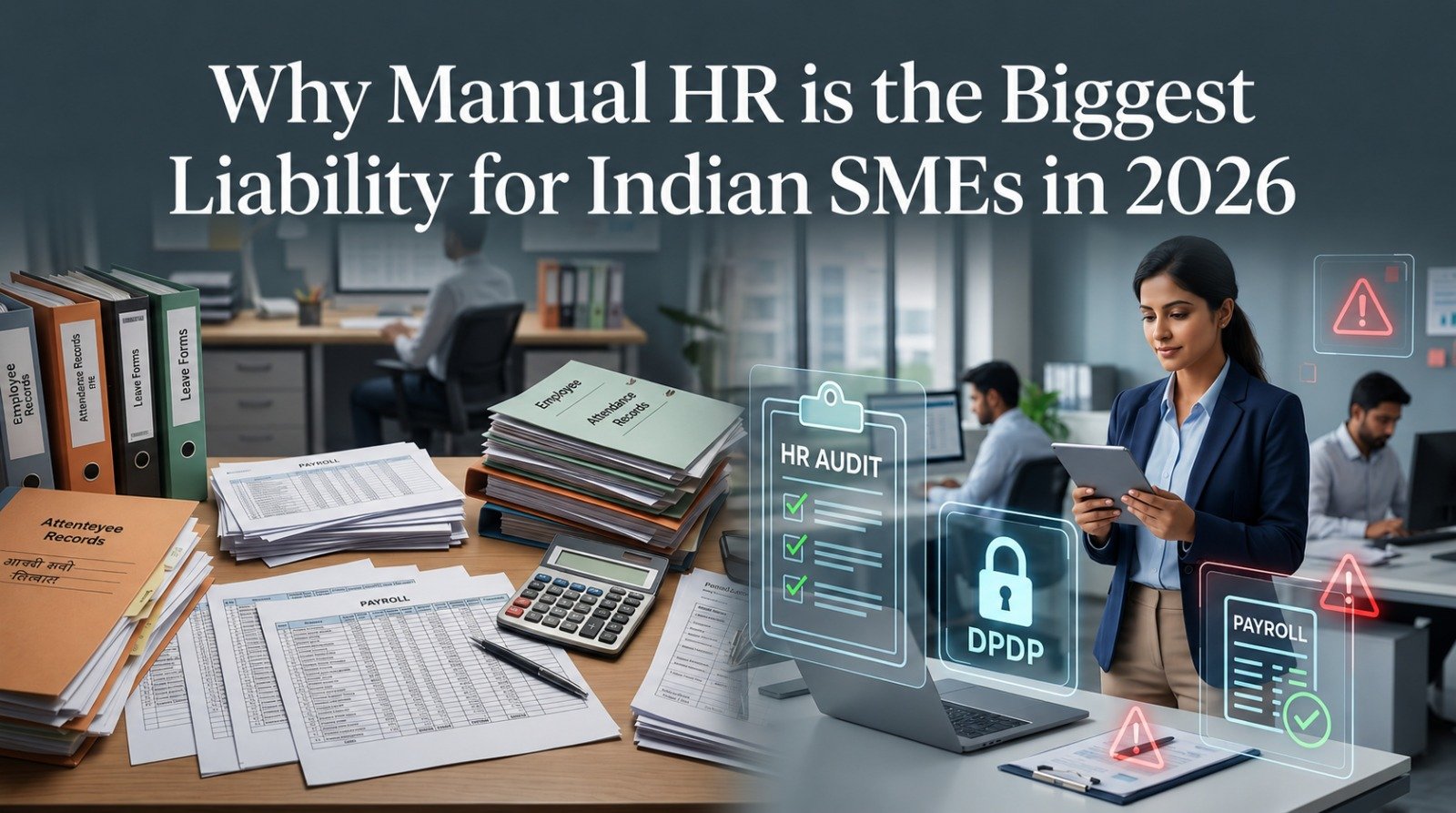
Why Manual HR is the Biggest Liability for Indian SMEs in 2026

For Indian SMEs, managing HR manually on spreadsheets in 2026 is no longer just inefficient it is a direct
compliance risk. With four new Labour Codes pending full implementation, DPDP Act obligations, and rising statutory penalties, manual HR processes expose businesses to legal liability, payroll errors, and employee disputes that structured HRMS platforms like ABStart are specifically built to prevent.

The Scale of India’s SME HR Challenge

India’s MSME sector employs over 11 crore people and contributes approximately 30% of the country’s
GDP, according to the Ministry of MSME. Yet a significant proportion of these businesses continue to
manage their HR operations through spreadsheets, informal records, and manual payroll calculations a
practice that was manageable a decade ago but carries serious risk in 2026.

The regulatory landscape has fundamentally shifted. Three converging developments make manual HR anactive liability rather than a passive inconvenience:

• The four Labour Codes (Code on Wages, Industrial Relations Code, Code on Social Security, and the
Occupational Safety Code) are expected to be operationalised in stages, directly altering wage
definitions, PF structures, and leave entitlements.
• The Digital Personal Data Protection (DPDP) Act, 2023, enforces obligations around employee data
handling, storage, and consent obligations that are impossible to manage systematically on
spreadsheets.
• The Employees’ Provident Fund Organisation (EPFO) and ESIC continue to intensify audit activity,
with growing scrutiny of SME payroll records and contribution accuracy.

Where Manual HR Breaks Down
Payroll Errors and Statutory Miscalculations

Manual payroll is inherently prone to error. Miscalculating EPF contributions, applying incorrect TDS slabs,
or missing professional tax deductions creates exposure at multiple levels. Under Section 14B of the EPF
Act, employers can face damages of up to 100% of the arrears due for delayed or incorrect contributions.
For an SME operating on thin margins, even a single audit cycle can result in crippling penalties.

Compliance Gaps Under the New Labour Codes

Under the Code on Wages, 2019, wages must include all remuneration except specific exclusions a
definition that significantly differs from how many SMEs currently structure their salary components.
Businesses still operating with old CTC templates that suppress Basic salary to reduce PF liability are
directly non-compliant with this framework. When these codes are enforced at scale, organisations without structured salary architectures will face retrospective liability.

DPDP Act and Employee Data Risk

The DPDP Act, 2023, establishes that employee personal data including Aadhaar numbers, bank details, and health records must be processed lawfully, stored securely, and deleted when no longer required.
Maintaining this data in unencrypted Excel files, email threads, or shared drives is a direct violation.
Penalties under the Act can reach ₹250 crore for significant data breaches, a scale that could be existential for smaller organisations.

Invisible Operational Costs

Beyond regulatory exposure, manual HR carries a hidden operational burden. HR personnel in SMEs
managing spreadsheet-based payroll spend significant time each month on data reconciliation, leave
tracking, and statutory filing hours that cannot be redirected to people development or business growth.
Employee self-service, automated payslips, and real-time compliance tracking remain unavailable when HR runs on shared files.

Manual HR, HR Liability, Payroll chaos, Spreadsheet, Compliance Risk, HR Mess, HR Automation
What Structured HR Looks Like in Practice

The transition from manual to structured HR does not require a large enterprise budget. Platforms like
ABStart, built specifically for growing Indian companies, offer end-to-end HRMS functionality from
employee onboarding and lifecycle management to statutory compliance automation and payroll
processing within an architecture designed around India’s regulatory requirements.
For SMEs, the specific value lies in compliance automation: salary structures that stay aligned with Code on Wages definitions, automatic PF and ESIC calculations, audit-ready records, and DPDP-compliant employee data handling. These are not optional enhancements they are operational necessities in 2026.

Purpose-built platforms like ABStart are designed specifically for Indian SMEs transitioning from manual HR — covering payroll, compliance, and employee management in one system.

Key Takeaways

• Manual HR on spreadsheets creates direct statutory liability under the EPF Act, Code on Wages,
and the DPDP Act, 2023.
• With four Labour Codes pending full implementation, salary structures not yet aligned with new
wage definitions will require urgent remediation.
• EPFO and ESIC audit activity targeting SMEs is intensifying inaccurate records and delayed filings
carry significant financial penalties.
• The DPDP Act makes unencrypted employee data storage in spreadsheets a compliance violation
with penalties up to ₹250 crore.
• Structured HRMS platforms purpose-built for Indian SMEs like ABStart convert compliance risk
into controlled, audit-ready processes.

References
  • Ministry of MSME – MSME at a Glance: gov.in
  • Code on Wages, 2019 – Ministry of Labour and Employment: gov.in
  • Employees’ Provident Fund Organisation (EPFO) – Section 14B, EPF Act, 1952: gov.in
  • Code on Social Security, 2020 – Ministry of Labour and Employment: gov.in
  • Digital Personal Data Protection Act, 2023 – Ministry of Electronics and IT: gov.in
  • ESIC – Employees’ State Insurance Corporation Official Portal: gov.in
  • PRS Legislative Research – Labour Codes Summary: org
  • Income Tax Department – TDS on Salary, Section 192: gov.in

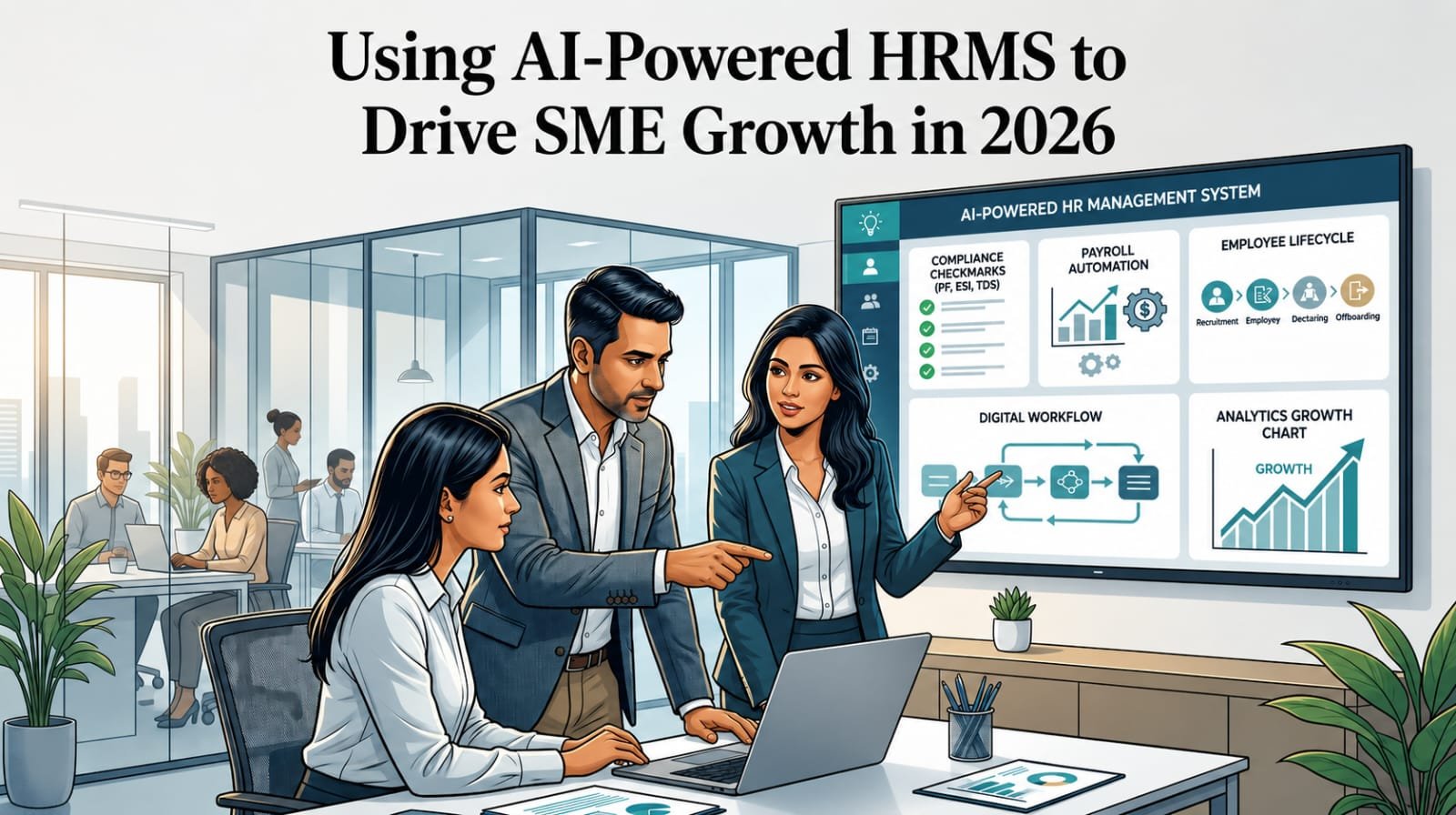
Using AI-Powered HRMS to Drive SME Growth in 2026

Using AI-Powered HRMS to Drive SME Growth in 2026

India’s SME sector employs over 11 crore people and contributes approximately 30% of GDP, according
to the Ministry of MSME. Yet a large share of these businesses still manage payroll and compliance
through spreadsheets and manual registers. In 2026, that is not just inefficient it is a measurable
business risk.
With India’s four Labour Codes advancing toward full state-level notification, the Digital Personal Data
Protection (DPDP) Act 2023 now enforceable, and the Income Tax Department’s TDS systems
increasingly automated, compliance has become complex enough that manual processes cannot
reliably keep pace.

The Compliance Landscape Has Changed

The Code on Wages 2019 mandates that Basic Salary must constitute at least 50% of total
remuneration. This directly reshapes how PF, Gratuity, Leave Encashment, and Bonus are calculated.
Simultaneously, the DPDP Act 2023 requires businesses to protect employee personal data with role-
based access controls and audit-ready records. And since Budget 2023, the New Tax Regime is the
default option, meaning payroll systems must handle TDS under Section 192 of the Income Tax Act
across two tax regimes simultaneously for employees who have opted in or out.
Each of these obligations carries penalties for non-compliance. Delayed PF challans attract interest
under EPFO rules. Misfiled TDS returns draw notices under Section 200A of the Income Tax Act. For an
SME managing this manually across even 30 employees, the risk is structural, not theoretical.

HRMS, Automation, Workforce, SME, Growth, Taxation, Productivity
What AI Actually Does Inside a Modern HRMS

In the context of Indian SMEs, an AI-powered HRMS delivers specific, practical functions:

Automated payroll processing that reads attendance, leave, and advance data to compute gross
pay, all statutory deductions, and net take-home without manual entry.

Compliance anomaly detection that flags salary structures violating Labour Code thresholds,
missed EPFO or ESIC filing deadlines, and employees approaching gratuity eligibility.

Dual-regime TDS logic that computes projected annual tax for each employee at the start of the
financial year, adjusts monthly deductions accordingly, and generates Form 16 data as a clean
output.

Lifecycle automation from structured digital onboarding through performance management,
benefits tracking, and offboarding with data flowing across modules without re-entry.

How ABStart Addresses the SME Gap

ABStart, developed by TalentCo HR Services, is built specifically for the transition growing Indian
companies face from informal, spreadsheet-driven HR to a structured, compliance-ready operation.
The platform covers the full employee lifecycle end to end: onboarding, attendance, leave, payroll with
built-in statutory logic, performance management, benefits administration, and clean exit workflows.
ABStart, built by TalentCo HR Services with 30+ years of HR and domain expertise, is one such platform purpose-built for Indian SMEs, combining AI-ready HRMS capabilities with deep compliance expertise. ABStart is built by HR professionals who have managed the exact challenges that manual HR creates as businesses scale. It focuses not just on features, but on people, processes, and clarity so SMEs can build a professional business culture without adding compliance overhead.

The New Tax Regime and Payroll Complexity in 2026

Since Budget 2023, the New Tax Regime has been the default option for individual taxpayers. This
means payroll systems must correctly handle employees on both regimes simultaneously, ensuring
that TDS calculations under Section 192 of the Income Tax Act reflect each employee’s declared choice.
Employees on the Old Regime claiming HRA exemptions under Section 10(13A), 80C deductions, or 80D
medical insurance benefits require a different computation path than those under the simplified New
Regime slabs.
Managing this dual-track TDS logic manually across a team of even 30 employees creates meaningful
risk. An AI-powered HRMS handles both regimes in parallel, computes projected annual tax for each
employee at the start of the financial year, adjusts monthly TDS accordingly, and reconciles
declarations at year-end generating Form 16 data as a clean output of the process rather than a
separate manual task.

Key Takeaways

• India’s Labour Codes and the DPDP Act 2023 have raised the compliance floor for every employer,
regardless of size.
• AI-powered HRMS automates payroll, TDS across both tax regimes, statutory filings, and
compliance monitoring.
• The New Tax Regime as default from FY 2023–24 adds dual-track TDS complexity that manual
payroll handles poorly.
• ABStart by TalentCo provides SMEs with end-to-end HRMS grounded in Indian HR realities, not
feature lists.

References

Ministry of MSME at a Glance: https://msme.gov.in

Code on Wages, 2019 Ministry of Labour and Employment: https://labour.gov.in

Employees’ Provident Fund Organisation (EPFO): https://www.epfindia.gov.in

Employees’ State Insurance Corporation (ESIC): https://www.esic.in

Digital Personal Data Protection Act, 2023 Ministry of Electronics and IT: https://www.meity.gov.in

Income Tax Department Section 192, TDS on Salary: https://www.incometax.gov.in

Payment of Gratuity Act, 1972, Ministry of Labour: https://labour.gov.in

PRS Legislative Research, Summary of Labour Codes: https://prsindia.org

Readers Note:

TalentCo HR Services LLP is an HR consulting and solutions company offering services across HR operations, compliance, liasoning, payroll management, and HR
technology through its proprietary platform — ABStart.
This article is intended for general informational and educational purposes only. Labour laws, tax regulations, and compliance requirements are subject to change based
on government notifications and jurisdictional updates. Readers are advised to independently verify current regulations or consult qualified professionals before making
any business or financial decisions.
Our role is to simplify and present complex HR and payroll concepts in a comprehensible manner for business owners, HR professionals, and employees.

5 Payroll Mistake Costing your Business

Payroll errors often go unnoticed but they can quietly lead to compliance risks, penalties, and financial losses for your business. From EPF & ESIC non-compliance to incorrect TDS calculations and poor record-keeping, even small mistakes can have a big impact.
In this guide, we break down the 5 most common payroll mistakes and how you can fix them early to ensure smooth operations and stay legally compliant.

The Beginner’s Guide to Payslips

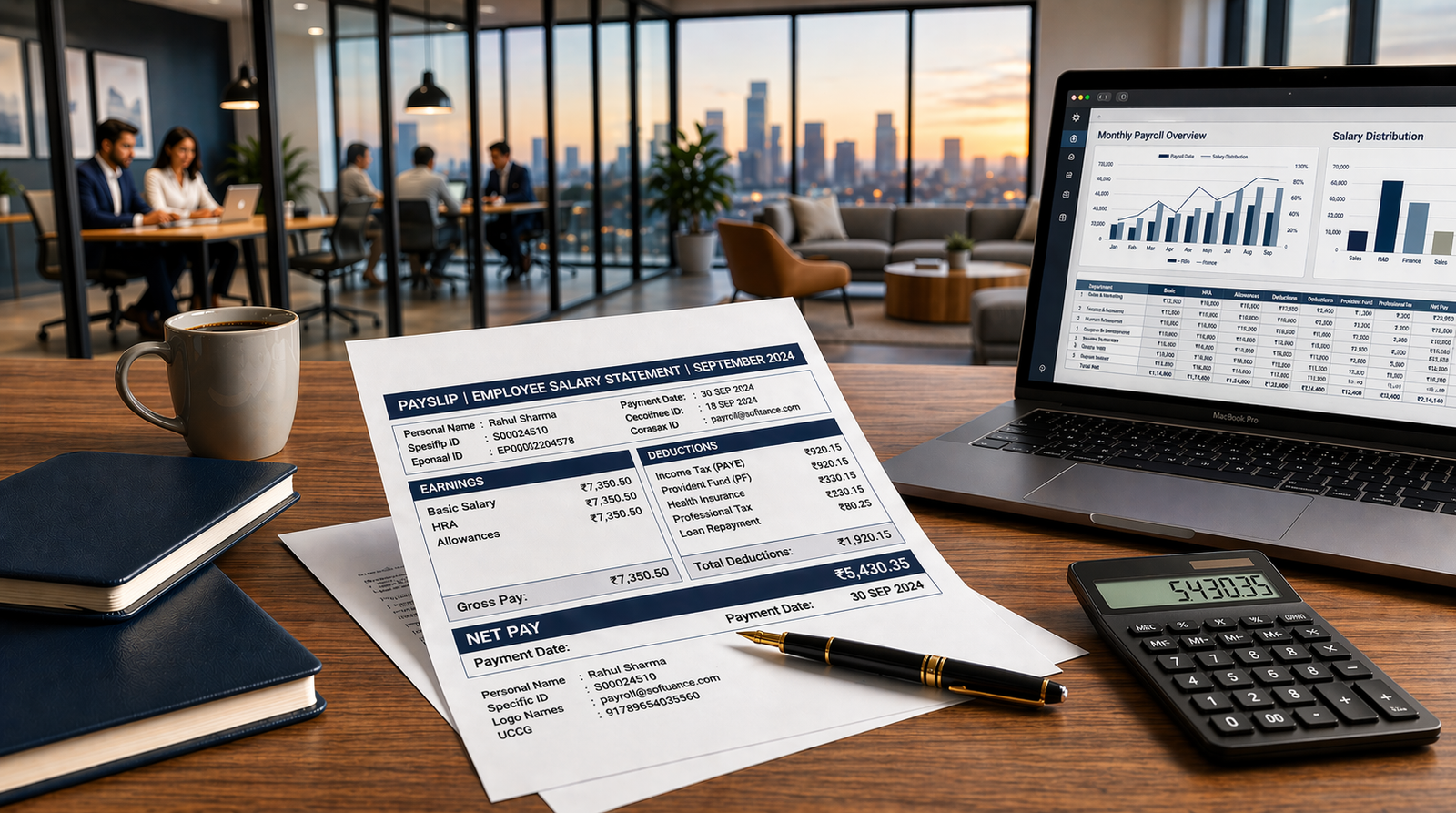
Most employees receive a payslip every month but rarely read it with full understanding. Every component on that document has a name, a purpose, and a legal basis and knowing what each one means can directly affect how much tax is paid, how much PF is accumulated, and whether entitlements are being correctly applied. This article breaks down every component of a payslip, explains how it is calculated, and highlights what employees commonly miss.

According to industry surveys, a significant proportion of employees estimated at around 60% do not fully understand the components of their payslip, which can lead to confusion about actual earnings, deductions, and benefits.

Research also indicates that approximately 1 in 3 employees end up overpaying income tax, often because they miss making the necessary declarations or fail to submit proof of investments and expenses on time. (Source: Income Tax Department – TDS on Salary)

Surveys further suggest that a significant share of employees in some estimates, as many as 74% have never checked their Form 26AS to verify their TDS (Tax Deducted at Source) credits, which increases the risk of discrepancies in tax filings and potential financial loss. (Source: CBDT – Form 26AS Overview)

The gap nobody talks about

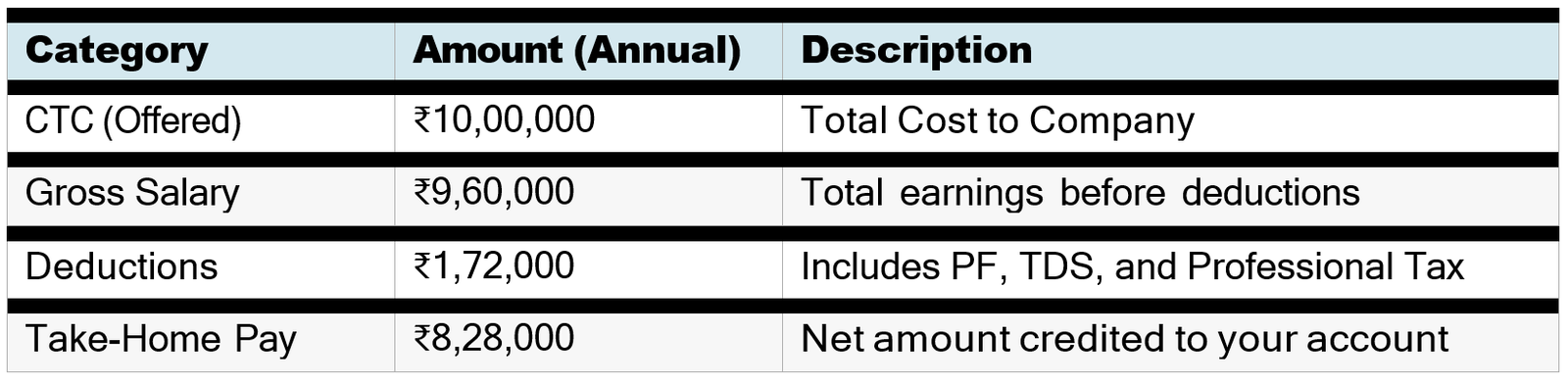
Consider a common scenario: an employee is offered ₹10 LPA. The monthly credit to their account is ₹69,000 which works out to ₹8.28L annually, not ₹10L. The difference of ₹1.72L is accounted for by statutory deductions and employer-borne costs included in the CTC. This is a standard feature of how CTC is structured in India, and the payslip is the document that explains every element of it.

CTC (Cost to Company) is the total expense your employer incurs including their PF contribution, gratuity, and insurance. It is a notional figure, not your take home. Gross salary is what you earn before deductions. Net salary is what lands in your bank. The Payment of Wages Act, 1936 mandates employers furnish a wage slip every pay period.

What every line on your payslip means

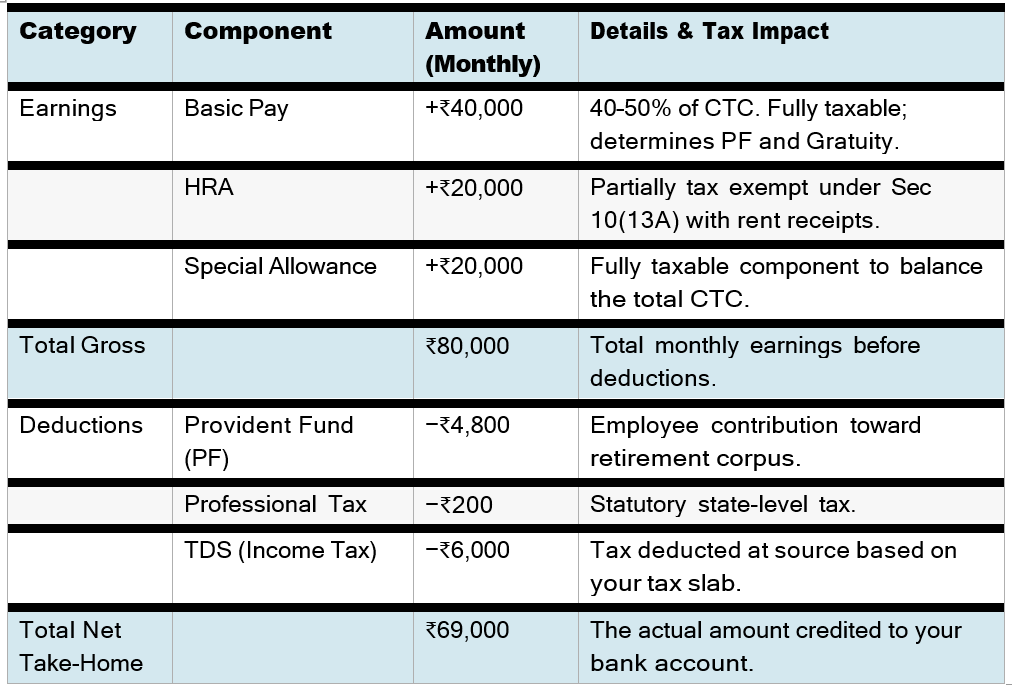
Here is a decoded breakdown of a typical ₹10 LPA payslip every component, its purpose, and the law behind it.

Understanding Deductions in Detail

Special Allowance

Special Allowance: This is a fully taxable component used by employers to bridge the gap between CTC and structured allowances such as Basic and HRA. It carries no exemptions. Employers include it to meet a target CTC figure without inflating components that affect PF or HRA calculations.

Tax Deducted at Source (TDS)

TDS is not a separate tax it is the annual income tax liability divided across 12 months. The employer estimates the employee’s tax liability for the year and deducts a proportionate amount

each month. This amount reduces when the employee submits Form 12BB declarations covering rent, ELSS, PPF, and insurance premiums. Declarations should be submitted at the start of the financial year in April, not at the end in March. (Ref: Section 192 – Income Tax Act)

Professional Tax

This is a state-level statutory levy. The applicable amount varies by state — Maharashtra, for example, caps it at ₹200 per month, while certain states such as Delhi do not levy it at all.

Professional Tax is deductible from taxable income under Section 16(iii) of the Income Tax Act.

Provident Fund (PF)

The employee contributes 12% of Basic Pay to the EPFO account each month, and the employer matches this with an equivalent 12% contribution. In the example above, this amounts to a combined monthly credit of ₹9,600 to the employee’s PF account, earning interest at 8.25% per

annum as applicable. The employee’s contribution is deductible under Section 80C of the Income

Tax Act. PF accumulations are generally accessible upon retirement at age 58, subject to applicable EPFO regulations.

How Form 12BB Declarations Affect Take-Home Pay

One of the most direct ways to reduce monthly TDS is through the Form 12BB declaration submitted at the start of every financial year. When employees inform their employer of rent payments, ELSS investments, PPF contributions, and insurance premiums at the beginning of April, the employer factors these into the TDS calculation and reduces the monthly deduction accordingly. Many employees either skip this step or submit declarations late in March rather than April.

When declarations are submitted late, TDS is deducted at a higher rate for most of the year. The employee then claims a refund during ITR filing which means the excess amount remains with the government, interest-free, for several months. Under Section 80C of the Income Tax Act, investments up to ₹1.5L per year including PF, ELSS, PPF, and life insurance premiums reduce taxable income directly, and timely declaration ensures these benefits are reflected in monthly take-home pay rather than recovered as a lump-sum refund.

Important: Timing of Investment Declarations

Declare your investments in April not March. The earlier you submit Form 12BB, the more your TDS reduces across the full year. Late declarers get a refund instead of monthly savings, which means less cash flow all year long.

Common Payslip Questions, Answered

The following addresses questions employees commonly raise about their payslip components:

  • “My PF says ₹4,800, where’s my employer’s share?” Into the same EPFO account. Your total monthly credit is ₹9,600. Verify it on the EPFO Member Portal using your UAN.
  •  
  • “I pay TDS monthly do I still file an ITR?” Yes, always. TDS is advance tax. ITR reconciles your actual liability you may get a refund or owe more. Skipping ITR blocks future loans and
  • “My HRA is ₹20,000 but I pay ₹15,000 rent am I losing the gap?” Exemption is the lower of: actual HRA received, actual rent minus 10% of basic, or 40–50% of basic (by city). Submit receipts to HR to claim it.
  •  
  • “CTC was ₹10L but I get ₹28L was I misled?” No. CTC includes employer’s PF, gratuity, and benefits. Ask HR for a written CTC breakup letter every employer must provide one under the Labour Codes.

5-Step Payslip Review

1. Confirm name, PAN, and UAN are Errors here affect TDS credit and PF access both are painful to fix later.

2. Verify PF deduction equal to exactly 12% of Basic Any discrepancy should be raised with HR in writing.

3. Check TDS against Form 26AS every quarter to confirm the employer is depositing

4.Compare HRA with your offer letter some companies silently reduce it at appraisal while keeping gross unchanged.

5.Save all payslips in one Banks, visa offices, and background-check firms ask for 3–6 months often at the worst moment.

Understanding a payslip in full its earnings, deductions, and statutory components enable employees to verify accuracy, make timely investment declarations, and avoid common errors in tax filing. Many employees forego significant savings each year simply due to undeclared investments, unverified TDS credits, or unclaimed HRA exemptions.

Reviewing last month’s payslip against the breakdown in this article is a practical starting point. Matching each component to its purpose, verifying PF and TDS figures, and checking Form 26AS quarterly are straightforward steps that can prevent errors and optimize tax outcomes over the full financial year.

References

  • 1. Employees’ Provident Fund Organisation (EPFO) – Official Website: epfindia.gov.in
  • 2. Income Tax Department of India – Official Portal: incometax.gov.in
  • 3. Form 12BB – Investment Declaration Form (CBDT)
  • 4. Payment of Wages Act, 1936 – Chief Labour Commissioner (CLC): gov.in/clc/acts- rules/payment-wages
  • 5. Section 80C Deductions – Income Tax Department (AY 2026-27): gov.in – Salaried Individuals AY 2026-27
  • 6. Code on Wages, 2019 – Ministry of Labour and Employment: https://labour.gov.in/offerings/schemes-and-services/details/labour-codes-gzNzQzMtQWa
  • 7. EPFO FAQ on PF Contributions: gov.in/site_en/FAQ.php


Reader Note

TalentCo HR Services LLP is an HR consulting and solutions company offering services across HR operations, compliance, liasoning, payroll management, and HR technology through its proprietary platform — ABStart. This article is intended for general informational and educational purposes only. Labour laws, tax regulations, and compliance requirements are subject to change. Readers are advised to independently verify current regulations or consult qualified professionals before making any business or financial decisions. Our role is to simplify and present complex HR and payroll concepts in a comprehensible manner for business owners, HR professionals, and employees.